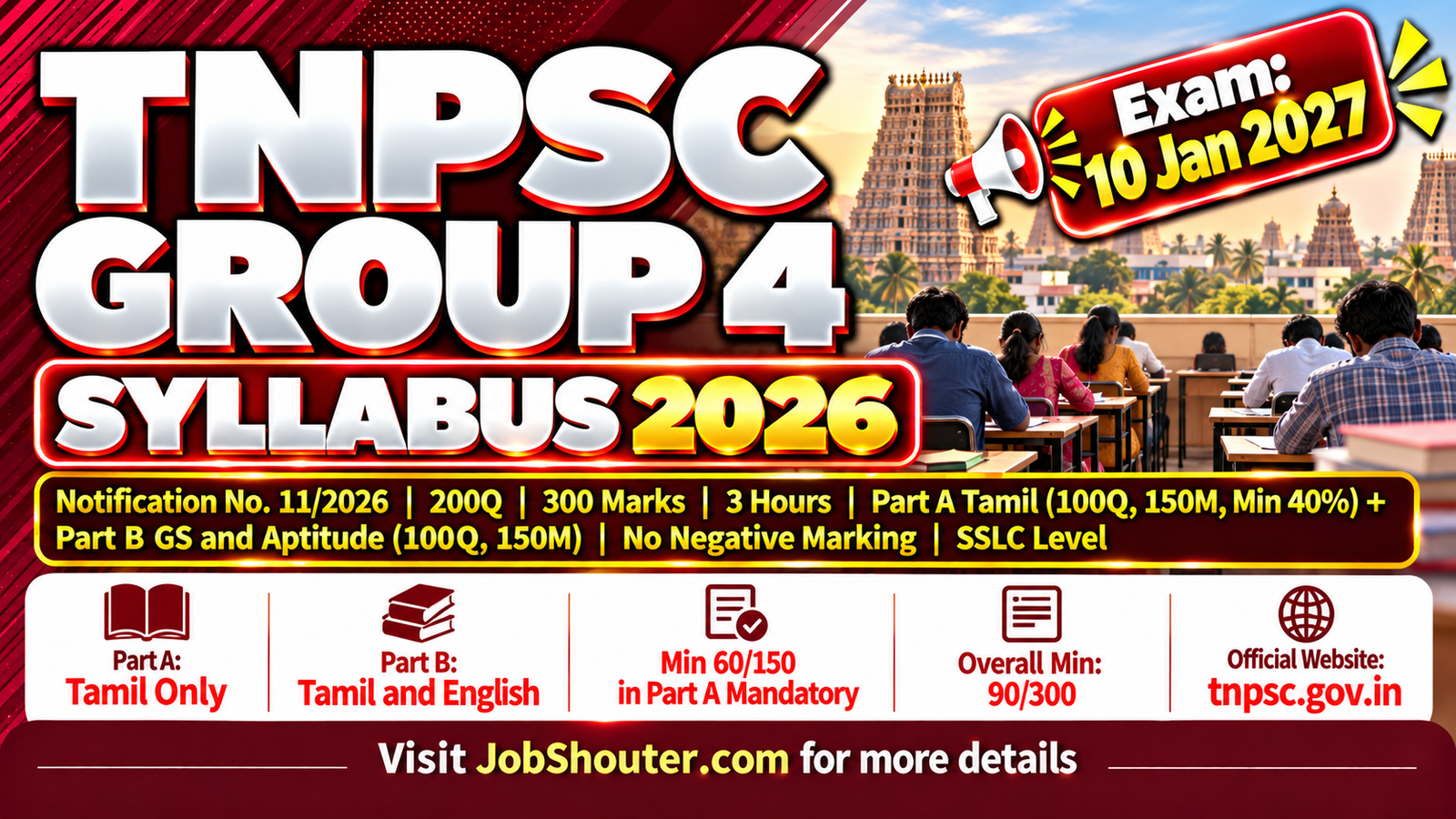
The Tamil Nadu Public Service Commission (TNPSC) has published the official syllabus for the Combined Civil Services Examination-IV (CCSE-IV) / Group 4 Services (Notification No. 11/2026). The exam is OMR-based, single paper, 200 questions for 300 marks in 3 hours at SSLC (10th standard) level. There are two parts: Part A is the Tamil Eligibility-cum-Scoring Test (100 questions, 150 marks) and Part B covers General Studies (75 questions) and Aptitude and Mental Ability (25 questions) for a combined 150 marks. The written exam is scheduled for 10 January 2027.
Important Note: Three things every candidate must understand before starting preparation. First, Part B is evaluated ONLY if you score at least 40% in Part A — that is, a minimum of 60 out of 150 marks in Tamil. Candidates who neglect Part A preparation risk losing their entire General Studies and Aptitude marks. Second, Part A questions are in Tamil only. Part B questions appear in both Tamil and English — choose the language you are comfortable with. Third, there is NO negative marking. Every unanswered question gets zero marks and every correct answer gets 1.5 marks. Attempt all questions.
TNPSC Group 4 Syllabus 2026: Quick Overview
| Particulars | Details |
|---|---|
| Organisation | Tamil Nadu Public Service Commission (TNPSC) |
| Examination | Combined Civil Services Examination-IV (CCSE-IV) / Group 4 |
| Notification No. | 11/2026 |
| Standard | SSLC (10th standard) |
| Mode | Offline, OMR-based (pen and paper) |
| Question Type | Objective type MCQs |
| Total Questions | 200 |
| Total Marks | 300 (1.5 marks per correct answer) |
| Duration | 3 hours (180 minutes) |
| Negative Marking | None |
| Part A Qualifying Marks | 60 out of 150 (40%) mandatory for Part B evaluation |
| Overall Minimum Qualifying Marks | 90 out of 300 (30%) |
| Exam Date | 10 January 2027 |
| Official Website | tnpsc.gov.in |
TNPSC Group 4 Exam Pattern 2026
| Part | Subject | Questions | Marks | Language |
|---|---|---|---|---|
| A | Tamil Eligibility-cum-Scoring Test | 100 | 150 | Tamil only |
| B | General Studies | 75 | 150 (combined with Aptitude) | Tamil and English |
| B | Aptitude and Mental Ability | 25 | Included in 150 | Tamil and English |
| Total | 200 | 300 |
Marking Scheme
- Each correct answer: 1.5 marks
- Wrong answer: No deduction (no negative marking)
- Unanswered: Zero marks
Critical Rule
Part B is evaluated ONLY if Part A score is at least 60 marks (40% of 150). Failing to clear Part A means only Part A marks count — and 60 out of 300 will never reach the final merit list. Prepare Tamil thoroughly.
TNPSC Group 4 Part A Syllabus: Tamil Eligibility-cum-Scoring Test (100 Questions, 150 Marks)
Part A tests Tamil grammar, literature, Thirukkural, scholars, culture and the development of the Tamil language at SSLC standard.
Tamil Grammar
Choosing correct words, famous quotations and their authors, continuing phrases and their meanings, splitting words, antonyms, identifying incorrect words, correcting spelling errors, singular and plural errors, grammar errors, Tamil equivalents of English words, sound variations and meanings, meaning of one-letter words, root words, verb forms, verbal nouns and occupational nouns, alphabetical ordering, arranging words into sentences, types of nouns, types of sentences, active, causative and passive sentences, similes, Ethukai, Monai, Iyaibu, proverbs.
Thirukkural (25 Chapters)
Anbu, Panbu, Kalvi, Kelvi, Arivu, Adakkam, Ozhukkam, Porai, Natpu, Vaimai, Kalam, Vali, Oppuravarithal, Seynandri, Sanrananmai, Periyarai Thunaik Kolal, Porul Seyal Vagai, Vinai Thittam, Iniyavai Kural, Ookka Mudaiyai, Eegai, Therindhu Seyal Vagai, Inna Seyyamai, Kooda Nattri, Uzhavu.
Aram Noolgal (Classical Ethics Literature)
Naladiyar, Nanmanikadigai, Pazhamozhi Naanuru, Muthumozhi Kanchi, Thirikadugam, Inna Narpathu, Iniyavai Narpathu, Sirupanchamoolam, Elathi, Avvaiyar’s works and other Pathinen Keezhkanakku works.
Epic and Classical Literature
Kamba Ramayanam, Ravana Kaviyam, Purananuru, Agananuru, Natrinai, Kurunthogai, Aingurunuru, Kalithogai, Ettuthogai, Pathupattu, Silappathikaram, Manimekalai, Jain and Buddhist epics.
Bhakti and Other Works
Periyapuranam, Nalayira Divya Prabandham, Thiruvilaiyadal Puranam, Thembavani, Seerapuranam.
Minor and Other Literary Works
Thirukkutralakuravanji, Kalingathuparani, Muthollayiram, Tamilvidu Thoothu, Nandhikkalambagam, Mukkoodarpallu, Kavadi Chindu, Rajaraja Soman Ula, Manonmaniyam, Panchali Sabatham, Kuyil Pattu, Siddhar songs, folk songs.
Scholars and Religious Pioneers
Appar, Sambandhar, Sundarar, Manickavasagar, Thirumoolar, Kulasekara Azhwar, Andal, Seethalai Sathanar, H.A. Krishnanar, Umaruppuvar.
Modern Poets and Writers
Bharathiyar, Bharathidasan, Namakkal Kavignar, Kavimani Desiga Vinayagam, Mudiyarasan, Vanidasan, Suratha, Kannadasan, Udumalai Narayana Kavi, Pattukkottai Kalyanasundaram, Marudhakasi.
New Poetry (Puthukavithai)
N. Pichamurthy, C.S. Chellappa, Dharumu Sivaramu, Pasuvayya, Ra. Meenakshi, C. Mani, Sirpi, Mu. Metha, Erode Thamizhan, Abdul Rahman, Kalapriya, Kalyanji, Gnanakkoothan.
Social Reformers and Tamil Nadu Personalities
Thanthai Periyar, Perarignar Anna, Muthuramalingar, B.R. Ambedkar, Kamarajar, Ma.Po. Sivagnanam, Kayidhe Millath.
Women in Tamil History and Society
Mooloor Ramamirthammal, Dr. Muthulakshmi Ammaiyar, Velu Nachiyar, Thillaiyadi Valliammai, Rani Mangammal, Annie Besant; women in the freedom struggle.
Antiquity and Development of Tamil
Antiquity of Tamil, special features of Tamil, Dravidian languages, development of Tamil, scientific ideas in Tamil.
Tamil Nadu and Global Tamil Community
Origin and changes of place names, global Tamil contributions, Tamil heritage, Tamil trade and archaeological studies, ancient sea voyages, palm-leaf manuscripts, food as medicine, religious harmony.
TNPSC Group 4 Part B Syllabus: General Studies (75 Questions)
Unit 1: General Science
Nature of the universe; scientific laws in motion, force, pressure, energy; everyday applications of mechanics, electricity, magnetism, light, sound, heat and nuclear physics; elements, compounds, acids, bases, salts, petroleum products, fertilizers, pesticides, metallurgy, food adulterants; life science including classification, evolution, genetics, physiology, nutrition, health and hygiene, human diseases; environmental science.
Unit 2: Current Events
Latest national and Tamil Nadu events; national symbols; eminent personalities; places in news; sports; books and authors; government welfare schemes; political parties and systems; latest inventions in science and technology; geographical landmarks; current socio-economic issues.
Unit 3: Geography
Earth location and physical features; monsoon, rainfall, weather and climate; water resources; rivers; soil; minerals and natural resources; forest and wildlife; agriculture; transport and communication; population density and distribution in Tamil Nadu and India; calamities and disaster management; environment and climate change.
Unit 4: History and Culture of India
Indus Valley Civilization, Guptas, Delhi Sultans, Mughals, Marathas, South Indian history; characteristics of Indian culture; unity in diversity (race, language, custom); India as a secular state.
Unit 5: Indian Polity
Constitution of India, Preamble and salient features; Union, State and Union Territory; citizenship; Fundamental Rights, Fundamental Duties, Directive Principles; Union and State executive and legislature; local governments and Panchayat Raj; Centre-State relations; elections; judiciary and rule of law; corruption and anti-corruption measures including Lokpal, Lokayukta and RTI; women empowerment; consumer protection; human rights.
Unit 6: Indian Economy
Nature of the Indian economy; Five Year Plans; Planning Commission and NITI Aayog; sources of revenue, RBI, Finance Commission, resource sharing, GST; economic trends; employment; land reforms; agriculture and science and technology in agriculture; industrial growth; rural welfare programmes; social problems including population, education, health and poverty.
Unit 7: Indian National Movement
National renaissance; early uprisings against British rule; Indian National Congress; leaders including B.R. Ambedkar, Bhagat Singh, Bharathiar, V.O. Chidambaranar, Thanthai Periyar, Jawaharlal Nehru, Rabindranath Tagore, Kamarajar, Mahatma Gandhi, Maulana Abul Kalam Azad, Rajaji, Subhash Chandra Bose, Muthulakshmi Ammaiyar, Muvalur Ramamirtham; modes of agitation in Tamil Nadu.
Unit 8: History, Culture, Heritage and Socio-Political Movements of Tamil Nadu
History of Tamil society; archaeological discoveries; Tamil literature from the Sangam age to contemporary times; Thirukkural (secular literature, relevance to daily life, universal values, philosophical content); Tamil Nadu in the freedom struggle; role of women; social reformers and reform movements.
Unit 9: Development Administration in Tamil Nadu
Social justice and social harmony in socio-economic development; education and health systems in Tamil Nadu; geography of Tamil Nadu and its impact on economic growth.
TNPSC Group 4 Aptitude and Mental Ability Syllabus (25 Questions)
| Topic | Details |
|---|---|
| Simplification | Percentage, HCF and LCM |
| Ratio and Proportion | Simple and compound problems |
| Interest | Simple interest and compound interest |
| Mensuration | Area and volume |
| Time and Work | Work, pipe and cistern problems |
| Logical Reasoning and Puzzles | Blood relations, seating arrangements, direction problems |
| Dice and Visual Reasoning | Cube and dice problems, figure matching |
| Alpha-Numeric Reasoning and Number Series | Coding-decoding, number and alphabet series |
How to Prepare for the TNPSC Group 4 Syllabus 2026
Seven preparation steps based on the exam pattern:
- Start with Tamil grammar, Thirukkural chapters and listed classical authors in Part A – these are the highest-priority topics and Part A is the gateway to merit.
- Build General Studies basics from Tamil Nadu State Board textbooks, standard 6 to 10 – the syllabus is explicitly at SSLC level.
- Cover all 25 Thirukkural chapters listed in the syllabus. Questions on specific kurals and chapters appear every year.
- For current events in Unit 2, follow national and Tamil Nadu news regularly and make monthly notes.
- Prepare all nine General Studies units in sequence – Units 5 (Polity) and 6 (Economy) typically carry the most weight in Group 4.
- Practise aptitude and reasoning questions daily with a strict time limit (about 18 minutes for 25 questions).
- Take full-length 200-question OMR mock tests within 3 hours at least once per week before January 2027.
Key Rules to Remember on Exam Day
- The exam is on 10 January 2027 from 9:30 AM to 12:30 PM.
- OMR sheet-based. Use only the prescribed pen on the answer sheet.
- Part A questions are in Tamil only. Part B in Tamil and English.
- No negative marking. Attempt all 200 questions.
- Score at least 60 marks in Part A or Part B will not be evaluated.
TNPSC Group 4 Syllabus 2026: Important Links
| Description | Link |
|---|---|
| TNPSC Official Website | Click Here |
| TNPSC Group 4 Notification No. 11/2026 (English PDF) | Click Here |
| TNPSC Group 4 Notification No. 11/2026 (Tamil PDF) | Click Here |
| Apply Online | Click Here |
FAQs
Q1. What is the TNPSC Group 4 exam pattern 2026?
Single OMR-based paper. 200 questions, 300 marks, 3 hours. Part A (Tamil): 100 questions, 150 marks. Part B (General Studies 75 questions + Aptitude 25 questions): 150 marks combined.
Q2. Is there negative marking in TNPSC Group 4?
No. Each correct answer gives 1.5 marks. Wrong answers carry zero marks (no deduction).
Q3. What is the minimum qualifying marks in Part A?
60 out of 150 marks (40%). Part B is not evaluated if you do not clear this threshold.
Q4. What is the overall qualifying mark?
90 out of 300 (30% overall).
Q5. What level is the TNPSC Group 4 exam set at?
SSLC (Class 10 / 10th standard) level for all parts.
Q6. When is the TNPSC Group 4 exam?
10 January 2027, 9:30 AM to 12:30 PM.
Disclaimer
The information in this article is based on TNPSC Notification No. 11/2026 (Advertisement No. 747) published on tnpsc.gov.in. Candidates must download and read the full official notification and syllabus from tnpsc.gov.in before beginning preparation. JobShouter is not associated with TNPSC or the Government of Tamil Nadu. This article is for informational purposes only.
Check this – TNPSC Group 4 Recruitment 2026 (Notification No. 11/2026)