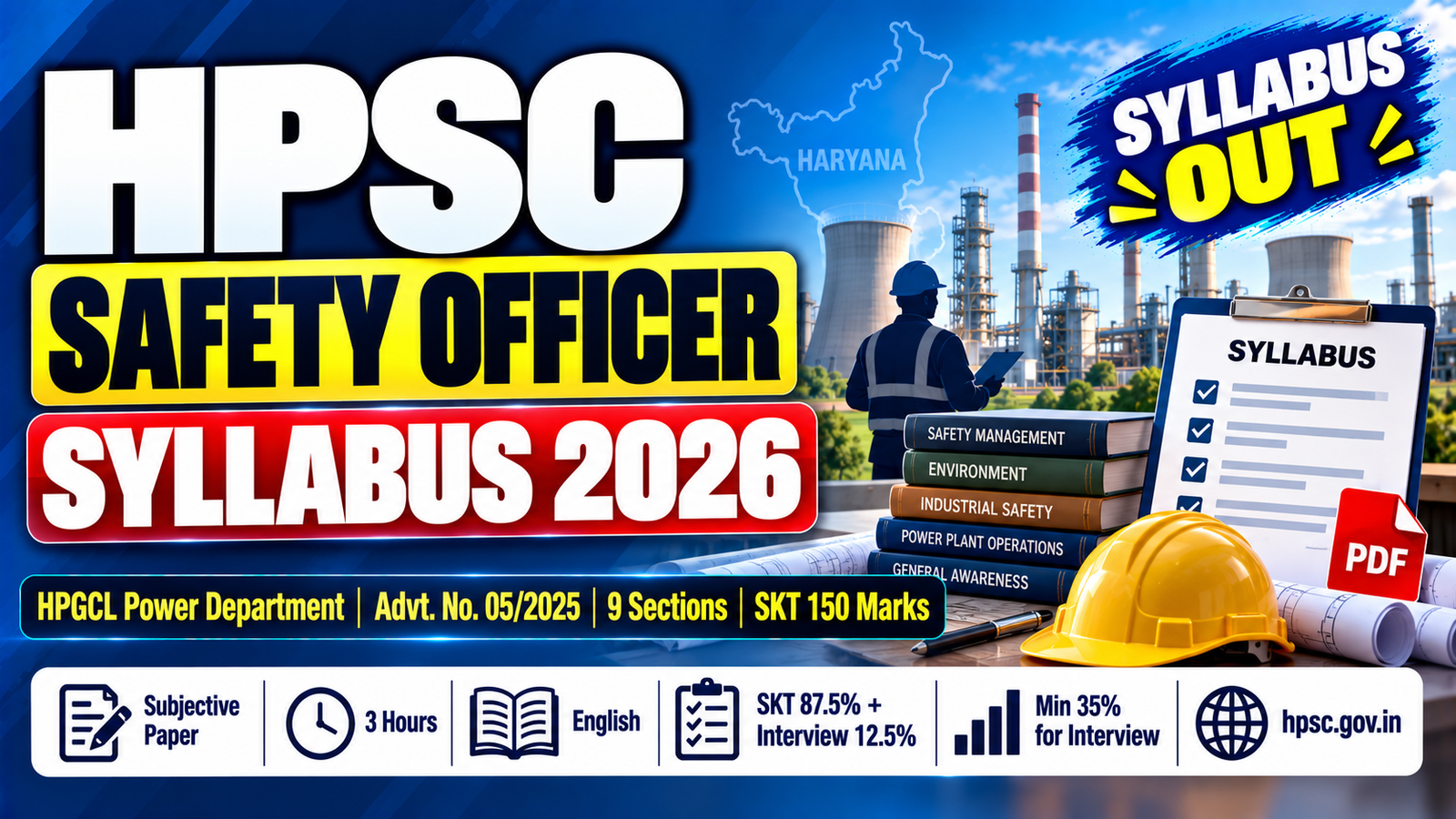
The Haryana Public Service Commission (HPSC), Panchkula has released the official scheme and syllabus for the post of Safety Officer in HPGCL (Haryana Power Generation Corporation Ltd.), Power Department, Haryana under Advertisement No. 05/2025 (published 26 June 2025). The scheme and syllabus were announced on 28 September 2026. The selection process comprises two stages: a Subject Knowledge Test (SKT) carrying 87.5% weightage and an Interview carrying 12.5% weightage. The SKT is a 3-hour subjective written paper of 150 marks conducted in English. A minimum of 35% marks in the SKT is required to be called for the interview. Candidates shortlisted for interview will be three times the advertised posts.
Important Note: Three things every candidate must know before preparing. First, this is a subjective (written answer) paper – not multiple choice. Candidates must practise writing detailed, structured answers in English under time constraints. Second, the minimum qualifying mark for the interview call is 35% in the SKT. However, since only 3x the vacancies are called, the actual competition cut-off will be much higher than 35%. Aim well above the minimum. Third, the official syllabus has 9 sections but does not mention specific safety laws or industrial safety topics. Prepare strictly from the 9 sections listed in the official document. Verify any additional topics directly from the official HPSC syllabus PDF at hpsc.gov.in.
HPSC Safety Officer Syllabus 2026: Overview
| Particulars | Details |
|---|---|
| Conducting Body | Haryana Public Service Commission (HPSC), Panchkula |
| Post | Safety Officer |
| Department | HPGCL (Haryana Power Generation Corporation Ltd.), Power Department, Haryana |
| Advertisement No. | 05/2025 (published 26 June 2025) |
| Scheme and Syllabus Announced | 28 September 2026 |
| Selection Stages | Stage 1: Subject Knowledge Test (SKT) + Stage 2: Interview |
| Official Website | hpsc.gov.in |
HPSC Safety Officer Exam Pattern 2026
Stage 1: Subject Knowledge Test (SKT)
| Parameter | Details |
|---|---|
| Type of Paper | Subjective (written answers) |
| Duration | 3 hours |
| Total Marks | 150 |
| Language | English |
| Minimum Qualifying Marks | 35% (i.e. 52.5 out of 150) |
| Weightage in Final Merit | 87.5% |
| Candidates Shortlisted for Interview | 3 times the advertised posts (including bracketed candidates), subject to securing minimum 35% |
Stage 2: Interview
| Parameter | Details |
|---|---|
| Weightage in Final Merit | 12.5% |
| Eligibility for Interview | Minimum 35% in SKT |
Final Merit List
The final merit list is prepared by adding the marks obtained in the Subject Knowledge Test and the Interview, weighted as 87.5% and 12.5% respectively. Attendance at both stages is mandatory.
HPSC Safety Officer Syllabus 2026: Subject-wise Topics (All 9 Sections)
Section 1: National and International Scenario of Skill Development
- Vocational Education System in India
- Current National Policy on Skill Development in India
- Objective and need for skill development in India
- Recommendations of various committees on vocational education
- Scope of skill development
Section 2: Academic and Administrative Management
- Organisation structure of Government ITIs
- Reporting systems, reporting authorities and general administration
- SWOT analysis, vision and mission, goals and strategic planning
- Internal and external environment management
- Resource mobilisation and library management
- Maintenance of academic facilities
- Problem-solving techniques
- Personal management and value analysis
- Faculty norms
Section 3: Skill Development Schemes
- Central and State Government schemes including the Craftsmen Training Scheme
- Pradhan Mantri Kaushal Vikas Yojana (PMKVY)
- National Skill Qualification Framework (NSQF)
- State skilling schemes
- Crafts Instructor Training Schemes (CITS)
- National Apprentice Promotion Scheme (NAPS)
- SANKALP Scheme and STRIVE Scheme
Section 4: Engineering Mechanics and Engineering Drawing
- Force and system of forces; equilibrium of rigid bodies; free body diagram; Lami’s theorem
- Laws of Coulomb friction; equilibrium of bodies involving dry friction; belt friction
- Centre of gravity and moment of inertia
- Stress and strain: simple stresses (tensile, compressive, shear, bending and torsion); stress-strain curves; elastic constants
- Engineering graphics and technical drawing: drawing equipment and instruments; conventions; dimensioning; scales
- Theory of projection of planes and solids; orthographic projection
Section 5: Fundamentals of Thermal Science
- Introduction to thermodynamics: properties, forms of energy, thermodynamic systems and steady flow systems
- Types of work; thermodynamic processes; laws of thermodynamics; Carnot theorem
- Concept of enthalpy and entropy
- I.C. Engines: two-stroke and four-stroke S.I. and C.I. engines; Otto cycle; Diesel cycle
- Basic idea of refrigeration and air conditioning cycle
Section 6: Basic Knowledge of Workshop Science
- Measuring instruments and gauges; introduction to manufacturing processes and basic terminology
- Engineering materials: properties, nomenclature and basics of heat treatment
- Fitting: tools, measuring and marking, sawing, filing, tapping and die, introduction to drills
- Welding: electric arc and gas welding processes and equipment; soldering and brazing; types of sheets (ferrous and non-ferrous); standard sheet sizes; sheet metal tools
- Metal cutting: classification of machine tools and cutting tools; basic operations on lathe, drilling, shaper and milling; cutting tool material; work-holding devices; cutting parameters (speed, feed, depth of cut)
- Casting: pattern types; moulding sand and its properties; casting process and defects
Section 7: Basic Electrical Science
- Network laws and theorems: Kirchhoff’s laws; network elements; superposition theorem; Thevenin’s and Norton’s theorems; maximum power transfer theorem
- Single-phase A.C. circuits: EMF generation; form factor; peak factor; rms and average value; phasor diagram; resistive, inductive and capacitive circuits; series and parallel circuits; RLC series circuits; resonance and Q factor; three-phase A.C. circuits (general relations)
- Magnetic circuits and transformers: analogy between electric and magnetic circuits; B-H curve; hysteresis loop; inductances in series and parallel; hysteresis and eddy current losses
- Transformers: construction; EMF equation; rating; phasor diagram on no-load and loaded conditions
- Electrical machines: three-phase induction motors (construction, working, applications)
- Electrical instruments: moving iron, PMMC, dynamometer and induction type instruments; torque equation; dynamometer type wattmeter
Section 8: Basic Electronics and Communication Science
- Electronic instruments: general-purpose test instruments; CRO and CRT
- Semiconductor diodes: PN junction diode; V-I characteristics; ideal diodes; LED; tunnel diode; photodiode
- Rectifiers and regulators: half-wave, full-wave and bridge rectifiers; passive filters; Zener diode as voltage regulator; SMPS concept
- Transistors: BJT; FET; MOSFET
- Operational amplifiers: summing amplifier; differentiator and integrator
- Digital electronics: number systems; logic gates; NAND and NOR as universal gates; SR and JK flip-flops
- Introduction to computers: generations, characteristics and classification; components; types of memory; software and its types; operating system; algorithm and flowchart
- Computer networks and communication: LAN, MAN, WAN; network topologies; modes of data communication; internet and its safeguards; router, switches, hub and bridges
Section 9: Civil
- Surveying instruments and uses; civil engineering surveys
- Building by-laws
- Properties and tests on construction materials: bricks, cement, coarse aggregate and steel reinforcement
- Units of fluid properties; types of fluid and flow; flow measurement
- Construction management techniques: bar chart; milestone; network CPM/PERT; construction equipment; notice inviting tender; administrative approval; technical sanction; specification
- Tests on water and waste water; Environment Protection Act
- Sources of air pollution; National Clean Air Programme
- Types of dams and canals; rainfall measurement
- Safe bearing capacity of soil
- Methods of building estimates; forms used in the public works department
Key Notes on the Syllabus
| Important Point | Details |
|---|---|
| Language of the test | English only |
| Type of questions | Subjective (written answers) – not MCQ |
| Section-wise marks | Not specified in the official announcement |
| Safety laws/Industrial safety | Not explicitly listed as a separate section in the official syllabus. Prepare from the 9 sections above only. |
| Preparation approach | Write detailed answer-length responses; practise finishing within 3 hours |
Eligibility Details (from Advt. No. 05/2025)
| Criteria | Details (as reported from third-party coverage of the 2025 advertisement) |
|---|---|
| Vacancies | 1 post |
| Application Window | 30 June to 20 July 2025 |
| Age Limit | 18 to 42 years |
| Qualification | Engineering or Technology degree with at least 2 years supervisory factory experience OR Physics or Chemistry degree with at least 5 years supervisory factory experience |
Note: Verify exact eligibility conditions from the official HPSC advertisement on hpsc.gov.in.
Preparation Tips for HPSC Safety Officer SKT 2026
- Download and print the official 9-section syllabus from hpsc.gov.in before beginning preparation.
- Since the paper is subjective, practise writing detailed answers – not bullet points. Practise under timed conditions with a 3-hour limit.
- Write all answers in English. No other language is permitted.
- Revise derivations, diagrams and formulas for Sections 4 to 9 (Engineering Mechanics, Thermal Science, Workshop, Electrical, Electronics and Civil).
- For Sections 1 to 3 (Skill Development), focus on national schemes, policy frameworks and their objectives.
- Aim for at least 55 to 60% in the SKT. The minimum is 35% but competition cut-offs will be significantly higher as only 3x vacancies are called for interview.
- The SKT carries 87.5% of the final merit. Perform as strongly as possible in this stage.
HPSC Safety Officer Syllabus 2026: Important Links
| Description | Link |
|---|---|
| HPSC Safety Officer Syllabus and Exam Pattern 2026 PDF | Click Here |
| HPSC Official Website | Click Here |
HPSC Safety Officer Syllabus 2026: FAQs
Q1. Has the HPSC Safety Officer Syllabus 2026 been released?
Yes. HPSC announced the scheme and syllabus for Safety Officer in HPGCL, Power Department, Haryana (Advt. No. 05/2025) on 28 September 2026.
Q2. Is the HPSC Safety Officer exam objective or subjective?
Subjective. The Subject Knowledge Test (SKT) is a 3-hour written paper of 150 marks conducted entirely in English.
Q3. What is the minimum qualifying mark for the HPSC Safety Officer interview?
35% in the Subject Knowledge Test (i.e. 52.5 out of 150 marks).
Q4. What is the weightage of SKT and Interview in final merit?
SKT carries 87.5% and the Interview carries 12.5% of the final merit.
Q5. How many candidates are called for the interview?
Three times the number of advertised posts (including bracketed candidates), subject to scoring at least 35% in the SKT.
Q6. How many sections are in the HPSC Safety Officer syllabus?
Nine sections: Skill Development Scenario, Academic and Administrative Management, Skill Development Schemes, Engineering Mechanics and Drawing, Thermal Science, Workshop Science, Electrical Science, Electronics and Communication, and Civil.
Q7. Is industrial safety or safety law a separate section in the HPSC Safety Officer syllabus?
No. The official syllabus as announced does not list industrial safety or safety legislation as separate sections. Prepare strictly from the 9 official sections. Verify from the official PDF at hpsc.gov.in.
Disclaimer
The information in this article is based on the official scheme and syllabus announcement for Safety Officer (HPGCL, Power Department, Haryana) under Advertisement No. 05/2025, released by the Haryana Public Service Commission on hpsc.gov.in on 28 September 2026. Eligibility details mentioned are from third-party coverage of the June 2025 advertisement and must be verified on hpsc.gov.in. JobShouter is not associated with HPSC or HPGCL. This article is for informational purposes only.