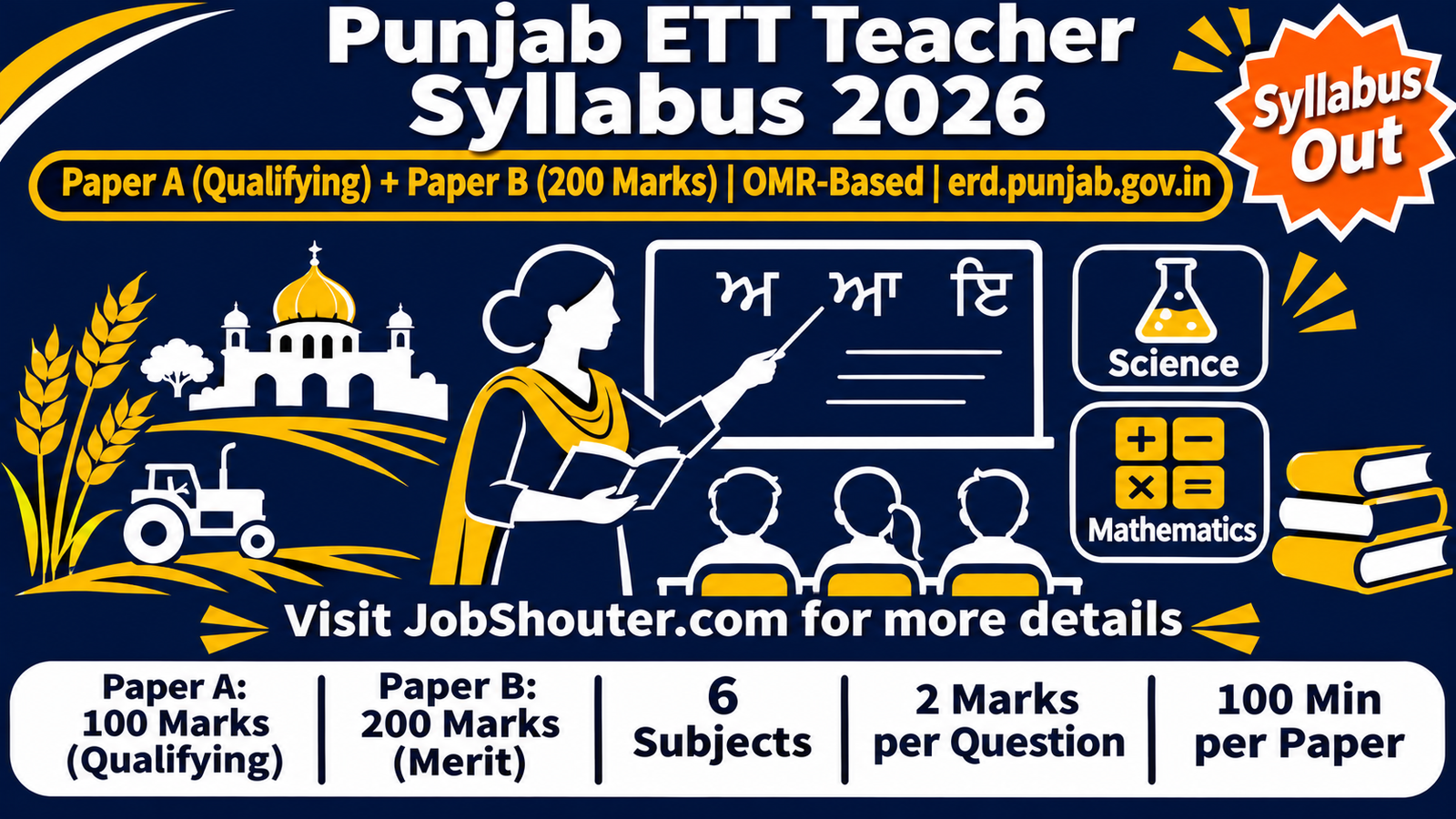
The Education Recruitment Board (ERB), Punjab has released the syllabus for the Elementary Teacher Training (ETT) Teacher written examination 2026. The exam has two offline OMR-based papers of 100 minutes each. Paper A is a qualifying Punjabi language test carrying 100 marks. Paper B carries 200 marks across six subjects and is the basis for the written examination merit. This article covers the full exam pattern and subject-wise topics for both papers.
Important Note
1. Paper A is qualifying only. Candidates must pass it, but its marks are not counted in the final written examination merit. The merit list is prepared entirely from Paper B marks.
2. Paper B carries 200 marks for 100 questions across six subjects, with each question worth 2 marks. Subjects are Punjabi (40 marks), English (20 marks), Hindi (20 marks), General Science (40 marks), Social Studies (40 marks) and Mathematics (40 marks).
3. The Social Studies syllabus is not fully detailed in the available source. Download the official syllabus PDF from erd.punjab.gov.in for the complete Social Studies topic list.
Punjab ETT Teacher Syllabus 2026: Overview
| Particulars | Details |
|---|---|
| Recruitment Board | Education Recruitment Board (ERB), Punjab |
| Post Name | Elementary Teacher Training (ETT) Teacher |
| Exam Level | State Level |
| Exam Type | Objective type (MCQ) |
| Exam Mode | Offline (OMR-Based) |
| Total Papers | 2 (Paper A and Paper B) |
| Total Questions | 200 (100 per paper) |
| Total Marks | 300 (100 for Paper A + 200 for Paper B) |
| Duration Per Paper | 100 minutes |
| Negative Marking | Not stated in the available source |
| Merit Basis | Paper B marks only |
| Official Website | erd.punjab.gov.in |
Punjab ETT Exam Pattern 2026
Paper A: Qualifying Paper
| Subject | Questions | Marks | Duration |
|---|---|---|---|
| Punjabi Language | 100 | 100 | 100 minutes |
Paper A is qualifying in nature. Its marks are not included in the final written merit.
Paper B: Merit Paper
| Subject | Questions | Marks per Question | Total Marks |
|---|---|---|---|
| Punjabi | 20 | 2 | 40 |
| General Science | 20 | 2 | 40 |
| Social Studies | 20 | 2 | 40 |
| Mathematics | 20 | 2 | 40 |
| English | 10 | 2 | 20 |
| Hindi | 10 | 2 | 20 |
| Total | 100 | 2 | 200 |
Duration: 100 minutes. Each question carries 2 marks. Paper B scores are used for the written examination merit list.
Punjab ETT Paper A Syllabus 2026 (Punjabi Language, Qualifying)
| Topic |
|---|
| Punjabi language: definition, types and dialects |
| Classical Punjabi language |
| Punjabi script and Gurmukhi script |
| Vowels, consonants and sounds |
| Word formation, prefixes and suffixes |
| Nouns, pronouns, adjectives and verbs |
| Adverbs and conjunctions |
| Sentence structure and classification |
| Synonyms and antonyms |
| One-word substitutions |
| Gender, tense and grammar rules |
| Idioms and Punjabi vocabulary |
| Punctuation and correct spelling |
Punjab ETT Paper B Syllabus 2026 (Merit Paper)
Punjabi (20 Questions, 40 Marks)
| Topic |
|---|
| Punjabi folklore and culture |
| Punjabi language and literature |
| Idioms and proverbs |
| English-to-Punjabi translation |
| Sentence conversion and grammar |
English (10 Questions, 20 Marks)
| Topic |
|---|
| Reading comprehension and unseen passages |
| Articles, prepositions and determiners |
| Conjunctions and modals |
| Tenses and error correction |
| Active and passive voice |
| Direct and indirect narration |
| Sentence and clause transformation |
| Synonyms and antonyms |
| One-word substitutions |
| Idioms and phrases |
| Punjabi-to-English and English-to-Punjabi translation |
Hindi (10 Questions, 20 Marks)
| Topic |
|---|
| भाषा और लिपि |
| वर्ण विचार और शब्द विचार |
| संज्ञा, सर्वनाम, विशेषण और क्रिया |
| क्रिया विशेषण और अव्यय |
| पर्यायवाची और विलोम शब्द |
| तत्सम और तद्भव शब्द |
| उपसर्ग और प्रत्यय |
| अनेक शब्दों के लिए एक शब्द |
| अनेकार्थक शब्द |
| शुद्ध और अशुद्ध शब्द |
| मुहावरे और लोकोक्तियां |
| हिंदी से पंजाबी अनुवाद |
Mathematics (20 Questions, 40 Marks)
| Topic |
|---|
| Number System and Real Numbers |
| Exponents and Algebraic Equations |
| Arithmetic Series |
| Euclid’s Division |
| Lines and Angles |
| Triangles, Quadrilaterals and Circles |
| Area of Triangles and Quadrilaterals |
| Mensuration, Surface Area and Volume |
| Area Related to Circles |
| Statistics |
| Probability |
General Science (20 Questions, 40 Marks)
| Topic |
|---|
| Motion and Laws of Motion |
| Force and Gravitation |
| Work, Energy and Sound |
| Light, Reflection and Refraction |
| Electricity and Magnetism |
| Sources of Energy |
| Matter, Atoms and Molecules |
| Chemical Reactions and Equations |
| Acids, Bases and Salts |
| Metals and Non-Metals |
| Carbon and Its Compounds |
| Cells and Tissues |
| Diversity of Living Organisms |
| Life Processes |
| Control and Coordination |
| Reproduction, Heredity and Evolution |
| Natural Resources and Environmental Science |
| Human Eye and Colourful World |
Social Studies (20 Questions, 40 Marks)
The detailed topic list for Social Studies is not fully stated in the available source. Download the official syllabus PDF from erd.punjab.gov.in for the prescribed Social Studies topics in History, Geography, Civics and related areas.
How to Download the Punjab ETT Teacher Syllabus 2026 PDF
- Go to erd.punjab.gov.in.
- Open the recruitment notifications section.
- Find the ETT Teacher recruitment notification.
- Look for the syllabus or examination pattern PDF link.
- Download and save the Paper A and Paper B syllabus PDFs.
Preparation Tips
Start with Paper A basics. Paper A is qualifying but cannot be treated lightly. Build a strong foundation in Gurmukhi script, Punjabi grammar and vocabulary before the exam.
Prioritise the four 40-mark subjects in Paper B. Punjabi, General Science, Social Studies and Mathematics each carry 40 marks. Together they account for 160 of the 200 marks in Paper B, so give them the most daily preparation time.
Each question is worth 2 marks. The higher per-question value means a few wrong answers significantly affect your score. Accuracy matters more than attempting all questions.
Use the official syllabus PDF. The Social Studies topic list is not fully available in this article. Download the official syllabus from erd.punjab.gov.in before you start preparing for that section.
Practise in OMR format. The exam is offline OMR-based. Practise filling OMR sheets correctly and managing 100 questions in 100 minutes per paper.
Important Links
| Description | Link |
|---|---|
| Punjab ERB Official Website / Syllabus PDF | Click Here |
FAQs
What is the Punjab ETT Teacher exam pattern 2026?
Two offline OMR papers of 100 minutes each. Paper A has 100 Punjabi language questions for 100 marks (qualifying only). Paper B has 100 questions for 200 marks across six subjects.
Does Paper A marks count in the merit?
No. Paper A is qualifying only. The final written examination merit is based entirely on Paper B marks.
Which subjects are in Punjab ETT Paper B?
Punjabi (40 marks), General Science (40 marks), Social Studies (40 marks), Mathematics (40 marks), English (20 marks) and Hindi (20 marks).
What is the marks per question in Paper B?
Each question in Paper B carries 2 marks.
Is there negative marking in the Punjab ETT exam?
Negative marking is not stated in the available source. Verify in the official notification at erd.punjab.gov.in.
Where can I find the Social Studies syllabus for Punjab ETT?
Download the official syllabus PDF from erd.punjab.gov.in. The Social Studies topic list is not fully detailed in the available source.
Disclaimer
This article is based on the Punjab ETT Teacher syllabus published at erd.punjab.gov.in on 12 November 2026. The Social Studies topic list and negative marking rule are not available in the source. Candidates must download the official syllabus PDF from erd.punjab.gov.in before starting preparation. JobShouter is not associated with the Education Recruitment Board, Punjab. This article is for informational purposes only.