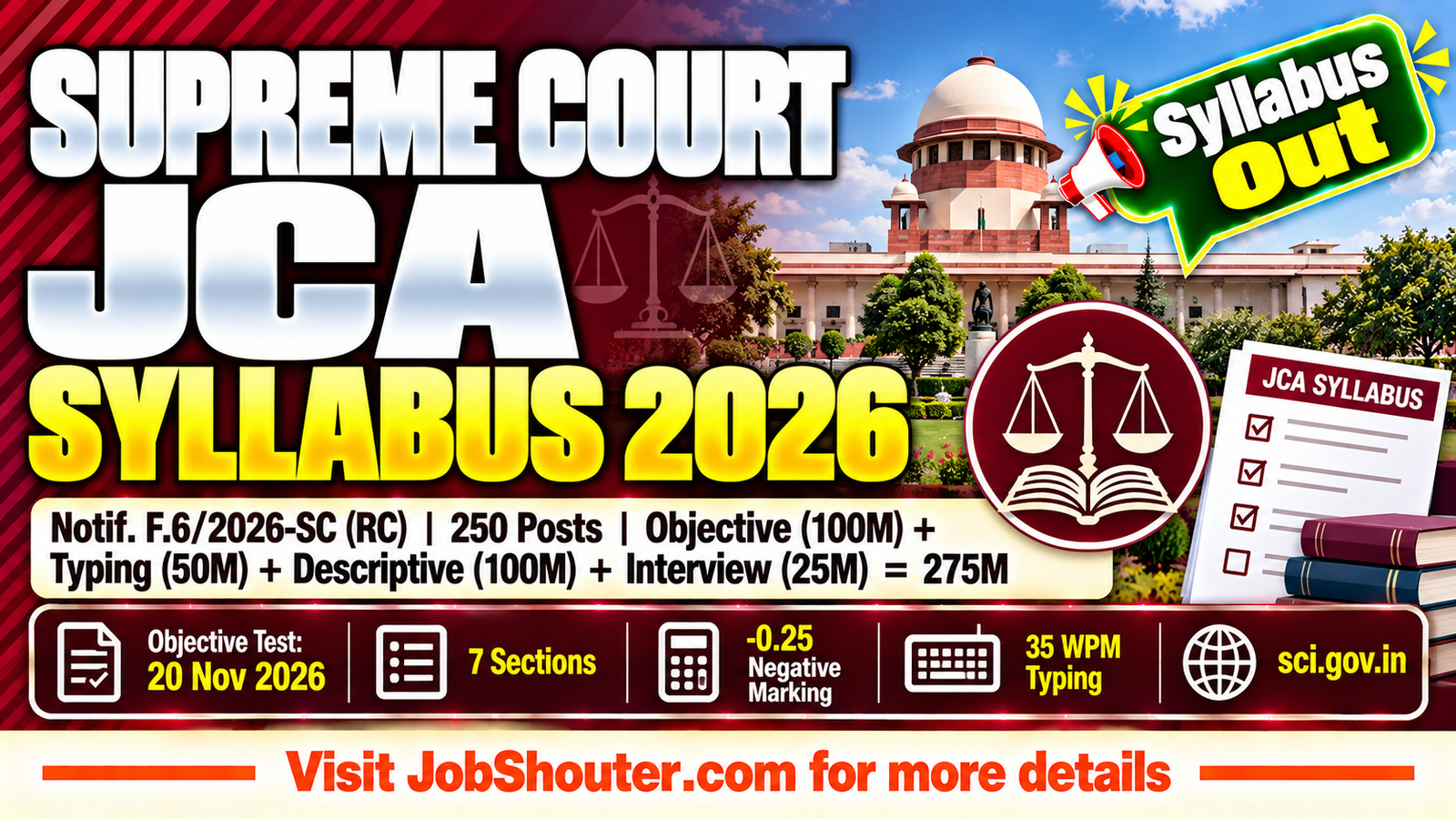
The Supreme Court of India has released the official syllabus and exam scheme for the Junior Court Assistant (JCA) recruitment 2026 (Notification No. F.6/2026-SC (RC)) on 30 September 2026. The selection process has four stages: Objective Test (100 marks), Typing Speed Test (50 marks), Descriptive Written Test (100 marks) and Interview (25 marks), with a grand total of 275 marks. The Objective Test has 7 sections covering General English, General Aptitude, General Knowledge, Judiciary provisions in the Constitution, Supreme Court Rules 2013, Supreme Court Officers and Servants Rules 1961 and Computer Knowledge. The Objective Test is tentatively scheduled for 20 November 2026.
Important Note: Three things every candidate must understand before starting preparation. First, the Objective Test is a gate — only those scoring 50 or above, ranked up to 10 times the vacancies (about 2,500 for 250 posts), move forward. Your rank in the Objective Test determines whether you reach the next stages. Second, the Descriptive Test answer sheets are evaluated ONLY for candidates who pass the Typing Test. If you fail the typing, your descriptive paper is not even checked. Prioritise typing accuracy and speed alongside the written content. Third, 35 of the 100 objective questions come from three Supreme Court-specific sections — Judiciary provisions in the Constitution, Supreme Court Rules 2013 and Supreme Court Officers and Servants Rules 1961. These are unique to this exam and cannot be prepared from general competitive exam books. Study the bare texts directly.
Supreme Court JCA Syllabus 2026: Quick Overview
| Particulars | Details |
|---|---|
| Conducting Body | Supreme Court of India (Registry) |
| Notification No. | F.6/2026-SC (RC) issued 30 September 2026 |
| Post | Junior Court Assistant (Group B, Non-Gazetted) |
| Vacancies | 250 (tentative) |
| Pay Level | Level 6, initial basic pay Rs. 35,400 plus allowances |
| Syllabus Released | 30 September 2026 |
| Stages of Selection | Objective Test, Typing Test, Descriptive Test, Interview |
| Total Marks | 275 |
| Objective Test Date (Tentative) | 20 November 2026 |
| Official Website | sci.gov.in |
Supreme Court JCA Recruitment 2026: Important Dates
| Event | Date |
|---|---|
| Online Registration Opens | 7 October 2026 |
| Last Date to Apply | 28 October 2026 (11:55 PM) |
| Objective Test (Tentative) | 20 November 2026 |
| Answer Key Release | 22 November 2026 |
| Objection Window | 22 November 2026 to 23 November 2026 (11:55 PM) |
Supreme Court JCA Exam Pattern 2026
| Stage | Test | Duration | Maximum Marks | Minimum Qualifying Marks |
|---|---|---|---|---|
| Stage 1 | Objective Type Test (100 MCQs) | 1.5 hours | 100 | 50 |
| Stage 2 | Typing Speed Test on Computer (English) | 10 minutes | 50 | 25 |
| Stage 3 | Descriptive Written Test (English) | 2 hours | 100 | 50 |
| Stage 4 | Interview (Personality Test) | – | 25 | 13 |
| Grand Total | 275 |
How Candidates Progress Between Stages
| Stage | Shortlisting Rule |
|---|---|
| Objective Test (Stage 1) to Stage 2 | Top candidates scoring 50+ marks, in ratio up to 10 times vacancies (approx. 2,500 for 250 posts) |
| Typing Test (Stage 2) | Must score minimum 25/50 to have the Descriptive Test evaluated |
| Descriptive Test (Stage 3) to Interview | Candidates clearing both Typing and Descriptive tests called for interview in 1:3 ratio against vacancies (approx. 750) |
| Interview (Stage 4) | Minimum 13/25 to qualify |
Negative Marking in the Supreme Court JCA Objective Test
- Each correct answer: +1 mark.
- Each wrong answer: -0.25 marks (one-fourth deduction).
- Unanswered questions: 0 marks (no deduction).
- If more than one answer is marked for the same question: -0.25 marks even if one answer is correct.
- Do not guess blindly. Unattempted questions are safer than wrong answers when unsure.
Supreme Court JCA Syllabus 2026: Objective Test – Section-wise Topics
Section-wise Distribution
| Section | Subject | Questions | Marks |
|---|---|---|---|
| Section 1 | General English (including comprehension) | 20 | 20 |
| Section 2 | General Aptitude | 15 | 15 |
| Section 3 | General Knowledge | 15 | 15 |
| Section 4 | Provisions relating to Judiciary in the Constitution of India | 15 | 15 |
| Section 5 | Supreme Court Rules, 2013 | 10 | 10 |
| Section 6 | Supreme Court Officers and Servants (Conditions of Service and Conduct) Rules, 1961 | 10 | 10 |
| Section 7 | Computer Knowledge | 15 | 15 |
| Total | 100 | 100 |
Section 1: General English (20 Questions)
- Grammar and sentence structure
- Vocabulary: synonyms, antonyms, homonyms
- Fill in the blanks and spot the error
- Idioms and phrases, one-word substitutions
- Spellings and detecting mis-spelt words
- Shuffling of sentences in a passage and shuffling of sentence parts
- Reading comprehension
Section 2: General Aptitude (15 Questions)
- Number series and alphanumeric series
- Analogies and verbal reasoning
- Coding and decoding
- Matching definitions and theme detection
- Cause and effect
- Logical deduction, statement and conclusions, statement and argument
Section 3: General Knowledge (15 Questions)
- National and international current affairs and national news
- History of India, Indian culture, tribes, handicrafts and national dances
- Geography of India, countries and capitals, famous places
- Political science and economic issues in India
- Science, innovations and new inventions
- Books and authors, artists, music, literature and musical instruments
- World organisations, important dates and international issues
Section 4: Provisions Relating to Judiciary in the Constitution of India (15 Questions)
- Supreme Court of India: Articles 124 to 147
- High Courts: Articles 214 to 231
- Subordinate courts
- Judicial review and writs
Preparation tip: Read these Articles directly from the bare text of the Constitution. Focus on composition, jurisdiction, appointment and removal of judges, original and appellate jurisdiction of the Supreme Court and High Courts.
Section 5: Supreme Court Rules, 2013 (10 Questions)
- Functions of the Registry
- Filing and listing of cases
- Advocates-on-Record
- Appeals, review and curative procedure
Preparation tip: Download and read the Supreme Court Rules, 2013 directly from sci.gov.in. Focus on the chapter on the Registry, modes of filing, listing procedures and the provisions on curative petitions.
Section 6: Supreme Court Officers and Servants (Conditions of Service and Conduct) Rules, 1961 (10 Questions)
- Recruitment and reservation (Rule 4A)
- Probation
- Conduct rules
- Leave and discipline
Preparation tip: Read the 1961 Rules directly from sci.gov.in. Focus especially on Rule 4A (reservation), probation conditions, conduct and discipline chapters.
Section 7: Computer Knowledge (15 Questions)
- Computer fundamentals
- Operating systems and computer software
- MS Word (word processing), MS Excel (spreadsheets), MS PowerPoint (presentations)
- Internet usage and email
- Keyboard shortcuts and cyber security basics
Supreme Court JCA Typing Test 2026: Syllabus and Rules
| Particulars | Details |
|---|---|
| Language | English |
| Duration | 10 minutes |
| Minimum Speed Required | 35 words per minute |
| Maximum Marks | 50 |
| Minimum Qualifying Marks | 25 |
| Errors Allowed | Up to 3% of total words typed |
How Typing Mistakes are Counted
| Type of Error | Deduction |
|---|---|
| Wrong word or figure | 1 full mistake |
| Wrong capital or small letter | 0.5 mistake |
| Punctuation mark omitted, added or wrongly placed | 0.5 mistake |
Key rule: The descriptive test answer sheets are evaluated ONLY for candidates who qualify the typing test. Failing the typing test ends your candidacy regardless of how well you performed in the objective test.
Supreme Court JCA Descriptive Written Test 2026
| Particulars | Details |
|---|---|
| Duration | 2 hours |
| Maximum Marks | 100 |
| Minimum Qualifying Marks | 50 |
| Medium | English only |
| Components | Comprehension passage, Precis writing, Essay writing |
The Descriptive Test evaluates clear and accurate English writing rather than subject knowledge. Practise comprehension reading, summarising passages in about one-third of the original length, and writing structured essays. All within a 2-hour discipline.
Supreme Court JCA Interview (Personality Test) 2026
| Particulars | Details |
|---|---|
| Maximum Marks | 25 |
| Minimum Qualifying Marks | 13 |
| Called in Ratio | 1:3 against vacancies (approx. 750 for 250 posts) |
The interview tests personality, communication, legal awareness and general aptitude in addition to the candidate’s fit for the role of Junior Court Assistant.
Supreme Court JCA Eligibility (Quick Reference)
| Criteria | Details |
|---|---|
| Educational Qualification | Bachelor’s degree from a recognised university in India |
| Computer Skills | Knowledge of computer operation with typing speed of 35 WPM |
| Age Limit (as on 01-09-2026) | 18 to 30 years |
| Age Relaxation | SC/ST/OBC (NCL)/PwD/Ex-Servicemen as per GoI rules; Dependents of freedom fighters up to 35 years; Supreme Court Registry departmental candidates – no upper age limit |
Supreme Court JCA Application Fee
| Category | Fee |
|---|---|
| General/Unreserved | Rs. 1,500 plus bank charges |
| SC/ST/OBC (NCL)/Ex-Servicemen/PwBD | Rs. 750 plus bank charges |
Key Preparation Tips for Supreme Court JCA 2026
- Law sections are the differentiator: 35 questions come from Sections 4, 5 and 6 – the Constitution’s judiciary provisions, Supreme Court Rules 2013 and the 1961 Service Rules. These sections cannot be prepared from generic books. Download and read these documents directly from sci.gov.in.
- Avoid blind guessing in Section 1-7: Each wrong answer costs 0.25 marks. Skip questions where you have no reasonable basis to choose.
- Typing is a gate, not a formality: 35 WPM with under 3% errors is the bar. Practise daily, with special attention to capital letters and punctuation, since each capitalisation error and punctuation error counts as half a mistake.
- Practise descriptive writing: Write one precis and one essay each week within a 2-hour time limit in English. Focus on clarity, conciseness and error-free writing.
- Current affairs for GK: The GK section covers a wide range. Stay updated on national and international news, important days, world organisations and Indian geography and history.
- Monitor sci.gov.in: Admit cards, later stage dates and any corrigenda will be notified on sci.gov.in and via your registered email and mobile number.
Supreme Court JCA Syllabus 2026: Important Links
| Description | Link |
|---|---|
| Official Notification PDF (F.6/2026-SC (RC)) | Click Here |
| Supreme Court of India Official Website | Click Here |
Supreme Court JCA Syllabus 2026: FAQs
Q1. What is the Supreme Court JCA Syllabus 2026?
The Objective Test has 7 sections: General English (20Q), General Aptitude (15Q), General Knowledge (15Q), Judiciary provisions in the Constitution (15Q), Supreme Court Rules 2013 (10Q), Supreme Court Officers and Servants Rules 1961 (10Q) and Computer Knowledge (15Q). Further stages include a Typing Test, a Descriptive Test (comprehension, precis, essay) and an Interview.
Q2. How many marks is the Supreme Court JCA exam?
Total 275 marks: Objective Test 100 + Typing Test 50 + Descriptive Test 100 + Interview 25.
Q3. Is there negative marking?
Yes, in the Objective Test only. -0.25 marks per wrong answer. No negative marking in the Typing or Descriptive tests.
Q4. What is the minimum qualifying marks for each stage?
Objective Test: 50/100. Typing Test: 25/50. Descriptive Test: 50/100. Interview: 13/25.
Q5. What typing speed is required?
Minimum 35 words per minute in English for 10 minutes, with errors not exceeding 3% of total words typed.
Q6. When is the Supreme Court JCA Objective Test 2026?
Tentatively 20 November 2026. Answer key on 22 November 2026 with objection window up to 23 November 2026.
Disclaimer
The information in this article is based on the official Supreme Court JCA Notification No. F.6/2026-SC (RC) issued on 30 September 2026 and the syllabus document published on sci.gov.in. The negative marking information is based on the 2026 notification — verify this from the official document before the exam. Vacancies (250) are tentative and may change. Candidates must read the full official notification before applying. JobShouter is not associated with the Supreme Court of India. This article is for informational purposes only.