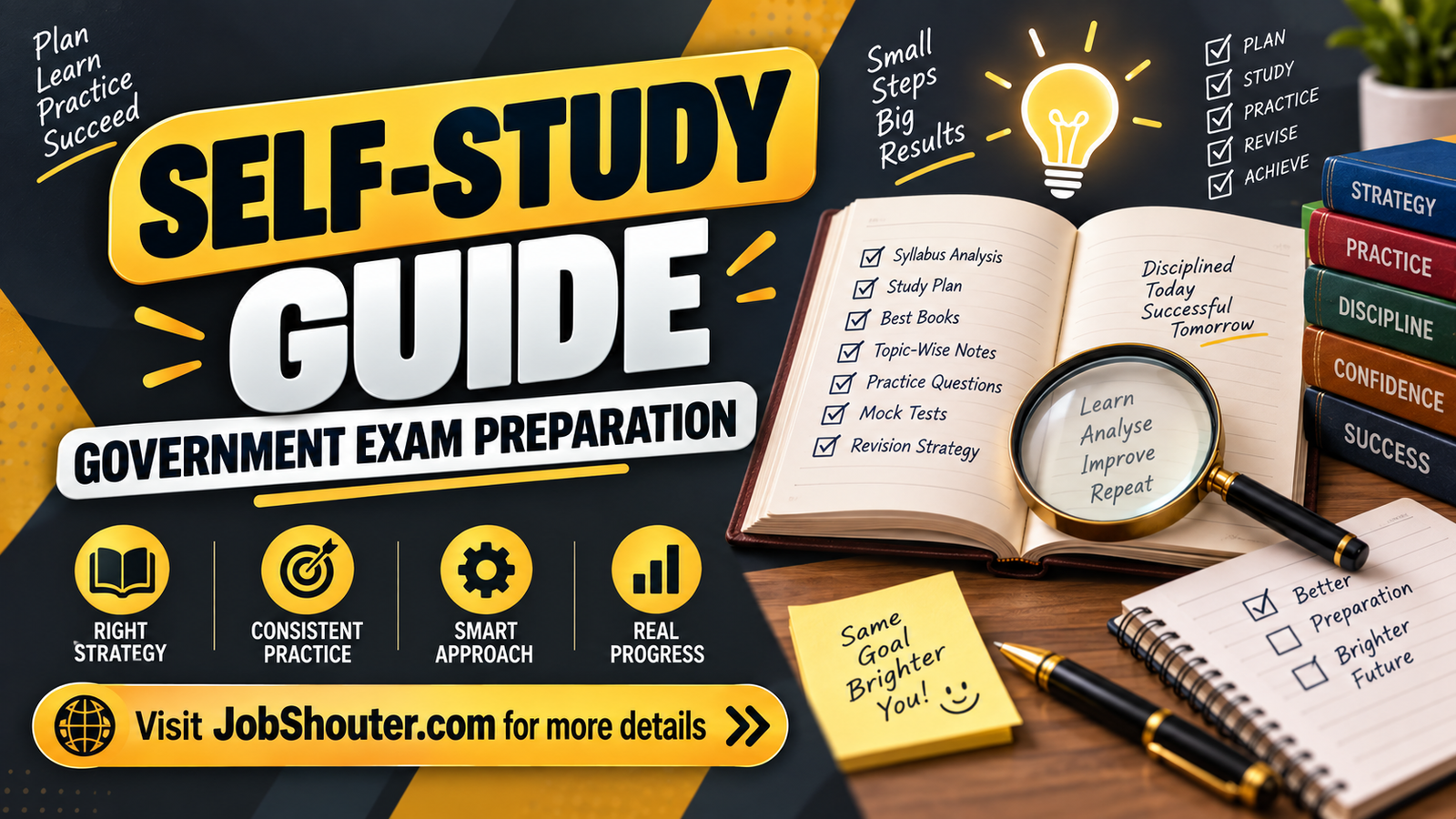
Not everyone preparing for a government job can afford expensive coaching institutes, and the good news is that self-study, when done with the right structure and discipline, has helped countless candidates clear exams like SSC, banking, railways, and state PSC recruitments every year. This detailed guide lays out a practical, phase-wise self-study strategy covering subject priority, daily timetables, recommended books, current affairs approach, mock test strategy, and free study resources for government exam aspirants preparing without coaching.
Why Self-Study Works for Government Exams
Most government exams like SSC CGL, SSC CHSL, IBPS PO, RRB NTPC, and various state PSC exams share a largely similar core syllabus covering Quantitative Aptitude, Reasoning, English Language, and General Awareness. This overlap means that a well-structured self-study plan built around strong fundamentals can prepare a candidate for multiple exams simultaneously, without needing to depend on paid coaching, provided the candidate maintains consistency and uses the right resources.
Common Subjects Across Government Exams
| Subject | Relevance | High-Weightage Topics |
|---|---|---|
| Quantitative Aptitude | SSC, Banking, Railways, State PSC | Profit and Loss, Time and Work, Ratio and Proportion, Data Interpretation |
| Reasoning | SSC, Banking, Railways, State PSC | Coding-Decoding, Blood Relations, Puzzles, Seating Arrangement |
| English Language | SSC, Banking, Railways, State PSC | Reading Comprehension, Error Detection, Fill in the Blanks |
| General Awareness/GK | SSC, Railways, State PSC (limited in Banking) | Current Affairs, Indian Polity, History, Geography |
Subject-Wise Priority for Beginners
For a beginner starting from scratch, it generally works well to start with Reasoning, since it is largely pattern-based and does not require prior formula knowledge, followed by Mathematics, which needs the most consistent practice but is also one of the highest-scoring sections once fundamentals are clear. English should be tackled through a combination of grammar rules and regular reading comprehension practice, while General Awareness should be built through a mix of static topics such as Polity, History, and Geography, along with a daily current affairs habit, since current affairs alone typically accounts for around 20 to 25 percent of the General Awareness section in most exams.
Recommended Books for Self-Study
| Subject | Recommended Book | Foundation Level |
|---|---|---|
| Quantitative Aptitude | Quantitative Aptitude by R.S. Aggarwal | NCERT Mathematics (Class 6-10) |
| Reasoning | A Modern Approach to Verbal & Non-Verbal Reasoning by R.S. Aggarwal | – |
| English Language | Objective General English by S.P. Bakshi | – |
| General Knowledge | Lucent’s General Knowledge | NCERT History, Geography, Polity, Economics (Class 6-12) |
Building a strong NCERT foundation across Class 6 to Class 12 before moving to these standard reference books is one of the most cost-effective and reliable strategies, since NCERT books are freely available as PDFs and cover the base concepts needed for both objective and descriptive government exam papers.
Sample Daily Study Timetable
For a Full-Time Aspirant (5-6 Hours Daily)
| Time | Activity |
|---|---|
| 7:00-7:30 AM | Newspaper reading for current affairs |
| 8:00-10:00 AM | Mathematics: concepts and practice |
| 10:30 AM-12:00 PM | Reasoning: topic-wise practice |
| 2:00-3:00 PM | English: grammar and comprehension |
| 3:30-4:30 PM | General Knowledge: static topics and revision |
| 8:00-9:00 PM | Error review and revision |
For a Working Professional (3-4 Hours Daily)
| Time | Activity |
|---|---|
| 6:00-7:00 AM | Mathematics practice (30 questions) |
| 7:00-7:30 AM | Current affairs headlines |
| During commute | Video lectures or GK app revision |
| 9:00-10:30 PM | Reasoning practice and mock test analysis |
| Weekends | One full-length mock test |
Consistency matters far more than intensity in government exam preparation; a candidate studying 4 focused hours daily over several months will typically outperform someone attempting irregular 10 to 12 hour study marathons.
Current Affairs Strategy
A daily habit of reading a reliable newspaper such as The Hindu or Indian Express for about 30 minutes each morning, focusing on national news, government policies, and important announcements, works better than last-minute cramming before the exam. Maintaining either handwritten notes or a monthly current affairs compilation throughout the preparation period, and revising these compilations periodically rather than only once, helps retain information for the exam far more effectively.
Free Resources for Self-Study
| Resource Type | Examples |
|---|---|
| Foundation Textbooks | NCERT Textbooks (Class 6-12), available as free PDFs |
| Government Learning Platforms | DIKSHA, SWAYAM, e-Pathshala |
| Current Affairs Sources | The Hindu, Indian Express, PIB press releases |
| Policy and Research Sources | PRS Legislative Research, RBI website |
| Previous Year Papers | Official papers released by UPSC, SSC, IBPS, and RRB on their respective websites |
| Free Mock Test Platforms | Various platforms offering limited free full-length tests and daily quizzes |
Mock Test Strategy: A Phase-Wise Approach
| Preparation Phase | Approximate Timeline | Mock Test Focus |
|---|---|---|
| Foundation Phase | Months 1 to 3 | Focus on concept-building; avoid full mocks |
| Building Phase | Months 4 to 6 | Begin sectional/subject-wise tests; cover 80% of syllabus |
| Practice Phase | Months 7 to 10 | 2 to 3 full-length mocks weekly; solve previous 5 years’ papers |
| Revision Phase | Months 11 to 12 | Daily full-length mocks under exam conditions; stop learning new topics |
After every mock test, spend roughly as much time analyzing your performance as you spent taking the test itself. Identify weak topics that need re-study, question types that consume disproportionate time, and recurring careless errors, since consistent mock test performance is ultimately what determines exam-day rank, not simply the number of books covered during preparation.
Maintaining an Error Notebook
Keeping a dedicated error notebook throughout the preparation period, where every mistake made in practice sessions and mock tests is recorded along with the correct approach, helps identify recurring weak areas and prevents the same mistakes from being repeated closer to the actual exam. This, along with a separate formula notebook for quick daily revision, becomes especially valuable during the final revision phase.
Key Points to Remember
Since self-study requires greater personal discipline compared to a structured coaching environment, setting realistic weekly targets and tracking progress consistently, rather than only during the final months, makes a significant difference in outcomes. It also helps to join a genuine peer study group or online community for doubt resolution and motivation, since one of the main challenges of self-study is the lack of an external support structure that coaching institutes typically provide.
Frequently Asked Questions (FAQs)
1. Can government exams really be cleared without coaching?
Yes, many candidates clear government exams like SSC, banking, and railway recruitment through self-study, provided they maintain a structured, consistent preparation plan.
2. Which subject should a beginner start with in self-study?
Beginners generally benefit from starting with Reasoning, since it is pattern-based, followed by Mathematics, English, and General Awareness.
3. How important is current affairs in government exam preparation?
Current affairs typically makes up around 20 to 25 percent of the General Awareness section in most exams, making a daily reading habit essential.
4. What are the best free resources for self-study?
NCERT textbooks, government learning platforms like DIKSHA and SWAYAM, newspapers, PIB press releases, and previous year question papers are among the best free resources.
5. How many hours should a full-time aspirant study daily?
A full-time aspirant should aim for around 5 to 6 hours of focused daily study, while working professionals can manage with 3 to 4 hours if used efficiently.
6. When should a candidate start taking mock tests?
Sectional mock tests should generally begin after the foundation phase, around month 3 to 4, with full-length mocks increasing in frequency closer to the exam.
7. Is it necessary to buy expensive books for self-study?
No, a combination of free NCERT textbooks and one standard reference book per subject is usually sufficient; expensive coaching material is not mandatory.
8. How should mistakes be tracked during self-study preparation?
Maintaining a dedicated error notebook to record and review mistakes from practice sessions and mock tests helps prevent repeated errors on the actual exam day.
9. Does self-study work for multiple government exams at once?
Yes, since exams like SSC, banking, and railways share significant syllabus overlap in Reasoning, Quantitative Aptitude, and English, a common self-study foundation can prepare candidates for multiple exams.
10. What should the final month of preparation focus on?
The final month should focus purely on revision and daily full-length mock tests under exam conditions, rather than learning new topics.
Disclaimer: JobShouter.com is not affiliated with any coaching institute or government recruiting body. Shared for informational purposes only, please verify details on the official website.
For SSC CGL Preparation Guide – Read through SSC CGL Preparation Strategy 2026 – 90-Day Study Plan, Section-Wise Tips & Exam Pattern