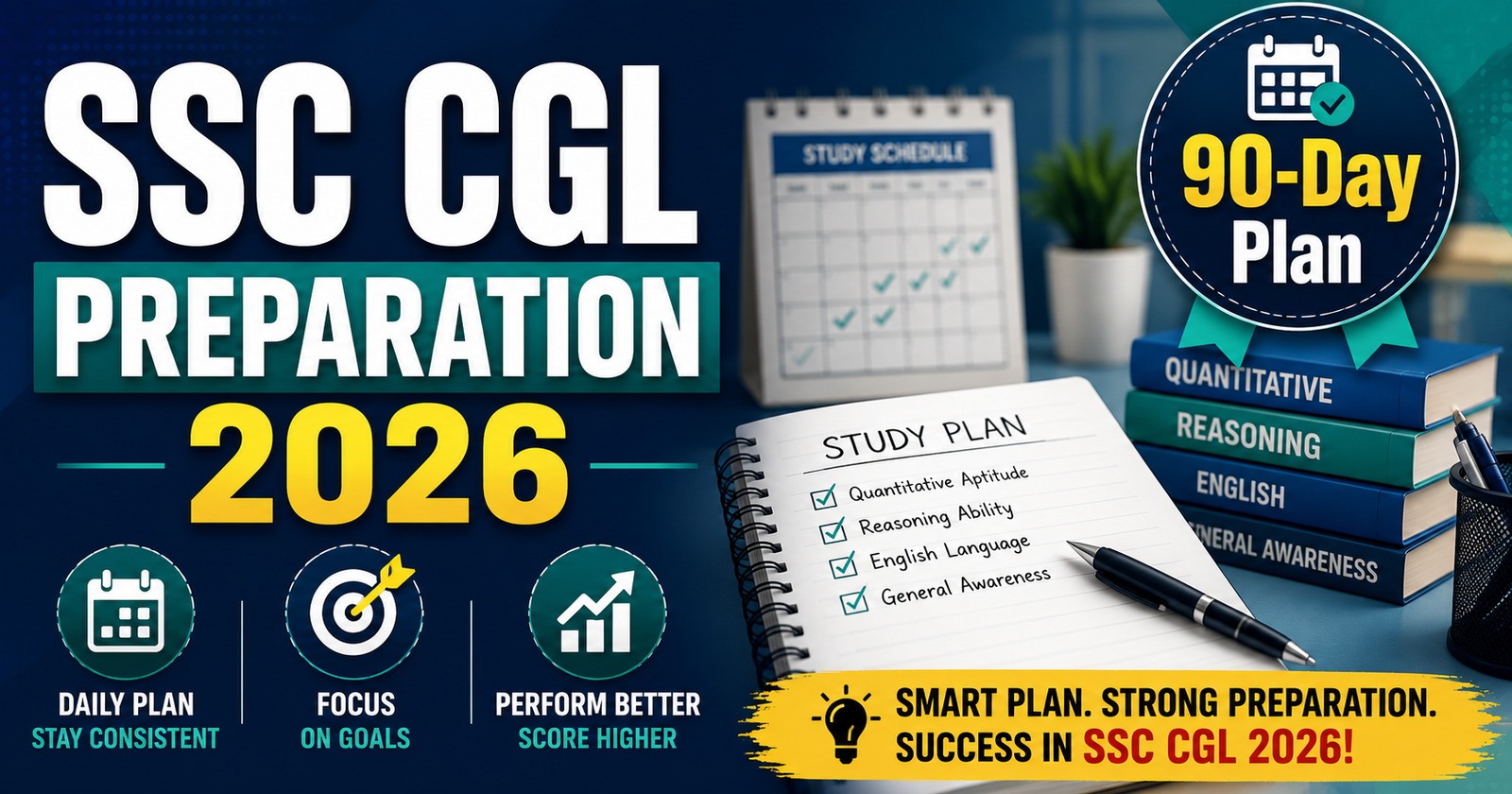
Most SSC CGL preparation advice tells you to “cover the syllabus and practice daily.” That is true and useless at the same time. What actually works is planning backwards from a number: the score you need. In our SSC CGL cut off analysis, we showed that a safe target for the General category is around 340+ in Tier 2, with other categories roughly 18–20 marks above their latest cut off. This guide turns that target into a concrete preparation strategy — the updated 2026 exam pattern, a section-wise approach, a realistic 90-day study plan, and a mock test schedule that tells you every week whether you are on track.
This strategy is built on the SSC CGL 2026 exam pattern as per the latest official notification. Always cross-check pattern details with the current notification on ssc.gov.in before your attempt.
First, Understand What Changed in the SSC CGL Pattern
Before planning, get the current structure clear, because it changes what deserves your time:
- Tier 1 is qualifying in nature. Its marks do not count in the final merit list. Your job in Tier 1 is simply to clear the shortlisting cut off — not to top it.
- Tier 1 now has sectional timing. 100 questions, 200 marks, 60 minutes — but with 15 minutes fixed per section (Reasoning, General Awareness, Quantitative Aptitude, English). You can no longer borrow time from a strong section to cover a weak one.
- Tier 2 decides everything. The final merit is based on Tier 2 Paper-I performance (Sections I and II), with the Computer module and DEST being qualifying.
- Negative marking differs by tier. Tier 1 deducts 0.50 marks per wrong answer; Tier 2 Paper-I deducts a full 1 mark in Sections I, II and Module-I of Section-III. Careless guessing is punished twice as hard exactly where marks matter most.
SSC CGL 2026 Exam Pattern at a Glance
Tier 1 (Qualifying)
| Section | Questions | Marks | Time |
| General Intelligence & Reasoning | 25 | 50 | 15 min |
| General Awareness | 25 | 50 | 15 min |
| Quantitative Aptitude | 25 | 50 | 15 min |
| English Comprehension | 25 | 50 | 15 min |
| Total | 100 | 200 | 60 min |
Negative marking: 0.50 per wrong answer.
Tier 2 Paper-I (Decides Merit)
| Part | Modules | Role |
| Section I | Mathematical Abilities + Reasoning & General Intelligence | Counted in merit |
| Section II | English Language & Comprehension + General Awareness | Counted in merit |
| Section III | Computer Knowledge module + Data Entry Speed Test (DEST) | Qualifying |
Negative marking: 1 mark per wrong answer in Sections I, II and the Computer module. Paper-II applies only to JSO/Statistical Investigator applicants.
The strategic conclusion: spend most of your preparation energy on the Tier 2 merit sections — Maths, Reasoning, English, and GA at Tier-2 depth — and treat Tier 1 as a speed-and-accuracy checkpoint along the way. The syllabus overlaps heavily, so preparing for Tier 2 depth automatically covers Tier 1.
The Backward-Planning Method
Your target is not “do well.” It is a number. If your category’s safe score is around 340 out of the 390 merit marks, that means an accuracy-first approach: you cannot afford wild attempts at 1 mark negative each. Work it as follows:
- Fix your target score from the safe-score table in our cut off analysis (roughly 18–20 marks above your category’s latest final cut off).
- Split the target across sections based on your strengths. A typical split for a 340 target: strong scorers take Maths and Reasoning close to full, English near-full, and accept some loss in GA — the one section where knowledge gaps cannot be reasoned out.
- Track the gap weekly. Every full mock you take produces a score; the difference between it and your target is your only meaningful progress metric. Chapters “completed” mean nothing if the mock score is not moving.
Section-Wise Strategy
Quantitative Aptitude / Mathematical Abilities
The highest-return section, because Tier 2 tests it at depth and speed. Build in this order: arithmetic first (percentages, ratio, profit & loss, time-speed-distance, time & work — these dominate), then advanced maths (algebra, geometry, trigonometry, mensuration, data interpretation). Two rules: learn one reliable method per topic rather than five shortcuts you half-remember, and maintain an error notebook — in a 1-mark-negative paper, repeated mistakes are the most expensive habit you have.
Reasoning & General Intelligence
The most improvable section in the least time. Practise the standard families daily — analogy, series, coding-decoding, syllogism, blood relations, direction sense, seating arrangement, and non-verbal figures. Reasoning rewards pattern familiarity: after enough sets, you recognise the trick before you finish reading the question. Aim for near-full accuracy here; it is where toppers bank marks.
English Language & Comprehension
Consistency beats cramming. Daily reading (editorials, quality articles) quietly builds the vocabulary and comprehension that carry the Tier 2 module. Alongside, drill the rule-based areas — error spotting, sentence improvement, active-passive, direct-indirect — where fixed grammar rules mean fixed marks. Learn idioms and one-word substitutions in small daily batches rather than a final-week dump.
General Awareness
The section that punishes last-minute preparation the most, and also the fastest to attempt on exam day — you either know it or you don’t, so it protects time for other sections in Tier 1’s sectional format. Split it: static GK (history, polity, geography, economy, science) on a fixed weekly rotation, and current affairs through a monthly compilation revised repeatedly rather than read once.
Computer Module & DEST
Qualifying, not merit — so give it enough to pass comfortably, not more. Basic computer awareness needs a few focused sessions. For DEST, ten minutes of daily typing practice from about a month before Tier 2 comfortably builds the required speed. Do not ignore it entirely: a qualifying stage failed is a selection lost.
The 90-Day Study Plan
This plan assumes roughly 5–6 productive hours a day. Adjust proportionally if you are working alongside preparation — stretch the phases, not the structure.
| Phase | Days | Focus |
| Phase 1 – Foundation | Day 1–30 | Complete arithmetic + core reasoning families + grammar rules. Daily: 2 hrs maths, 1.5 hrs reasoning, 1 hr English, 1 hr GA rotation. One sectional test each weekend. |
| Phase 2 – Advanced + Mocks Begin | Day 31–60 | Advanced maths (geometry, trigonometry, algebra, DI) + tougher reasoning + comprehension practice. Two full mocks per week, each followed by same-day error analysis. Start the error notebook review habit. |
| Phase 3 – Mock-Heavy Consolidation | Day 61–90 | Alternate days: full mock + complete analysis one day, targeted revision of weak areas the next. Revise the error notebook and GA compilations weekly. Begin daily DEST typing practice. No new topics in the last 15 days — only revision and mocks. |
The one rule that makes this plan work: a mock without analysis is entertainment. Every mock must produce three outputs — your score versus target, a list of avoidable errors, and one specific fix for the next mock. That loop, repeated twenty-plus times across Phases 2 and 3, is what actually moves your score.
Common Mistakes That Cost Selections
- Preparing for Tier 1 as the goal. Tier 1 is a gate, not the game. Candidates who spend three months on Tier-1-level practice arrive at Tier 2 — the paper that decides everything — underprepared for its depth.
- Ignoring the 1-mark negative in Tier 2. Attempt-everything habits from Tier 1 practice are expensive in Tier 2. Train a discipline: attempt when reasonably sure, skip cleanly when not.
- Collecting resources instead of finishing them. One standard book per subject plus one mock series, completed thoroughly, beats six half-used ones.
- Postponing GA and DEST. Both reward early, small, regular effort and punish last-minute panic.
- Measuring progress by syllabus covered instead of mock scores. The only metric that matches how SSC will measure you is a timed, full-length score.
Disclaimer: This guide reflects the SSC CGL exam pattern as per the latest official notification and general preparation principles. Exam patterns, dates, and rules can change; always verify current details from the official SSC website (ssc.gov.in) and the notification for your cycle before planning your preparation.
Q1. Is 90 days enough to prepare for SSC CGL?
For a candidate starting with basic graduation-level maths and English, 90 focused days covering foundation, advanced topics, and 20+ analysed mocks is a realistic serious attempt. Weaker starting points need 5–6 months with the same structure stretched
Q2. Should I prepare separately for Tier 1 and Tier 2?
No. The syllabus overlaps heavily, and Tier 2 tests the same subjects at greater depth. Prepare at Tier 2 depth from the start, and add Tier-1-format speed practice with sectional timing in the weeks before the Tier 1 exam.
Q3. How many mock tests should I take before SSC CGL?
Around 20–25 full mocks with complete analysis is a strong benchmark — roughly two per week in the middle phase and alternate days in the final month. The analysis matters more than the count
Q4. Which section should I start my preparation with?
Start maths and reasoning together from day one — maths because it needs the longest build-up, reasoning because it improves fastest and keeps early momentum. English and GA run as daily habits alongside rather than as separate phases.
Q5. Does Tier 1 score matter in the final selection?
No. As per the current pattern, Tier 1 is qualifying — it only shortlists you for Tier 2. The final merit is prepared from Tier 2 Paper-I performance.
Q6. What score should I target in Tier 2?
Aim roughly 18–20 marks above your category’s most recent final cut off — around 340+ for the General category. See our SSC CGL previous year cut off analysis for category-wise safe targets and the full trend.
Wondering what each post pays once you clear it? Our SSC CGL salary guide breaks down post-wise in-hand pay and job profiles.
“This is the summary version — the full topic-wise syllabus for both tiers is in our SSC CGL syllabus 2026 guide.”