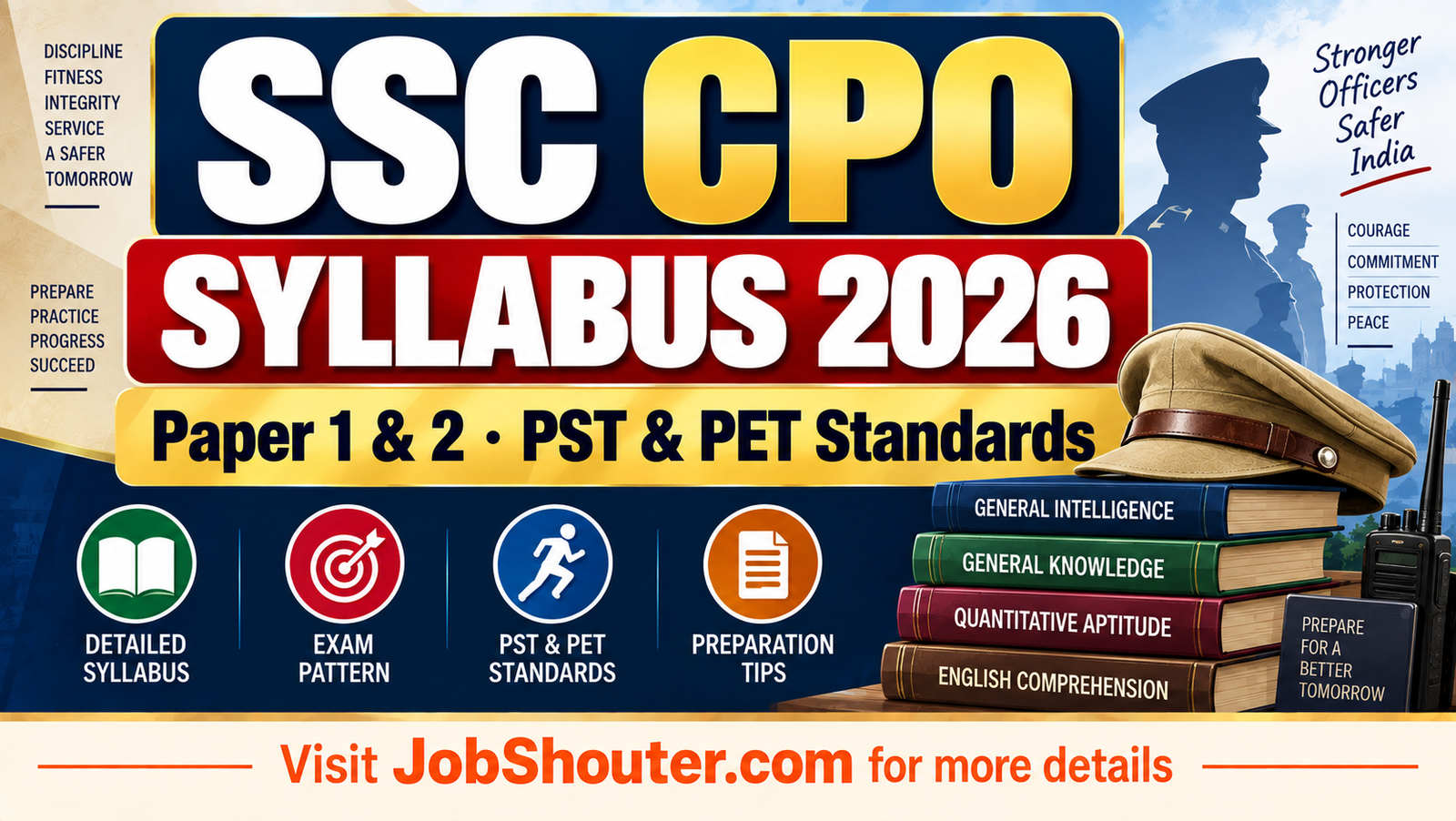
The SSC CPO 2026 syllabus below is taken from the Staff Selection Commission’s own Notice of Advertisement for the Sub-Inspector in Delhi Police and Central Armed Police Forces Examination, 2026, and was verified against it on 16 September 2026. Nothing here is copied from another coaching site.
Two facts shape everything else. Applications close on 30 September 2026 — two weeks away. And your rank comes from Paper-II alone, in which 100 of the 160 questions are English Comprehension. Get that one thing right and you have understood this exam better than most people sitting it.
SSC CPO 2026 at a glance
| Exam name | Sub-Inspector in Delhi Police and Central Armed Police Forces Examination, 2026 |
| Conducting body | Staff Selection Commission (SSC) |
| Application window | 10 September 2026 to 30 September 2026 (23:00 hrs) |
| Fee payment closes | 1 October 2026 (23:00 hrs) |
| Correction window | 8 October to 10 October 2026 (23:00 hrs) |
| Paper-I and Paper-II dates | To be notified later by SSC |
| Application fee | ₹100 — General. Nil for women, SC, ST and eligible ex-servicemen |
| Qualification | Bachelor’s degree (different for SI Fire — see below) |
| Age | 20–25 years for most posts, as on 1 August 2026 |
| Stages | Paper-I → PST/PET → Paper-II → Medical → Document Verification |
| Apply at | ssc.gov.in |
Applications close on 30 September 2026.
The fee must reach SSC by 1 October (23:00 hrs). The correction window runs 8–10 October and is the last opportunity to fix anything. Exam dates have not been announced yet — SSC will publish them on the Notice Board at ssc.gov.in.
Posts and vacancies
| Post | Force / Department | Group | Pay Level | Vacancies |
|---|---|---|---|---|
| Sub-Inspector (Executive) — Male | Delhi Police | Group C | Level-6 | 205 |
| Sub-Inspector (Executive) — Female | Delhi Police | Group C | Level-6 | 112 |
| Sub-Inspector (General Duty) | CAPFs | Group B (Non-Gazetted) | Level-6 | 1,320 |
| Sub-Inspector (Fire) | CISF | Group B (Non-Gazetted) | Level-6 | 234 |
SI (Fire) in CISF is a different exam route in the same notification.
It carries its own age band of 18–30 years and its own qualification: a Bachelor’s degree in Science with Physics, Chemistry and Mathematics, or matriculation plus a three-year diploma in Mechanical, Civil, Electrical, Automobile, Chemical, Mining, Aeronautical or Telecommunication Engineering. If you are eligible for it, it is a materially smaller field than the CAPF General Duty pool.
SSC CPO Paper-I exam pattern 2026
Objective type, multiple choice, computer based. Paper-I is the screening stage.
| Part | Subject | Questions | Marks | Time |
|---|---|---|---|---|
| I | General Intelligence and Reasoning | 25 | 25 | 15 min |
| II | General Knowledge and General Awareness | 25 | 25 | 15 min |
| III | Quantitative Aptitude | 25 | 25 | 15 min |
| IV | English Comprehension | 25 | 25 | 15 min |
| Total | 100 | 100 | 1 hour |
Each question carries 1 mark and each wrong answer costs 0.25. There is a 15-minute sectional timer on each part — unused time does not carry forward and a closed part cannot be reopened, so practise in 15-minute blocks rather than one unbroken hour.
SSC CPO Paper-II exam pattern 2026
This is the paper that decides your rank — and it is not shaped like Paper-I at all.
| Part | Subject | Questions | Marks | Time |
|---|---|---|---|---|
| I | General Intelligence and Reasoning | 20 | 40 | 1 hour for Parts I–III, |
| II | General Knowledge and General Awareness | 20 | 40 | with a 20-minute |
| III | Quantitative Aptitude | 20 | 40 | sectional timer on each |
| IV | English Comprehension | 100 | 200 | 1 hour |
| Total | 160 | 320 | 2 hours |
English is 62.5% of Paper-II — and Paper-II is 100% of your rank.
One hundred of the 160 questions, and 200 of the 320 marks, are English Comprehension. The notification states that final selection and allocation of post and force are made on the basis of performance in Paper-II only, together with your stated preferences. Reasoning, General Knowledge and Quantitative Aptitude carry 40 marks each here. If you are dividing study time evenly across four subjects, you are dividing it wrong.
The notification also states plainly that the difficulty level of Paper-II will be higher than that of Paper-I. Clearing Paper-I comfortably is not evidence that you are ready for Paper-II.
Minimum qualifying marks
| Category | Minimum |
|---|---|
| UR | 30% |
| OBC / EWS | 25% |
| All other categories | 20% |
NCC certificate bonus
| Certificate | Bonus |
|---|---|
| NCC ‘C’ Certificate | 5% of the maximum marks |
| NCC ‘B’ Certificate | 3% of the maximum marks |
| NCC ‘A’ Certificate | 2% of the maximum marks |
The bonus applies in each paper, and the notification includes it when describing how Paper-II performance determines final selection. If you hold an NCC certificate, make sure it is claimed correctly in your application — it is worth several marks in a list decided by fractions.
Writing more than one SSC exam this year?
CPO, CGL and CHSL all run on their own patterns but overlap heavily in what you actually study. We cover each one the same way, from the same official source — full topic-wise syllabus, real marks, and what does and does not count towards your rank.
PST and PET — the stage that eliminates, not scores
The Physical Standard Test and Physical Endurance Test carry no marks. They are purely qualifying and eliminating. Fail either and your written performance becomes irrelevant, which makes them the cheapest thing to prepare and the most expensive thing to neglect.
Physical Standard Test — height and chest
Male candidates
| Category | Height | Chest (unexpanded / expanded) |
|---|---|---|
| General — Delhi Police, CAPFs | 170 cm | 80 cm / 85 cm |
| General — SI (Fire), CISF | 170 cm | 81 cm / 86 cm |
| Hill areas — Garhwal, Kumaon, Himachal Pradesh and other specified areas | 165 cm | 80 cm / 85 cm |
| Gorkhas (CAPFs) | 157 cm | 80 cm / 85 cm |
| Scheduled Tribes | 162.5 cm | 77 cm / 82 cm |
| Scheduled Tribes — North-Eastern (CAPFs) | 157 cm | 77 cm / 82 cm |
Female candidates — no chest measurement applies.
| Category | Height |
|---|---|
| General | 157 cm |
| Hill areas | 155 cm |
| Scheduled Tribes | 154 cm |
The relaxed standards are area- and category-specific and require the prescribed certificate. Check the exact wording in the notification for the category you intend to claim under.
Physical Endurance Test — events and standards
| Event | Male | Female |
|---|---|---|
| 100 metre race | 16 seconds | 18 seconds |
| Long race | 1.6 km in 6.5 minutes | 800 m in 4 minutes |
| Long jump | 3.65 m in 3 chances | 2.7 m in 3 chances |
| High jump | 1.2 m in 3 chances | 0.9 m in 3 chances |
| Shot put (16 lbs) | 4.5 m in 3 chances | Not applicable |
Ex-servicemen are exempt from the PET but must still clear the PST and the medical examination.
Male Delhi Police candidates need a driving licence before the PET.
The notification requires male candidates for Sub-Inspector (Executive) in Delhi Police to hold a valid LMV driving licence for motorcycle and car on the date fixed for the Physical Endurance and Measurement Tests. Not by joining — by the PET date. If you do not have one, start the process now; it is the single most avoidable way to lose this exam.
Medical standards
| Near vision | N6 in the better eye, N9 in the worse eye |
| Distant vision | 6/6 in the better eye, 6/9 in the worse eye |
| Correction | Vision standards are to be met without correction |
| Disqualifying conditions | Knock knee, flat foot, varicose veins, squint |
| Colour vision | High colour vision required |
These are worth reading before you apply rather than after you have prepared for a year. Flat foot and squint in particular disqualify candidates who had no idea they were at risk.
SSC CPO syllabus 2026 (topic-wise)
The same four subjects appear in both papers. The difference is depth: the notification states Paper-II is set at a higher difficulty level, and it weights English far more heavily. SSC publishes this syllabus as running paragraphs — below it is broken into topic lists for readability, and the arrangement is ours while the scope is SSC’s.
General Intelligence and Reasoning
Both verbal and non-verbal. The notification describes questions on analogies, similarities and differences, space visualization, spatial orientation, problem solving, analysis, judgment, decision making, visual memory, discrimination, observation, relationship concepts, arithmetical reasoning and figural classification.
| Area | Topics |
|---|---|
| Analogy & classification | Semantic analogy; symbolic and number analogy; figural analogy. Semantic classification; symbolic and number classification; figural classification. |
| Series | Semantic series; number series; figural series. |
| Coding & operations | Problem solving; word building; coding and decoding; numerical operations; symbolic operations. |
| Visual & spatial | Trends; space orientation; space visualization; Venn diagrams; drawing inferences; punched hole, pattern folding and unfolding; figural pattern folding and completion; embedded figures. |
| Matching & indexing | Indexing; address matching; date and city matching; classification of centre codes and roll numbers; small and capital letters and numbers coding, decoding and classification. |
| Higher-order reasoning | Critical thinking; emotional intelligence; social intelligence. |
General Knowledge and General Awareness
Questions test general awareness of the environment and its application to society, and knowledge of current events and everyday observation and experience in their scientific aspect.
| Area | Topics |
|---|---|
| History | Ancient, medieval and modern India; the freedom movement. |
| Culture | Art, architecture, literature, festivals. |
| Geography | Physical, economic and social geography of India and the world. |
| Economic scene | The Indian economy, the Budget, banking, key indicators. |
| Polity & Constitution | General polity and the Indian Constitution — named explicitly in the CPO syllabus. |
| Scientific research | General science; recent developments; space; defence. |
| Current affairs | National and international events, sports, awards, appointments. |
Note that the Indian Constitution is named explicitly in the CPO syllabus, which is not the case in every SSC syllabus. For a policing exam that is not an accident — treat polity as core rather than peripheral.
Quantitative Aptitude
| Area | Topics |
|---|---|
| Arithmetic | Computation of whole numbers, decimals, fractions and relationships between numbers; percentage; ratio and proportion; square roots; averages; interest; profit and loss; discount; partnership business; mixture and alligation; time and distance; time and work. |
| Algebra | Basic algebraic identities of school algebra and elementary surds; graphs of linear equations. |
| Geometry | Triangle and its various kinds of centres; congruence and similarity of triangles; circle and its chords; tangents; angles subtended by chords; common tangents to two or more circles. |
| Mensuration | Triangle; quadrilaterals; regular polygons; circle; right prism; right circular cone and cylinder; sphere; hemispheres; rectangular parallelepiped; regular right pyramid. |
| Trigonometry | Trigonometric ratios; degree and radian measures; standard identities; complementary angles; heights and distances. |
| Data interpretation | Histogram; frequency polygon; bar diagram; pie chart. |
English Comprehension — the section that decides the exam
Twenty-five questions in Paper-I. One hundred questions and 200 marks in Paper-II. The notification lists the scope as error recognition, filling in the blanks using verbs, prepositions and articles, vocabulary, spellings, grammar, sentence structure, synonyms, antonyms, sentence completion, phrases and idiomatic use of words, and comprehension.
| Area | Topics |
|---|---|
| Error & correction | Error recognition; sentence structure; sentence completion; improvement of sentences. |
| Fill in the blanks | Using verbs, prepositions, articles and other parts of speech. |
| Vocabulary | Vocabulary; spellings; synonyms; antonyms; phrases and idiomatic use of words. |
| Grammar | Grammar across the standard school syllabus, applied rather than theoretical. |
| Comprehension | Reading comprehension passages. |
How to read that weighting in practice
Two hundred marks of English against 120 marks of everything else combined means English is not a section you revise — it is the exam. Daily reading, a running vocabulary list and timed comprehension practice from the first week will do more for your rank than any amount of extra quantitative practice. That is an unusual thing to say about an SSC exam, and it is a direct consequence of how SSC has weighted this paper.
Eligibility
Educational qualification
| Post | Requirement |
|---|---|
| SI (Executive) in Delhi Police and SI (GD) in CAPFs | Bachelor’s degree from a recognised University. Male Delhi Police candidates must also hold a valid LMV driving licence for motorcycle and car by the PET/PST date. |
| SI (Fire) in CISF | Bachelor’s degree in Science with Physics, Chemistry and Mathematics; or matriculation or equivalent plus a three-year diploma in Mechanical, Civil, Electrical, Automobile, Chemical, Mining, Aeronautical or Telecommunication Engineering. |
Age limit, as on 1 August 2026
| Post | Age | Date of birth |
|---|---|---|
| SI (Executive), Delhi Police and SI (GD), CAPFs | 20–25 years | 2 August 2001 to 1 August 2006 |
| SI (Fire), CISF | 18–30 years | 2 August 1996 to 1 August 2008 |
| Category | Age relaxation |
|---|---|
| SC / ST | 5 years |
| OBC | 3 years |
| Ex-servicemen | 3 years after deduction of military service rendered |
Verify your own eligibility on ssc.gov.in.
Age bands here are post-specific, relaxations are category-specific, and the physical and medical standards disqualify more candidates than the written papers do. All of it is checked at the notification, not at a summary — including this one.
How to use this syllabus
Four things follow directly from the pattern above:
- Treat English as the main subject, not a section. It is 200 of the 320 marks in the only paper that counts towards your rank.
- Start PET training the week you apply. It carries no marks, so it feels postponable — and it eliminates candidates who cleared the written papers. A 1.6 km run in 6.5 minutes is not something to discover you cannot do on the day.
- If you are a male Delhi Police applicant, get the LMV licence now. It is required by the PET date, and licensing timelines are outside your control.
- Read the medical standards before you commit a year. Vision, flat foot and squint are checked, and they are not things preparation can change.
If you are also writing other SSC exams this cycle, our SSC CGL syllabus guide and SSC CHSL syllabus guide cover those from the same official source, and the 90-day preparation plan sets out a section-wise approach that adapts to any of them.
Frequently asked questions
What is the last date to apply for SSC CPO 2026?
30 September 2026 (23:00 hrs) for the application, and 1 October 2026 (23:00 hrs) for the fee. The correction window is 8–10 October 2026.
Does Paper-I count towards the SSC CPO merit list?
No. The notification states that final selection and allocation of post and force are made on the basis of performance in Paper-II, including NCC bonus marks, together with the preferences you exercised. Paper-I is a screening stage.
How many marks is SSC CPO Paper-II out of?
320 marks across 160 questions, at 2 marks a question. Parts I to III carry 20 questions and 40 marks each; Part IV, English Comprehension, carries 100 questions and 200 marks.
Why is English so heavily weighted in SSC CPO?
That is how SSC has set the paper. English Comprehension is 100 of the 160 questions in Paper-II and 200 of its 320 marks — roughly 62.5% of the only paper that determines your rank.
What is the negative marking in SSC CPO?
0.25 marks for each wrong answer in Paper-I, where questions carry 1 mark, and 0.50 marks for each wrong answer in Paper-II, where questions carry 2 marks.
Do PST and PET carry marks?
No. They are qualifying and eliminating in nature. You must clear them, but they add nothing to your score. Ex-servicemen are exempt from the PET but must clear the PST and the medical examination.
What is the height requirement for SSC CPO?
170 cm for general male candidates, with chest of 80 cm unexpanded and 85 cm expanded (81/86 cm for SI Fire in CISF). 157 cm for general female candidates, with no chest requirement. Relaxed standards apply for hill areas, Gorkhas and Scheduled Tribes.
Do I need a driving licence for SSC CPO?
Male candidates applying for Sub-Inspector (Executive) in Delhi Police must hold a valid LMV driving licence for motorcycle and car on the date fixed for the Physical Endurance and Measurement Tests. It is not required for CAPF posts.
How many bonus marks does an NCC certificate give?
5% of the maximum marks for an NCC ‘C’ certificate, 3% for a ‘B’ certificate and 2% for an ‘A’ certificate, in each paper. Claim it correctly in your application.
When is the SSC CPO 2026 exam?
SSC has not announced Paper-I or Paper-II dates yet — the notification says they will be notified later. Check the Notice Board at ssc.gov.in, which is where every genuine change appears first.
Source and verification
| Conducting body | Staff Selection Commission (SSC) |
| Primary source | Notice of Advertisement — Sub-Inspector in Delhi Police and Central Armed Police Forces Examination, 2026 |
| Official website | ssc.gov.in |
| Verified on | 16 September 2026 |
| Next review | On any SSC corrigendum, or when exam dates are announced |
This page is not an official publication.
JobShouter.com is an independent information website and is not affiliated with, endorsed by or authorised by the Staff Selection Commission, Delhi Police, the CAPFs or the CISF. Where this page and the official notification differ, the official notification prevails. Verify eligibility, physical standards, dates and pattern on ssc.gov.in before you apply.
More free syllabus guides: Exam Guides · Syllabus & Exam Notifications