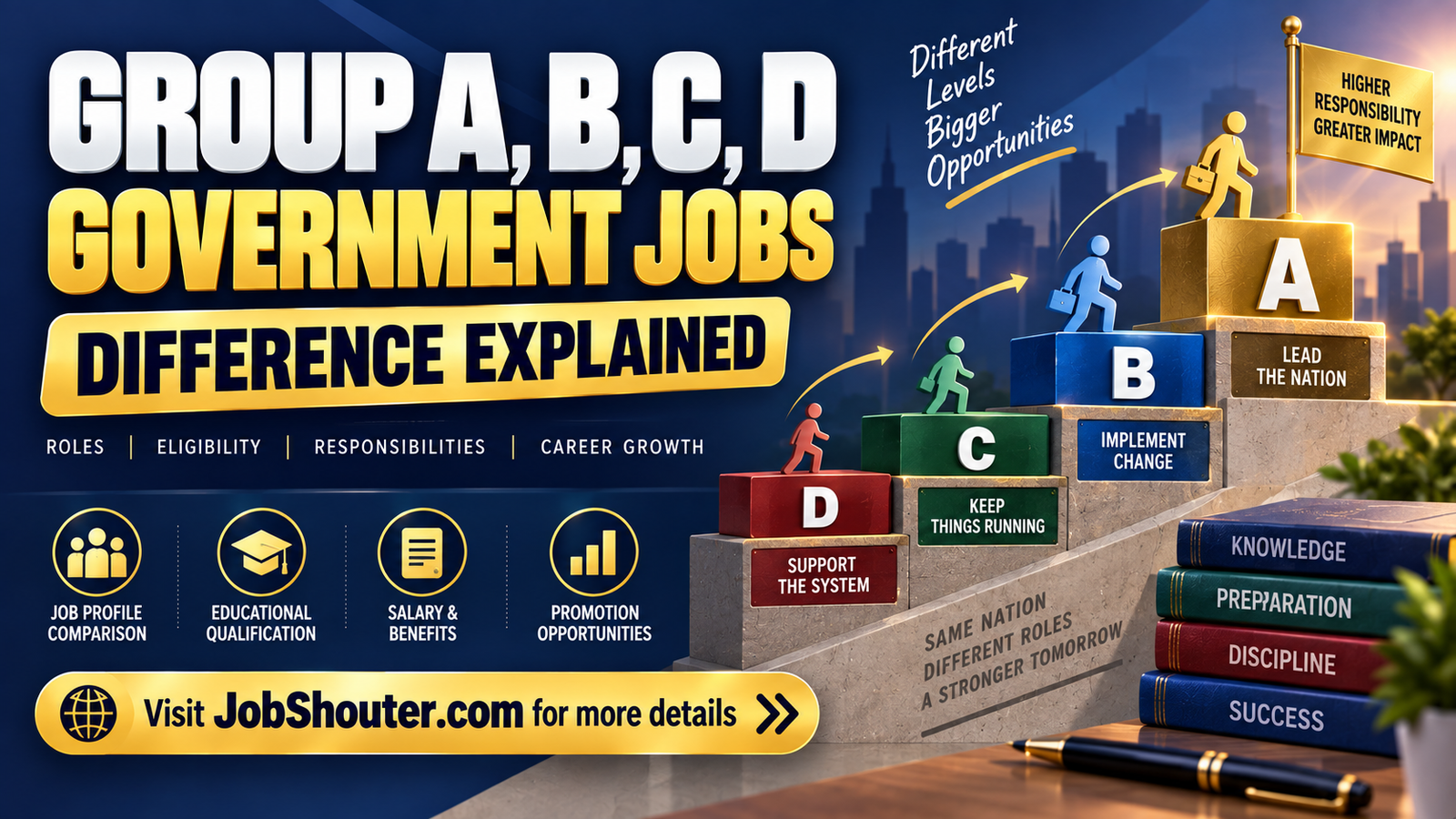
“Is this a Group A job or Group C job?” is a question almost every government exam aspirant runs into sooner or later, whether while filling an application form, reading a recruitment notification, or comparing two job offers. This guide explains the complete classification of government jobs in India into Group A, Group B, Group C, and the now largely phased-out Group D, covering pay levels, gazetted status, appointing authority, eligibility, recruiting exams, and real examples for each category.
What is Group Classification in Government Jobs
Government posts in India, both at the central and state level, are classified into groups based on the level of responsibility, pay scale, and administrative authority attached to the post. This classification determines the recruiting exam, the appointing authority, whether the post carries gazetted status, and the general career trajectory associated with it.
Group A, B, C, D: Complete Comparison Table
| Parameter | Group A | Group B | Group C | Group D (Now Merged into Group C) |
|---|---|---|---|---|
| Nature of Post | Senior administrative, managerial, and policy-making | Middle-management and supervisory | Clerical, secretarial, and technical support | Basic entry-level, manual/routine support |
| 7th CPC Pay Level | Level 10 to Level 18 | Level 6 to Level 9 | Level 1 to Level 5 | Level 1 (merged with Group C) |
| Approximate Pay Range | Rs. 56,100 to Rs. 2,50,000 | Rs. 35,400 to Rs. 1,12,400 | Rs. 19,900 to Rs. 81,100 | Starting from around Rs. 18,000 |
| Gazetted Status | All Group A posts are gazetted | Some posts gazetted, some non-gazetted, depending on specific recruitment rules | All non-gazetted | All non-gazetted |
| Educational Requirement | Graduation or higher, often with specialized qualification | Graduation typically required | 12th pass or graduation depending on the specific post | 8th or 10th pass |
| Typical Appointing Authority | President of India (for central Group A services) | Appropriate Ministry/Department or Head of Department, depending on gazetted/non-gazetted status | Head of Department or Head of Office | Head of Office |
Group A Government Jobs Explained
Group A posts represent the highest tier of government service in India, involving senior managerial, administrative, and policy-formulation responsibilities. All Group A posts are gazetted, meaning appointments to these posts are formally notified in the Official Gazette under the authority of the President of India for central services, or the Governor for certain state-level equivalents.
Examples of Group A Posts
Indian Administrative Service (IAS), Indian Police Service (IPS), Indian Foreign Service (IFS), and Indian Revenue Service (IRS) are classic examples of Group A services, along with various specialized Group A services such as Indian Engineering Services and Indian Economic Service.
Recruiting Exams for Group A
Group A posts are primarily recruited through the UPSC Civil Services Examination, along with specialized examinations such as the Indian Engineering Services Examination and other UPSC-conducted exams for technical and specialized Group A services.
Group B Government Jobs Explained
Group B posts occupy a middle-management tier, bridging senior Group A officers and the larger operational workforce in Group C. Unlike Group A, Group B posts are not uniformly gazetted; some Group B posts carry gazetted status while others are non-gazetted, and this depends entirely on the specific recruitment rules notified for that post rather than a blanket rule for the entire group.
Examples of Group B Posts
Income Tax Inspector, Section Officers in central ministries, Junior Engineers, and Assistant Section Officers are common examples of Group B posts, some of which are gazetted depending on the specific department and cadre rules.
Recruiting Exams for Group B
Group B posts are commonly recruited through the SSC Combined Graduate Level Examination (SSC CGL), UPSC-conducted examinations for certain services, and various State Public Service Commission examinations.
Group C Government Jobs Explained
Group C posts form the largest workforce segment within government service, covering clerical, secretarial, technical, and operational support roles across ministries, departments, and public sector organizations. All Group C posts are non-gazetted.
Examples of Group C Posts
Lower Division Clerk/Junior Secretariat Assistant, Data Entry Operator, Stenographer, Postal Assistant, Railway Group C technical and non-technical staff, and Multi-Tasking Staff are all examples of Group C posts.
Recruiting Exams for Group C
Group C posts are commonly recruited through SSC CGL, SSC CHSL, various RRB (Railway Recruitment Board) examinations such as RRB NTPC, and numerous state-level subordinate services selection commission examinations.
What Happened to Group D Government Jobs
Group D previously referred to the most basic, entry-level government posts involving manual and routine support tasks such as Peon, Sweeper, Watchman, and Helper, typically requiring only an 8th or 10th pass qualification. However, following the recommendations of the 6th Central Pay Commission, which were carried forward and implemented under the 7th Central Pay Commission, Group D as a separate classification was abolished, and all former Group D posts were merged into and upgraded to Group C status. As a result, in most current central government recruitment, you will no longer see a distinct “Group D” category, though the term is still commonly and informally used, especially in the context of railway recruitment such as RRB Group D, which technically now falls under Group C.
Gazetted vs Non-Gazetted: What is the Real Difference
Beyond pay and seniority, one of the most practically relevant differences between gazetted and non-gazetted status is the authority to attest documents. A gazetted officer, since their appointment is formally published in the Government Gazette, is empowered to certify photocopies of documents as true copies, attest photographs on official application forms, and sign character and identity verification certificates, an authority that non-gazetted employees, regardless of their pay or seniority, do not possess. This is why many government application forms specifically require attestation “by a Gazetted Officer” for documents like photographs and certificates.
Key Points to Remember
Understanding which group a post belongs to helps candidates set realistic expectations about pay, promotion trajectory, and the nature of day-to-day responsibilities before choosing which competitive exam to prepare for. It’s also worth remembering that within Group B specifically, gazetted status varies post to post, so candidates should check the specific recruitment notification rather than assuming all Group B jobs carry the same privileges. Since Group D has technically been phased out and merged into Group C, candidates should not be confused if a recruitment notification for what is popularly still called a “Group D” post, such as certain Railway posts, actually lists it under Group C classification.
Frequently Asked Questions (FAQs)
1. What is the pay level range for Group A government jobs?
Group A posts fall under Pay Level 10 to Level 18 of the 7th Pay Commission Pay Matrix, with pay ranging from approximately Rs. 56,100 to Rs. 2,50,000.
2. Are all Group B posts gazetted?
No, Group B posts can be either gazetted or non-gazetted depending on the specific recruitment rules of that post; it is not uniform across the entire group.
3. Does Group D still exist as a separate classification?
No, Group D was formally abolished and merged into Group C following recommendations carried forward from the 6th and 7th Central Pay Commissions, though the term is still informally used for certain posts.
4. What exams recruit for Group A posts?
Group A posts are primarily recruited through the UPSC Civil Services Examination and other specialized UPSC-conducted examinations.
5. What is the main practical difference between gazetted and non-gazetted officers?
The key practical difference is that gazetted officers can legally attest documents, certify photocopies, and sign verification certificates, while non-gazetted employees cannot.
6. Which exams recruit for Group C posts?
Group C posts are commonly recruited through SSC CGL, SSC CHSL, various RRB examinations, and state-level subordinate services commissions.
7. What is the minimum qualification required for Group C posts?
The minimum qualification for Group C posts ranges from 12th pass to graduation, depending on the specific post.
8. Who is the appointing authority for Group A posts?
For most central Group A services, the appointing authority is the President of India.
9. Is a Group B post always higher paying than a Group C post?
Generally yes, Group B posts carry a higher pay level range (Level 6 to 9) compared to Group C posts (Level 1 to 5), though individual post-wise pay can vary.
10. Can a Group C employee be promoted to a Group B or Group A post?
Yes, through departmental promotions, seniority, and in some cases by clearing specific competitive or Limited Departmental Examinations, Group C employees can be promoted into Group B, and in some career paths eventually into Group A roles.
Disclaimer: JobShouter.com is not affiliated with any government recruiting body. Shared for informational purposes only, please verify details on the official website.
Looking at railway jobs? See our RRB Group D salary guide
Want to know about IAS Officer Salary Structure