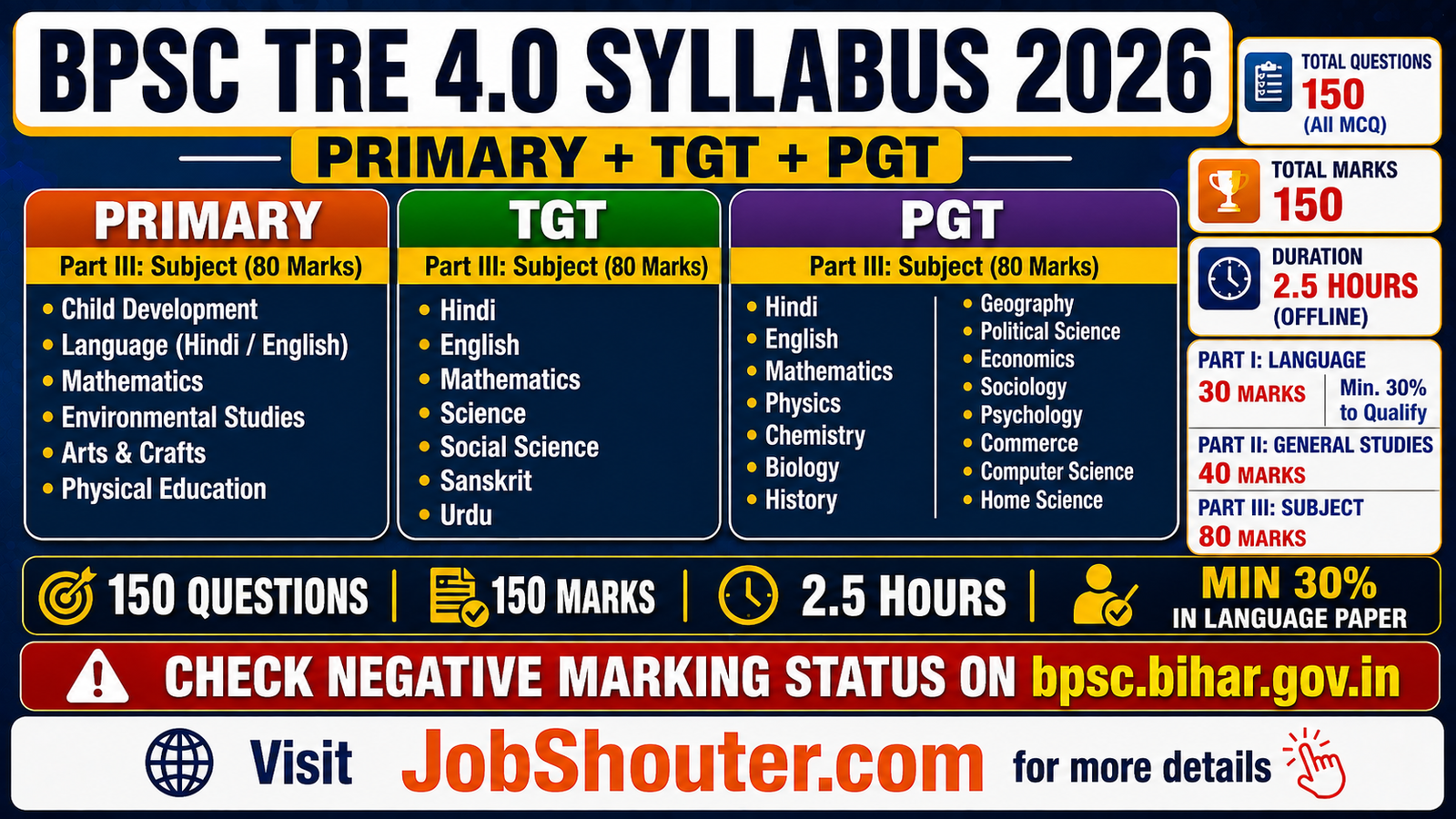
The Bihar Public Service Commission (BPSC) has released the official notification for the Bihar Teacher Recruitment Examination 4.0 (TRE 4.0) for 32,388 teacher posts across Primary, TGT (Class 9-10) and PGT (Class 11-12) levels. Understanding the syllabus and exam pattern is the first and most critical step before you begin preparation. This article gives you the complete BPSC TRE 4.0 Syllabus 2026 – Part I (Language), Part II (General Studies) and Part III (Concerned Subject options) – along with the exam pattern, qualifying criteria and targeted preparation tips for each level.
BPSC TRE 4.0 Exam Pattern 2026
The written examination is the same format across all three post levels – 150 multiple-choice questions for 150 marks, to be completed in 2 hours 30 minutes. The paper is divided into three parts. The exam is conducted in offline (pen and paper) mode.
The most important rule to know before you start: You must score a minimum of 30% in Part I (Language) – that is 9 out of 30 marks – to qualify. Failing Part I means disqualification regardless of your total score.
Primary/Middle School Teacher – Exam Pattern
| Part | Section | Questions | Marks |
|---|---|---|---|
| Part I | Language (English + Hindi/Urdu/Bangla) | 30 | 30 |
| Part II | General Studies (Mathematics, Reasoning, Awareness, Science, Social Studies, Geography, EVS, National Movement) | 40 | 40 |
| Part III | Concerned Subject – Mathematics or Science/Social Science/Hindi/English (choose one) | 80 | 80 |
| Total | 150 | 150 |
TGT (Class 9-10) – Exam Pattern
| Part | Section | Questions | Marks |
|---|---|---|---|
| Part I | Language (English + Hindi/Urdu/Bangla) | 30 | 30 |
| Part II | General Studies | 40 | 40 |
| Part III | Concerned Subject – Maths/Science/Hindi/English/Bangla/Urdu/Sanskrit/Arabic/Persian/Fine Arts/Dance/Physical Education/Maithili/Music/Social Science (choose one) | 80 | 80 |
| Total | 150 | 150 |
PGT (Class 11-12) – Exam Pattern
| Part | Section | Questions | Marks |
|---|---|---|---|
| Part I | Language (English + Hindi/Urdu/Bangla) | 30 | 30 |
| Part II | General Studies | 40 | 40 |
| Part III | Concerned Subject – Mathematics/Physics/Chemistry/Botany/Zoology/History/Political Science/Geography/Economics/Sociology/Psychology/Philosophy/Home Science/Computer Science/Commerce/Accountancy/Music/Entrepreneurship (choose one) | 80 | 80 |
| Total | 150 | 150 |
Key exam details:
- Mode: Offline (pen and paper)
- Duration: 2 hours 30 minutes (same for all posts)
- Qualifying condition: Minimum 30% in Part I (Language) – i.e. 9 out of 30 marks
- Category-wise overall qualifying marks: Not specified in the official notification
- Negative marking: Not confirmed in the official notification – check bpsc.bihar.gov.in for updates
- Selection process: Written Examination followed by Document Verification (no interview)
BPSC TRE 4.0 Syllabus 2026 – Part I: Language
Part I covers English (15 questions) and one of Hindi, Urdu or Bangla (15 questions) – candidates select the regional language option. Both sections together carry 30 marks with a mandatory minimum of 30% to qualify.
English
- Vocabulary and word meanings
- Noun, Pronoun, Verb, Adverb – parts of speech
- Grammar rules and usage
- Reading Comprehension passages
- Idioms and Phrases
Hindi/Urdu/Bangla (select one)
- Error identification in sentences
- Basic comprehension and writing ability
- Spelling correction
- Fill in the blanks – verb, preposition, article usage
- Vocabulary – synonyms and antonyms
- Sentence structure and completion
- Grammar
- Idiomatic use of words and phrases
Preparation tip: Part I is the qualifying gate for BPSC TRE 4.0. Even one marks below the 30% threshold (8 or fewer out of 30) means disqualification irrespective of your Part II and Part III performance. Do not neglect this section. Practice grammar rules and comprehension passages daily.
BPSC TRE 4.0 Syllabus 2026 – Part II: General Studies
Part II covers 40 questions across seven subject areas and carries 40 marks. The same topics apply across all three post levels (Primary, TGT and PGT).
Elementary Mathematics (General Studies)
- Number System
- Percentage
- Profit and Loss
- Simple and Compound Interest
- Time and Work
- Ratio and Proportion
- Average
- Problems Based on Ages
- Partnership
- Speed, Time and Distance
- Mixture and Alligation
- Algebra basics
- Mensuration
- Geometry
Mental Ability Test (Reasoning)
- Number Series and Letter Series
- Analogies
- Classification
- Blood Relations
- Coding and Decoding
- Direction Sense
- Ranking and Order
- Sitting Arrangement
- Verbal Classification
- Symbol Series
- Statement and Conclusion
- Statement and Assumption
- Syllogism
General Awareness
- India and its neighbouring countries
- History and Culture of India
- Geography of India and the World
- Economic developments and policy
- Indian Constitution and Polity
- Sports
- Current Affairs (national and international)
General Science
Physics: Physical World and Measurement, Force and Laws of Motion, Work, Energy and Power, Gravitation, Heat and Thermodynamics, Optics, Electrostatics, Current Electricity, Electromagnetic Waves, Atoms and Nuclei.
Chemistry: Structure of Atom, Periodic Classification of Elements, Acids, Bases and Salts, Metals and Non-Metals, States of Matter.
Biology: Plants and Animals (basic classification and characteristics), Skeleton System, Nervous System, Digestive System, Vitamins and Minerals.
Indian National Movement
- India on the eve of British conquest
- British conquest of Bengal; Anglo-Maratha and Anglo-Mysore struggles
- Expansion and consolidation of British power in India
- Resistance against the British before 1857; The Revolt of 1857 – causes, events, spread and leaders
- Beginning of modern nationalism; Foundation of Indian National Congress
- Era of Militant Nationalism (1905-1909); First phase of revolutionary activities (1907-1917)
- First World War and nationalist response
- Emergence of Mahatma Gandhi; Non-Cooperation Movement and Khilafat Andolan
- Relations of British India with neighbouring countries and the North-West Frontier
Social Science
- India and the Contemporary World (NCERT-level)
- Contemporary India – geography and resources
- Democratic Politics – political institutions and processes
- Understanding Economic Development
Geography and Environment
- Solar System, planets and the Earth
- Continents, mountains, plateaus and volcanoes
- Indian Geography – rivers, climate, natural resources
- Environment – ecology, pollution, conservation
- Human Geography – people, settlements and human activities
Preparation tip: Part II rewards breadth over depth. Study from NCERT Class 6-10 textbooks for Social Science, Science and Geography. For Mathematics, focus on speed and accuracy – these are standard aptitude-level questions, not advanced problems.
BPSC TRE 4.0 Syllabus 2026 – Part III: Concerned Subject
Part III carries 80 out of 150 marks and is the highest-weight section in the exam. The subject options differ by post level:
- Primary/Middle School: Mathematics or Science/Social Science/Hindi/English
- TGT (Class 9-10): Maths, Science, Hindi, English, Bangla, Urdu, Sanskrit, Arabic, Persian, Fine Arts, Dance, Physical Education, Maithili, Music, Social Science
- PGT (Class 11-12): Mathematics, Physics, Chemistry, Botany, Zoology, History, Political Science, Geography, Economics, Sociology, Psychology, Philosophy, Home Science, Computer Science, Commerce, Accountancy, Music, Entrepreneurship
The official BPSC TRE 4.0 notification does not list a separate topic-by-topic syllabus for each Concerned Subject paper. The general standard expected is:
- For Primary level – Class 1 to 8 content with pedagogical understanding
- For TGT level – up to Class 10 (Secondary) standard with teaching methodology
- For PGT level – up to Class 12 (Higher Secondary/graduation-entry) standard
Candidates must download the official BPSC TRE 4.0 notification and syllabus PDF from bpsc.bihar.gov.in for subject-specific detailed syllabi wherever published.
Preparation tip: Part III is where you win or lose this exam. Allocate the majority of your daily study time to your chosen Concerned Subject. Build deep conceptual understanding matched to the right class level for your post, and supplement with pedagogical knowledge (teaching methods, child development basics) for primary and TGT levels.
Key Preparation Strategies for BPSC TRE 4.0
Begin by mapping out all three parts on paper and assigning daily time blocks – more time for Part III, consistent revision sessions for Part II, and daily grammar/comprehension practice for Part I.
Target the 30% Part I qualifying mark first – this is non-negotiable. Candidates who underestimate the Language section often lose the chance to be ranked despite strong Part III scores.
For Part II General Studies, NCERT textbooks from Class 6 to 10 are the most efficient study material. Cover Science, Social Science, Geography and History in a single structured reading cycle.
For Mental Ability, solve 20-25 questions daily under timed conditions. Speed is the differentiator in MCQ-based reasoning sections.
For Part III Concerned Subject, use the standard textbooks for your subject at the appropriate class level (Class 8 for Primary, Class 10 for TGT, Class 12 for PGT). Supplement with previous years’ BPSC TRE question papers where available.
Practice full-length mock tests in the 2 hours 30 minutes offline format – marking answers on an OMR sheet (or simulating it) to build the stamina and time management habits the exam demands.
Check bpsc.bihar.gov.in regularly. The negative marking rule and category-wise overall qualifying marks were not confirmed in the official notification at the time of writing. These details may be updated before the exam and must be verified from the official PDF.
BPSC TRE 4.0 Syllabus 2026 – Important Links
| Description | Link |
|---|---|
| Official BPSC TRE 4.0 Syllabus and Notification PDF | Click Here |
| BPSC Official Website | Click Here |
Frequently Asked Questions – BPSC TRE 4.0 Syllabus 2026
What is the BPSC TRE 4.0 exam pattern for 2026?
The written exam has 150 MCQ questions for 150 marks in 2 hours 30 minutes, divided into Part I Language (30 marks), Part II General Studies (40 marks) and Part III Concerned Subject (80 marks). The same pattern applies to Primary, TGT and PGT posts. The exam is conducted in offline mode.
What is the qualifying criteria for Part I in BPSC TRE 4.0?
A minimum of 30% marks in Part I (Language) is mandatory – that is 9 out of 30 marks. Candidates who score below this threshold are disqualified from the overall result regardless of their total marks in Parts II and III.
What are the subject options in Part III for PGT posts?
PGT candidates can choose one from: Mathematics, Physics, Chemistry, Botany, Zoology, History, Political Science, Geography, Economics, Sociology, Psychology, Philosophy, Home Science, Computer Science, Commerce, Accountancy, Music and Entrepreneurship.
Is there negative marking in BPSC TRE 4.0?
The negative marking rule has not been confirmed in the official BPSC TRE 4.0 notification published at the time of writing. Candidates must check the latest official notification at bpsc.bihar.gov.in before the exam for confirmation.
What topics are covered in Part II General Studies?
Part II covers Elementary Mathematics, Mental Ability/Reasoning, General Awareness, General Science (Physics, Chemistry, Biology), Indian National Movement, Social Science and Geography/Environment – across 40 questions for 40 marks.
Is there an interview for BPSC TRE 4.0 selection?
No. The selection process for BPSC TRE 4.0 consists of the Written Examination followed by Document Verification only. There is no interview or personality test.
Where can I download the BPSC TRE 4.0 Syllabus PDF?
The official syllabus PDF is available on the BPSC website at bpsc.bihar.gov.in under the TRE 4.0 notification section.
What is the Part III syllabus for the Concerned Subject?
The official BPSC TRE 4.0 notification does not provide a separate detailed topic list for each Concerned Subject. The expected standard is Class 1-8 content for Primary, up to Class 10 for TGT, and up to Class 12 for PGT. Candidates must refer to the official PDF at bpsc.bihar.gov.in for any subject-specific syllabus additions.
Disclaimer: This article is based on the official BPSC TRE 4.0 notification and syllabus PDF released by the Bihar Public Service Commission (BPSC) for the Bihar Teacher Recruitment Examination 4.0. The negative marking rule and category-wise overall qualifying marks were not confirmed in the official notification at the time of writing and must be verified from the latest official document at bpsc.bihar.gov.in. Topic lists for Part III (Concerned Subject) are not separately detailed in the official notification; candidates must check the official BPSC syllabus PDF for subject-specific breakdowns. JobShouter.com is not associated with BPSC in any manner.