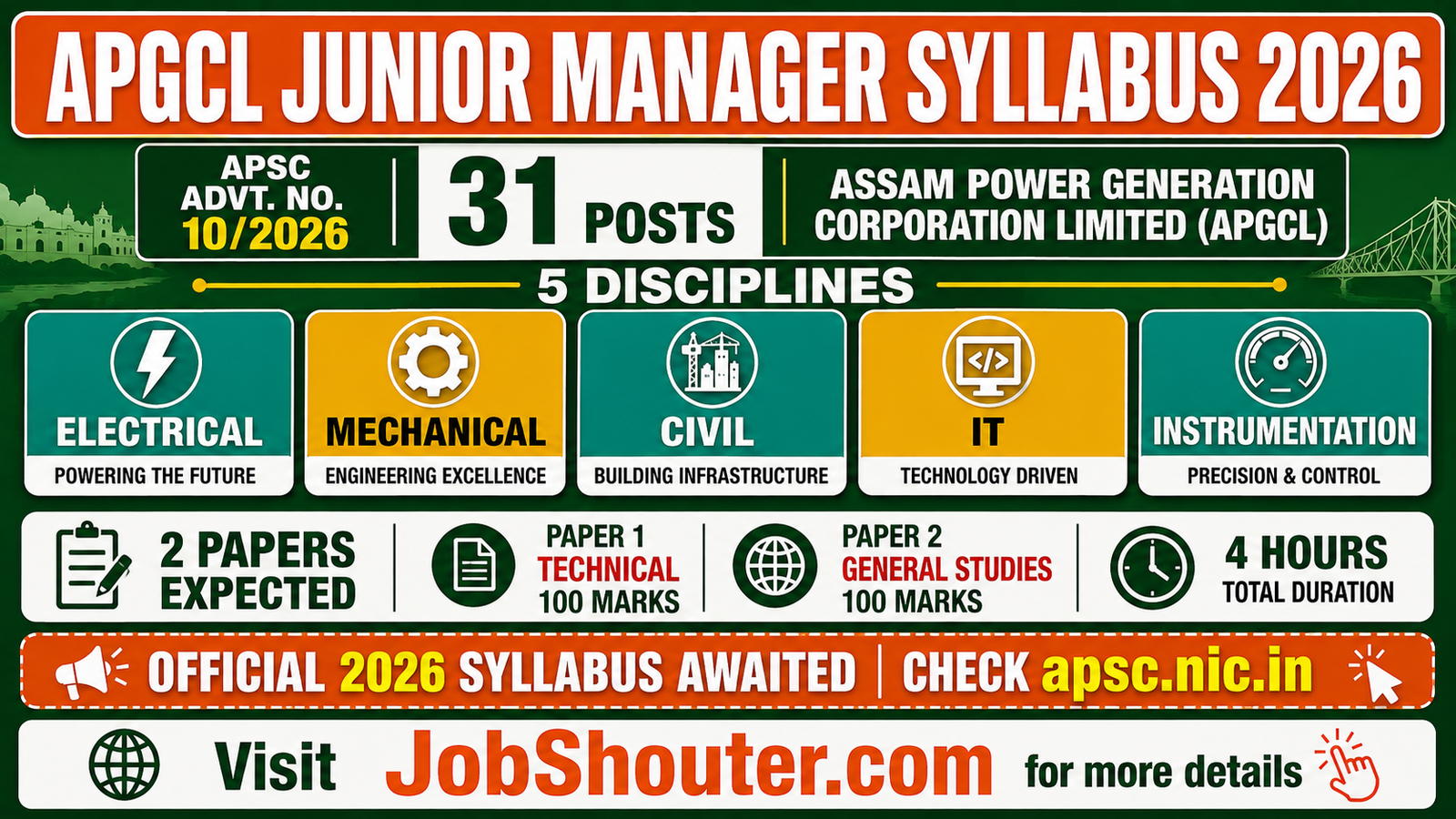
The Assam Public Service Commission (APSC) has released Advertisement No. 10/2026 for 31 Junior Manager posts in the Assam Power Generation Corporation Limited (APGCL) across five engineering disciplines – Electrical, Mechanical, Civil, Information Technology and Instrumentation. Candidates who have applied or plan to apply need to understand what they should be studying. This article covers the confirmed selection process as released by APSC, the expected exam pattern based on the previous APGCL/AEGCL Junior Manager recruitment cycle, and discipline-wise probable topic lists to help you begin preparation without delay. The official 2026 syllabus and detailed exam pattern have not yet been separately notified by APSC – keep checking apsc.nic.in for updates.
About APGCL and This Recruitment
APGCL (Assam Power Generation Corporation Limited) is the state government entity responsible for power generation in Assam. The Junior Manager post is a diploma-level engineering position. The recruitment is conducted by APSC (Assam Public Service Commission) under Advertisement No. 10/2026. The five disciplines covered are Electrical (highest vacancy count), Mechanical, Civil, Information Technology and Instrumentation.
APGCL Junior Manager Selection Process 2026
APSC has confirmed the following potential stages, with the final structure depending on the number of applications received:
Stage 1 – Screening Examination (Conditional): If the number of applicants is very high, APSC may conduct a screening test to shortlist candidates for the main Written Examination. This stage is not guaranteed – it depends entirely on application volume.
Stage 2 – Written Examination: The primary selection stage. Expected to test technical knowledge in the candidate’s chosen discipline and general studies. The exact pattern for 2026 has not yet been officially released.
Stage 3 – Interview/Viva-Voce: Candidates who qualify the Written Examination are called for an interview.
Stage 4 – Document Verification: Verification of educational qualifications, age, category and other certificates.
Stage 5 – Medical Examination: Where applicable before final appointment.
Candidates must check apsc.nic.in regularly as the finalised selection process and exam pattern will be published there.
Expected Exam Pattern (Based on Previous APGCL/AEGCL Junior Manager Cycle)
Important disclaimer: The exam pattern below is based on the previous APGCL and AEGCL Junior Manager examinations from the 2023 recruitment cycle. APSC has not yet released the official exam pattern for Advertisement No. 10/2026. These details may be revised. Treat this as a probable pattern and verify against the official notice once published.
| Paper | Subject | Marks | Duration |
|---|---|---|---|
| Paper I | Concerned Engineering Discipline (Technical) | 100 | 2 hours |
| Paper II | General Studies | 100 | 2 hours |
| Total | 200 | 4 hours |
Expected General Studies Paper breakdown (based on previous cycle):
| Subject | Expected Marks |
|---|---|
| General English | 25 |
| General Aptitude and Emotional Intelligence | 50 |
| General Knowledge and Current Affairs | 25 |
| Total | 100 |
Negative marking rule and category-wise qualifying marks for the 2026 cycle: not confirmed in the official notification. Do not assume they are the same as the previous cycle without verification.
Probable Syllabus – Discipline-Wise Technical Topics
The topics below are drawn from the previous APGCL/AEGCL Junior Manager 2023 examination. They should be used as a preparation reference while awaiting the official 2026 syllabus. Start with these if you are preparing now – revise when the official syllabus is released.
Electrical Engineering
Basic Electrical Engineering: Ohm’s Law, Kirchhoff’s Laws, Faraday’s Law, Thevenin’s and Norton’s Theorems, Maximum Power Transfer Theorem, EMF, loop and node analysis, resistance/inductance/capacitance, magnetic circuits, electromagnetic induction, transformers, generators and motors, measuring instruments, semiconductors and diodes.
Electrical Circuits: Phasor algebra, polyphase circuits, star-delta transformation, network theorems, RLC resonance, mesh and node analysis.
Electrical Engineering Materials: Conducting, insulating and magnetic materials – properties and applications.
Electrical Instruments and Measurements: Measurement principles, instrument classification, accuracy, shunts and multipliers, resistance measurement, AC bridges, multimeters, power factor meters.
Electrical Machines: DC machines, excitation systems, speed control and efficiency, transformer voltage regulation, three-phase induction and synchronous motors, single-phase motors.
Generation, Transmission and Distribution: Thermal, hydel and nuclear power plants, transmission line parameters, corona effect, distribution systems, substations, earthing, circuit breakers, protective relays.
Electrical Estimation and Costing: Residential and industrial installations, UPS and DG sets, cost estimation, tender preparation.
Power Electronics: Power diodes, thyristors, firing circuits, controlled/uncontrolled rectifiers, power MOSFETs.
Digital Electronics: Logic gates, Boolean algebra, multiplexers and demultiplexers, flip-flops, counters, A/D and D/A conversion.
Mechanical Engineering
Engineering Mechanics and Strength of Materials: Force systems, equilibrium, friction, stress-strain, Hooke’s Law, shear force and bending moment diagrams, torsion, columns, theories of failure.
Engineering Materials: Classification, heat treatment, alloys, corrosion, material testing.
Design of Machine Elements: Design fundamentals, factor of safety, riveted and welded joints, shafts, keys, couplings, gears, brakes and clutches.
Hydraulics and Hydraulic Machines: Fluid properties, Bernoulli’s equation, flow through pipes, turbines, centrifugal and reciprocating pumps.
Thermal Engineering: Laws of thermodynamics, steam boilers and turbines, IC engines, refrigeration and air conditioning, heat transfer.
Theory of Machines: Kinematics, cam mechanisms, governors, balancing, vibrations, flywheels.
Production and Industrial Engineering: Casting, forming and welding processes, machining, metrology, CNC basics, production planning, quality control, industrial safety.
Civil Engineering
Strength of Materials and Theory of Structures: Stress and strain, bending and shear, Mohr’s Circle, columns, slope and deflection, trusses and arches.
Water Resources Engineering: Hydrology, runoff and flood analysis, reservoir routing, irrigation systems, canal design.
Fluid Mechanics: Fluid properties, pressure measurement, flow equations, open channel flow.
Geotechnical Engineering: Soil classification and properties, permeability, consolidation, shear strength, foundations.
Highway and Railway Engineering: Geometric design, pavement design, traffic studies, railway track components.
Surveying: Contouring, theodolite surveying, tacheometry, total station surveying.
Structural Design: Working stress and limit state methods, RCC beam and slab design, steel structure connections.
Environmental Engineering: Water quality and treatment, sewage characteristics and treatment, population forecasting.
Information Technology
Object Oriented Programming (C++): Classes, objects, inheritance, polymorphism, encapsulation.
Database Management Systems (DBMS): Database models, ER diagrams, normalization, SQL, transaction processing.
Operating Systems: Process management, scheduling, memory management, file systems.
Data Structures and Algorithms: Sorting and searching, stacks, queues, linked lists, trees and graphs.
Microprocessors: Basics and instruction sets of 16-bit microprocessors, assembly programming.
Data Communication and Networks: Topologies, OSI and TCP/IP models, communication protocols.
Computer Organization: Addressing modes, CPU and memory organization.
Basic Electronics: Number systems, logic gates, flip-flops, semiconductors.
Software Development and Hardware Maintenance: SDLC basics, testing fundamentals, hardware troubleshooting.
Instrumentation Engineering
Electrical Circuits: Circuit laws, network theorems, RLC circuits, resonance.
Signals and Systems: Fourier series, Laplace and Z-transforms, sampling theorem.
Control Systems: Transfer functions, time and frequency domain analysis, stability criteria, PID controllers.
Analog and Digital Electronics: Semiconductor devices, amplifiers, oscillators, logic gates and flip-flops.
Measurements: Error analysis, transducers, calibration, data acquisition.
Sensors and Industrial Instrumentation: Temperature, pressure, flow and level measurement, PLC fundamentals.
Communication and Optical Instrumentation: Analog/digital communication basics, optical fibres and sensors.
Probable Syllabus – General Studies Paper (Common to All Disciplines)
General English
Sentence completion and improvement, error spotting, synonyms and antonyms, idioms and phrases, fill in the blanks, basic grammar.
General Aptitude and Emotional Intelligence
Number series, analogies, classification, direction sense, distance problems, verbal and non-verbal reasoning, time and distance, models of emotional intelligence (Bar-On, Genos), EQ in professional and workplace contexts.
General Knowledge and Current Affairs
National and international current affairs (last 6 months), Assam-specific current affairs and state government developments, sports, books and authors, awards and recognitions, science and technology developments.
Preparation note: Assam-specific GK is a distinguishing feature of APSC examinations. Give it dedicated preparation time separate from national current affairs.
How to Prepare While the Official Syllabus Is Still Awaited
The most productive approach right now is to begin core technical revision without waiting for the official syllabus. The Electrical, Mechanical, Civil, IT and Instrumentation topics listed above are broadly consistent with diploma-level curriculum and APSC examination patterns for similar posts.
Start with your core engineering diploma textbooks and revise fundamental concepts in your discipline. These form the base of any technical paper in APSC PSU recruitment exams and are unlikely to change significantly even when the 2026 official syllabus is released.
For General Studies, build a daily habit of reading Assam-specific current affairs alongside national news. APSC examinations for state PSU posts consistently include a higher proportion of Assam-focused GK than national-level exams.
Strengthen General Aptitude through daily timed practice on reasoning and numerical topics. The Emotional Intelligence component in the GS paper is often underestimated – read the basics of emotional intelligence models and their workplace application.
Once APSC releases the official 2026 syllabus on apsc.nic.in, compare it against this topic list, identify any additions or changes, and adjust your preparation accordingly. Do not restart from scratch – treat the official syllabus as a refinement of your existing preparation plan.
APGCL Junior Manager Syllabus 2026 – Important Links
| Description | Link |
|---|---|
| Official APSC Notification and Syllabus (when released) | Click Here |
| APSC Official Website | Click Here |
| APSC Recruitment Portal | Click Here |
Frequently Asked Questions – APGCL Junior Manager Syllabus 2026
Has the official APGCL Junior Manager Syllabus 2026 been released?
Not yet as a separate detailed document. APSC released Advertisement No. 10/2026 for 31 Junior Manager posts in APGCL but has not yet published a separate detailed syllabus and exam pattern notice for the 2026 cycle. The topic lists in this article are based on the previous 2023 recruitment cycle and should be treated as a probable reference until the official 2026 notice is released on apsc.nic.in.
What is the expected exam pattern for APGCL Junior Manager 2026?
Based on the previous APGCL/AEGCL Junior Manager cycle, the exam is expected to have two papers – Paper I covering the candidate’s engineering discipline (100 marks, 2 hours) and Paper II covering General Studies (100 marks, 2 hours) – for a total of 200 marks in 4 hours. This has not been officially confirmed for 2026 and may be revised.
What is the selection process for APGCL Junior Manager 2026?
Depending on the number of applications received, APSC may conduct a Screening Examination, followed by a Written Examination, Interview/Viva-Voce, Document Verification and Medical Examination. The detailed final process will be announced by APSC on apsc.nic.in.
What disciplines are covered in APGCL Junior Manager Recruitment 2026?
Five engineering disciplines: Electrical, Mechanical, Civil, Information Technology and Instrumentation. Candidates apply and are examined in their specific discipline.
What are the best study materials for APGCL Junior Manager preparation?
Diploma-level textbooks in your specific engineering discipline are the primary resource for the Technical paper. For General Studies, combine standard aptitude preparation materials with Assam-specific current affairs and GK resources, since APSC exams consistently include state-focused questions.
Is there negative marking in APGCL Junior Manager 2026?
The negative marking rule for the 2026 cycle has not been confirmed in the official notification. Candidates must check the official exam pattern notice once released on apsc.nic.in before making assumptions based on the previous cycle.
Disclaimer: This article is based on APSC Advertisement No. 10/2026 for APGCL Junior Manager posts and the previous APGCL/AEGCL Junior Manager (2023) examination pattern. The official exam pattern, detailed syllabus, negative marking rule and qualifying marks for the 2026 cycle have NOT yet been released by APSC. The exam pattern and topic lists in this article are probable references drawn from the previous cycle and may change. Candidates must check apsc.nic.in for the official 2026 syllabus and exam pattern once published. JobShouter.com is not associated with APSC or APGCL in any manner.