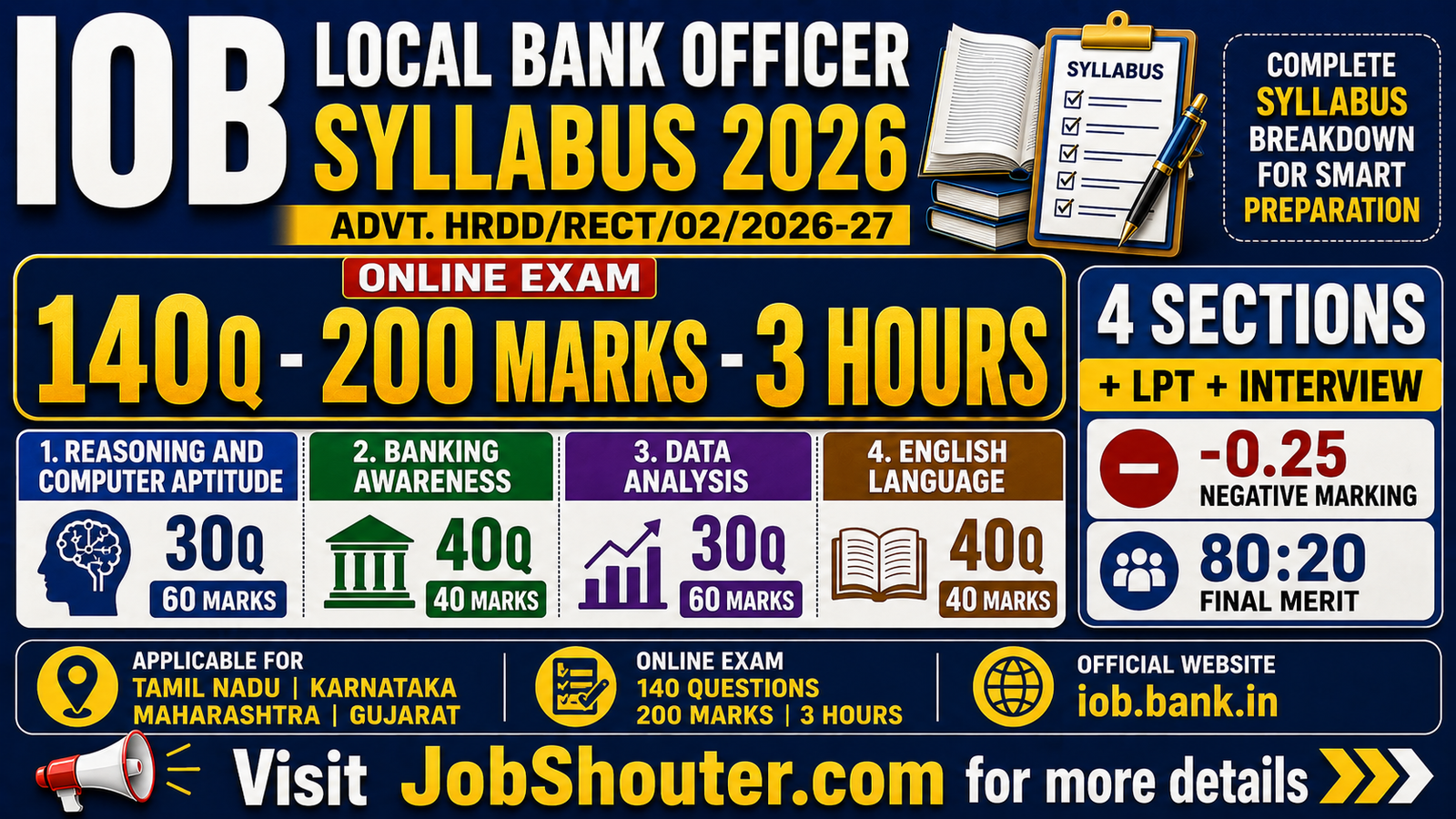
The Indian Overseas Bank (IOB) has notified the selection process for Local Bank Officer (LBO) Recruitment 2026-27 under Advertisement No. HRDD/RECT/02/2026-27 dated 07 August 2026. The selection involves an Online Examination (140 questions, 200 marks, 3 hours), a Language Proficiency Test (LPT) for candidates who have not studied the local language up to Std. X/XII, and a Personal Interview (100 marks). The final merit is based on an 80:20 ratio between the Online Exam and the Interview. The Online Examination consists of four sections – Reasoning and Computer Aptitude (30 questions, 60 marks, 60 minutes), General/Economy/Banking Awareness (40 questions, 40 marks, 30 minutes), Data Analysis and Interpretation (30 questions, 60 marks, 60 minutes), and English Language (40 questions, 40 marks, 30 minutes). The LBO examination is applicable for four states – Tamil Nadu (Tamil), Karnataka (Kannada), Maharashtra (Marathi), and Gujarat (Gujarati) – with each state having a separate merit list. The last date to apply is 24 August 2026 at iob.bank.in. Understanding the complete syllabus and exam pattern is essential since this is a targeted exam with high competition per vacancy in each state-language cadre.
Important Note: Three things every IOB LBO 2026 aspirant must factor into their preparation before 24 August 2026. First, the Online Exam has sectional time limits – each section has a fixed duration (60 minutes for Reasoning and Computer Aptitude, 30 minutes for Banking Awareness, 60 minutes for Data Analysis, 30 minutes for English) and you cannot spend extra time from one section on another; practise within these time constraints from day one. Second, the Language Proficiency Test (LPT) is a qualifying gate for candidates who have not studied the local language in Std. X or Std. XII – failing the LPT means no further consideration regardless of Online Exam performance; if you are in this category, begin language proficiency practice immediately alongside exam preparation. Third, negative marking is 0.25 per wrong answer in the Online Exam – unattempted questions carry no penalty, so if you are uncertain about an answer it may be safer to skip than to guess.
IOB LBO Recruitment 2026-27 – Overview
| Particulars | Details |
|---|---|
| Organisation | Indian Overseas Bank (IOB) |
| Advertisement No. | HRDD/RECT/02/2026-27 dated 07 August 2026 |
| Post | Local Bank Officer (LBO) – JMGS-I (Scale I) |
| Total Vacancies | 250 (Tamil Nadu-100, Karnataka-50, Maharashtra-50, Gujarat-50) |
| Online Exam Date | To be announced at iob.bank.in |
| Last Date to Apply | 24 August 2026 |
| Official Website | iob.bank.in |
IOB LBO Selection Process
| Stage | Details | Counts for Final Merit? |
|---|---|---|
| Online Examination | 140 questions, 200 marks, 3 hours | 80% weightage |
| Language Proficiency Test (LPT) | For candidates who have NOT studied local language in Std. X/XII – qualifying only | Qualifying – must pass to proceed |
| Personal Interview | 100 marks | 20% weightage |
Final Score Formula: Online Exam marks (80%) + Personal Interview marks (20%)
Minimum qualifying aggregate: 30% for reserved categories; 35% for unreserved (General/EWS)
IOB LBO Online Exam Pattern
| Section | Questions | Maximum Marks | Duration | Medium |
|---|---|---|---|---|
| Reasoning and Computer Aptitude | 30 | 60 | 60 minutes | English and Hindi |
| General/Economy/Banking Awareness | 40 | 40 | 30 minutes | English and Hindi |
| Data Analysis and Interpretation | 30 | 60 | 60 minutes | English and Hindi |
| English Language | 40 | 40 | 30 minutes | English only |
| Total | 140 | 200 | 180 minutes (3 hours) |
Negative Marking
| Answer Type | Marks |
|---|---|
| Correct Answer | Full marks for that question |
| Wrong Answer | -0.25 marks (1/4th of marks) |
| Unattempted | 0 (no deduction) |
IOB LBO Syllabus – Section-wise
Section 1 – Reasoning and Computer Aptitude (30 Questions, 60 Marks, 60 Minutes)
This section tests logical and analytical reasoning combined with basic computer aptitude. Marks per question: 2 marks each (hence 60 marks for 30 questions).
Reasoning Topics:
- Puzzles and seating arrangements (linear, circular, floor/flat-based)
- Syllogism (new pattern and old pattern)
- Coding and decoding
- Blood relations
- Direction and distance
- Data sufficiency (statement-based reasoning)
- Input-output
- Inequality
- Order and ranking
- Logical reasoning – statement and argument/conclusion/inference
- Machine input/output
- Alphanumeric series
Computer Aptitude Topics:
- Basics of computers – hardware, software, input/output devices
- Operating systems – Windows, basic concepts
- MS Office – Word, Excel, PowerPoint basics
- Internet and network basics – browsers, email, networking terms
- Database basics – concepts, DBMS
- Computer abbreviations and terminology (RAM, ROM, CPU, BIOS, etc.)
- Cybersecurity basics and malware types
- Computer generation and history
- Number systems and binary basics
Section 2 – General/Economy/Banking Awareness (40 Questions, 40 Marks, 30 Minutes)
This section tests current affairs, the Indian economy, and banking and financial awareness. Marks per question: 1 mark each.
Banking and Financial Awareness:
- Banking system in India – RBI, scheduled commercial banks, cooperative banks, RRBs
- Functions of RBI, monetary policy, CRR, SLR, repo rate, reverse repo rate, bank rate, MSF
- Financial inclusion schemes – PM Jan Dhan Yojana, MUDRA, Stand Up India, Startup India
- NABARD, SIDBI, NHB, EXIM Bank – roles and functions
- Banking regulations – Banking Regulation Act, RBI Act
- Payment systems – UPI, IMPS, RTGS, NEFT, NACH
- Digital banking and financial technology – mobile banking, internet banking
- Government schemes related to banking and finance
- NPA (Non-Performing Assets), priority sector lending norms
- Negotiable instruments – cheque, demand draft, promissory note
- Basel norms and capital adequacy
- CIBIL, credit ratings and credit bureaus
- Insurance – IRDA, types of insurance products, LIC, general insurance
- Capital markets – SEBI, stock exchanges, mutual funds, IPO, FPO
- Indian budget, fiscal policy, taxation basics (GST, direct and indirect taxes)
- IMF, World Bank, ADB, BRICS, G20
General Economy:
- Indian economy – GDP, GNP, GDP growth rate, per capita income
- Inflation, WPI, CPI, index numbers
- Economic planning and NITI Aayog
- Agriculture and rural economy – MSP, crop insurance schemes, Kisan Credit Card
- Industry, MSME, Make in India
- Trade – exports, imports, balance of payments, foreign exchange reserves
Current Affairs (Last 6-12 Months):
- Banking and financial news – RBI announcements, bank mergers, new schemes
- Government of India schemes and programmes
- International organisations – appointments, summits, agreements
- Awards, sports achievements, books and authors
- New appointments to constitutional posts, RBI, government committees
- Economic survey highlights, union budget key announcements
- News about the four IOB LBO states – Tamil Nadu, Karnataka, Maharashtra, Gujarat
Section 3 – Data Analysis and Interpretation (30 Questions, 60 Marks, 60 Minutes)
This section tests quantitative ability through data sets and graph analysis. Marks per question: 2 marks each. This is the highest-marks-per-question section and requires both speed and accuracy.
Data Interpretation (DI) Topics:
- Bar graph (single and double) – absolute values and percentage-based questions
- Line graph – trends, comparison, percentage change
- Pie chart – proportion, percentage, value calculation
- Table-based DI – two-way tables, missing data
- Radar/spider chart
- Mixed graph (combination of two chart types)
- Caselet DI (paragraph-based data with 5 questions)
Quantitative Aptitude Topics:
- Number series (missing number, wrong number in series)
- Simplification and approximation (BODMAS, fractions, decimals, surds)
- Quadratic equations
- Average, mean, median, mode
- Ratio and proportion, partnership
- Percentage, profit and loss, discount
- Simple and compound interest
- Time and work, pipes and cisterns
- Speed, time and distance, trains, boats and streams
- Mixtures and allegations
- Probability
- Permutation and combination
- Mensuration – area, perimeter, volume (2D and 3D figures)
- Data sufficiency (quantitative)
Section 4 – English Language (40 Questions, 40 Marks, 30 Minutes)
This section tests reading comprehension, grammar, vocabulary, and verbal ability. Medium is English only. Marks per question: 1 mark each.
Reading Comprehension:
- Passage-based questions (5-10 questions per passage, 1-2 passages)
- Inference-based, vocabulary-based (synonyms, antonyms from passage), title/theme-based, tone and attitude questions
Grammar and Usage:
- Error spotting – find grammatical errors in sentence parts
- Sentence correction – choose the grammatically correct option
- Fill in the blanks – single blank and double blank (vocabulary and grammar)
- Phrase replacement / sentence improvement
- Active and passive voice
- Direct and indirect speech
Vocabulary:
- Synonyms and antonyms
- Cloze test (fill in multiple blanks in a passage)
- Word usage/meaning in context
- Idioms and phrases
- One-word substitution
Verbal Ability:
- Para jumbles – arrange sentences to form a coherent paragraph
- Sentence rearrangement
- Odd sentence out (in a paragraph/jumble)
- Word/sentence connectors
Language Proficiency Test (LPT) – What You Need to Know
The LPT tests proficiency (reading, writing, and speaking) in the local language of the state applied for:
| State | Language Tested |
|---|---|
| Tamil Nadu | Tamil |
| Karnataka | Kannada |
| Maharashtra | Marathi |
| Gujarat | Gujarati |
Who must appear: Candidates who have NOT studied the local language as a subject in Std. X or Std. XII must qualify the LPT. Candidates who produce a Std. X or XII certificate showing the local language as a studied subject are exempted.
Consequence of failing: Failing the LPT means no further consideration for the Personal Interview or final selection, regardless of Online Exam score.
What to practise:
- Basic reading – newspapers, simple texts, official documents in the local language
- Basic writing – sentences, short paragraphs, official communication in local language
- Speaking – conversational ability, understanding spoken language
Personal Interview – 100 Marks
The Personal Interview carries 100 marks with a minimum qualifying score of 50% for unreserved (General/EWS) candidates and 45% for reserved category candidates.
Topics typically covered in Bank Scale-I Interview:
- Banking concepts and current banking news
- IOB’s history, products, services, CSR initiatives
- Economy and financial markets
- Your graduation subject and how it relates to banking
- General awareness and current affairs
- Soft skills – communication, confidence, leadership, situational judgment
- Why banking, why IOB, career goals
Preparation Tips – IOB LBO 2026
- Prioritise the high-marks sections first: Reasoning and Computer Aptitude (60 marks) and Data Analysis and Interpretation (60 marks) together account for 120 out of 200 marks – master these two sections above all others.
- Banking Awareness is compulsory reading: The 40-question Banking Awareness section is pure knowledge – no calculation – and can be maximised through daily reading of RBI announcements, the Business Standard or Economic Times, and a dedicated banking awareness preparation guide for 2026.
- Sectional time limits are non-negotiable: Practise timed full-length mock tests with the exact sectional time limits (60-30-60-30 minutes) from Week 1 of preparation. Time management within sections is the key differentiator in the final exam.
- English Language is 1 mark per question: Since English carries only 1 mark per question vs 2 marks in Reasoning and DA, attempt English efficiently after securing your marks in the 2-mark sections. Focus on the vocabulary and cloze test questions as they are faster than long RC passages.
- Negative marking discipline: Attempt questions you know confidently. For uncertain questions – especially in the 1-mark sections (Banking Awareness and English) – unattempting is safer than guessing. In the 2-mark sections (Reasoning and DA), one wrong answer costs you 2.25 marks in net terms.
- Start local language preparation on day one: If you must appear for the LPT, practise reading a local language newspaper daily. The LPT is a pass/fail gate – no amount of Online Exam marks can save you if you fail the language test.
- For Interview preparation: Practise with banking current affairs from the last 6 months; prepare 2-minute answers on “Tell me about yourself,” “Why banking,” and “Why IOB”; practise in the local state language if you are going to the LPT stage, as interviewers may speak to you in the local language.
Important Links
| Description | Link |
|---|---|
| Official Notification PDF (Advt. No. HRDD/RECT/02/2026-27) | Click Here |
| Apply Online – IOB LBO 2026-27 | Click Here |
| IOB Official Website | Click Here |
IOB LBO Syllabus 2026 – FAQs
Q1. What is the exam pattern for IOB LBO 2026?
✅ The IOB LBO Online Examination has 140 objective questions for 200 marks in 3 hours, divided into 4 sections with sectional time limits – Reasoning and Computer Aptitude (30Q, 60M, 60 min), General/Economy/Banking Awareness (40Q, 40M, 30 min), Data Analysis and Interpretation (30Q, 60M, 60 min), and English Language (40Q, 40M, 30 min). Negative marking of -0.25 applies per wrong answer.
Q2. Is there negative marking in IOB LBO exam?
✅ Yes. -0.25 marks (1/4th of the marks allotted to that question) are deducted for each wrong answer. There is no deduction for unattempted questions. This applies to all four sections.
Q3. What is the syllabus for Reasoning and Computer Aptitude in IOB LBO?
✅ Reasoning topics include puzzles, seating arrangements, syllogism, coding-decoding, blood relations, directions, data sufficiency, input-output, inequalities, order and ranking, and logical reasoning. Computer Aptitude covers hardware/software basics, MS Office, internet basics, database concepts, computer terminology, cybersecurity, and number systems.
Q4. What is the syllabus for Data Analysis and Interpretation in IOB LBO?
✅ Data Interpretation (bar graphs, line graphs, pie charts, tables, caselet DI, mixed charts) and Quantitative Aptitude topics including number series, simplification, quadratic equations, percentages, ratio, profit and loss, interest, time and work, speed and distance, probability, permutation and combination, and mensuration.
Q5. What is the Language Proficiency Test (LPT) in IOB LBO?
✅ The LPT tests reading, writing, and speaking proficiency in the local language of the applied state (Tamil/Kannada/Marathi/Gujarati). It is required only for candidates who have NOT studied the local language in Std. X or XII. Failing the LPT disqualifies the candidate from the Interview regardless of Online Exam performance.
Q6. What is the weightage of the Online Exam vs Interview in IOB LBO?
✅ The final merit is based on Online Exam: 80% weightage and Personal Interview: 20% weightage. The minimum qualifying marks for the Interview are 50% for unreserved candidates and 45% for reserved categories. The minimum qualifying aggregate (combined) is 35% for unreserved and 30% for reserved.
Q7. What topics should I focus on for Banking Awareness in IOB LBO?
✅ Focus on RBI functions and monetary policy, banking regulations and acts, government financial inclusion schemes, payment systems (UPI, NEFT, RTGS), NPA norms, Basel norms, SEBI and capital markets, insurance regulation, current affairs from the last 6-12 months including banking news, and specific news about Tamil Nadu/Karnataka/Maharashtra/Gujarat (the four LBO states).
Q8. How many questions are there in the English section of IOB LBO?
✅ The English Language section has 40 questions for 40 marks (1 mark each) with a 30-minute time limit. Topics include reading comprehension, error spotting, sentence correction, fill in the blanks, cloze test, para jumbles, and vocabulary.
Q9. What is the minimum qualifying mark for the IOB LBO Online Exam?
✅ Minimum qualifying aggregate marks in the Online Exam are 35% for unreserved (General/EWS) candidates and 30% for reserved category (SC/ST/OBC) candidates. There is no sectional cut-off specified in the notification; only an overall aggregate minimum applies.
Q10. How should I prepare for the IOB LBO Personal Interview?
✅ Prepare for the Interview by covering banking current affairs from the last 6 months, IOB’s history, products, and services, Indian economy and RBI policy updates, your academic background and its relevance to banking, and soft skills (communication, confidence, situational judgment). Practice answering in English and, where needed, in the local language of your applied state, as interviewers may converse in the local language.
Disclaimer
The information above on the IOB LBO Syllabus 2026 is compiled based on the official IOB Local Bank Officer Recruitment 2026-27 notification (Advertisement No. HRDD/RECT/02/2026-27 dated 07 August 2026), issued by Indian Overseas Bank (IOB), Central Office, 763, Anna Salai, Chennai – 600002, as available on iob.bank.in. The exact marks distribution within each section (marks per question) is as stated in the official notification. The subject-wise syllabus topics listed above are based on the IOB LBO exam pattern and standard banking exam syllabi – candidates must also refer to the official notification at iob.bank.in for the authoritative and complete selection process details. All links above lead only to the official IOB website and application portal.