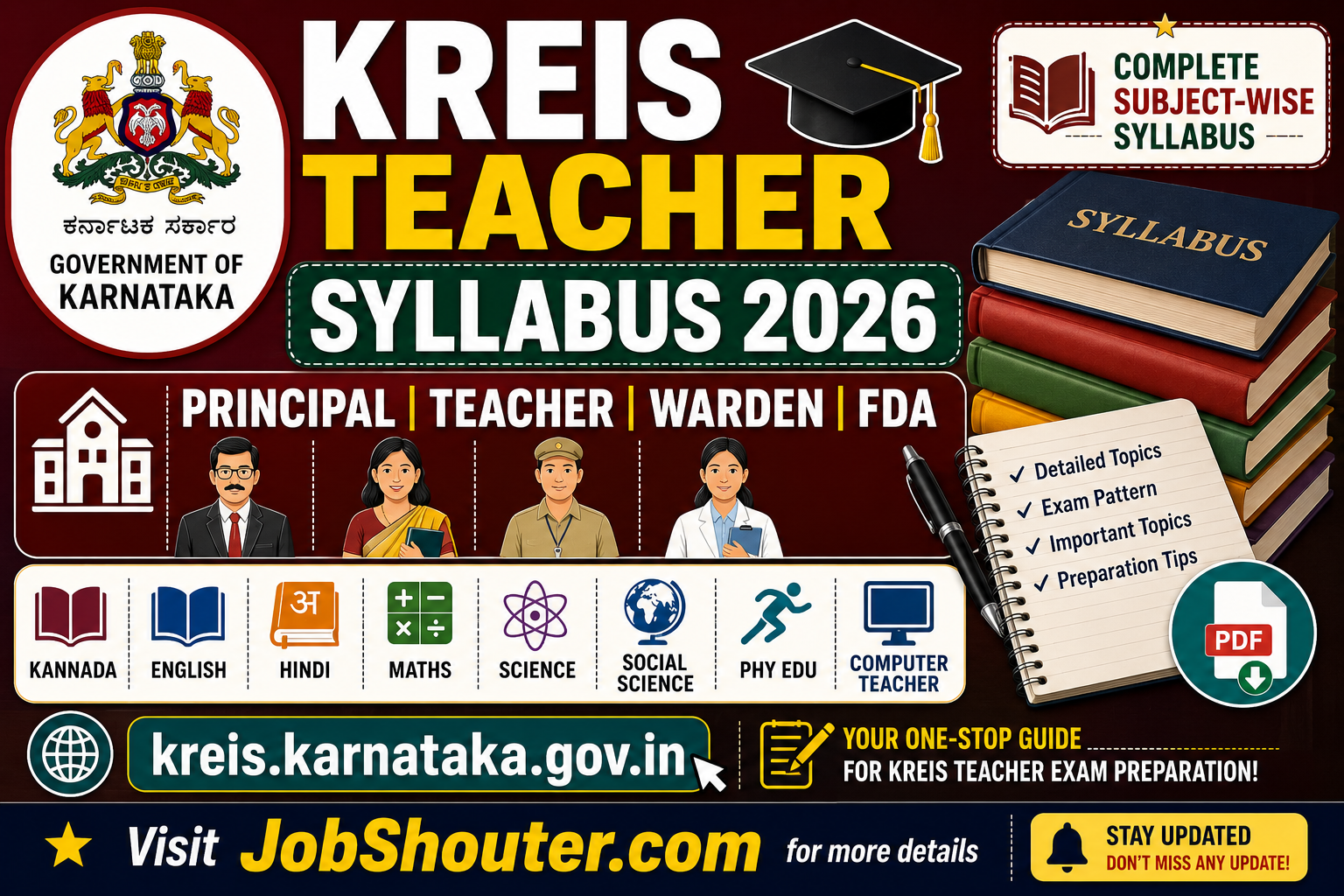
The Karnataka Residential Educational Institutions Society (KREIS) conducts a Combined Competitive Examination for the recruitment of Principals and Teachers in Morarji Desai, Kittur Rani Chennamma, and Ekalavya Model Residential Schools, along with Warden and First Division Assistant (FDA) cum Computer Operator posts. This article presents the complete syllabus exactly as laid out in the official KREIS syllabus document, organized paper-wise and subject-wise for easy reference – covering General Studies, Education, Kannada, English, Hindi, Mathematics, Science, Social Science, Physical Education, Computer Teacher, and Warden/FDA cum Computer Operator papers.
Important Note: This is a syllabus-only document – candidates should refer to the separate KREIS Teacher Recruitment 2026 notification for vacancy details, eligibility criteria, age limit, selection process, and application dates. For the Warden and FDA cum Computer Operator Paper II (Specific Paper), the official syllabus document does not provide a further topic-wise breakdown beyond the section names and marks – only General Kannada, General English, and Computer Knowledge sections with their respective marks are specified.
Overview
| Particulars | Details |
|---|---|
| Organization | Karnataka Residential Educational Institutions Society (KREIS) |
| Exam Name | KREIS Combined Competitive Examination 2026 |
| Posts Covered | Principal, Teacher, Warden, FDA cum Computer Operator |
| Exam Mode | Objective Type (MCQs) |
| Subjects Included | General Studies, Education, Subject-Specific Papers, Computer Knowledge |
| Official Website | kreis.karnataka.gov.in |
KREIS Exam Pattern
The examination is objective-type (Multiple Choice Questions) and is divided into papers depending on the post applied for.
Exam Pattern for Principal Post
| Paper | Subject |
|---|---|
| Paper 1 | General Studies |
| Paper 2 | Education – 1 |
| Paper 3 | Education – 2 |
Exam Pattern for Subject Teacher Posts
For Kannada, English, Hindi, Mathematics, Science, Social Science, Physical Education, and Computer Teacher posts, Paper 2 is the subject-specific Optional Paper, with syllabus details provided separately for each subject below.
Exam Pattern for Warden and FDA cum Computer Operator
Paper II is a Specific Paper set at Degree standard, consisting of three sections:
| Section | Subject | Maximum Marks |
|---|---|---|
| (a) | General Kannada | 70 |
| (b) | General English | 70 |
| (c) | Computer Knowledge | 60 |
KREIS Principal Syllabus – Paper 1: General Studies
Objective-type MCQs covering General Awareness, General Intelligence and Reasoning, Numerical Ability, Mental Ability, Teaching Aptitude, General English, General Kannada, and General Knowledge. The General English and General Kannada sections are expected to conform to the standard of a university Bachelor’s Degree examination, testing grammar, vocabulary, spelling, synonyms, comprehension, and correct/incorrect usage.
General Knowledge Topics
- Famous Books and Authors; Important Inventions and Discoveries
- Basic Science – Scientific Phenomena; Hygiene and Physiology (Human)
- Chronology of Events in World History; Glimpses of Indian History
- Geographical Terms (basic); Sports – International and National Figures
- Awards, Honours and Prizes
- Indian Culture – Land, People, Festivals; Physical Geography, Population, Literacy, Natural Regions, Resources, Crops, Industries, Projects, Public Undertakings
- Indian Art, Recognized Artists, Classical Awards; National Policy on Education; Constitution of India (major provisions); Union and State Government, Cabinets; Indian Leaders of International and National Recognition (Who’s Who – India)
- Current International Affairs – India’s Foreign Relations; Current National Affairs
KREIS Principal Syllabus – Paper 2: Education-1
Educational Administration
- Constitutional provisions and directive principles for education; measures for fulfilling constitutional obligations
- Role of different agencies (society, home, school) in education administration
- Education in relation to fundamental rights, democracy, secularism and social justice
- Critical analysis of aims of education in relation to national understanding
- Content and methodology changes; educational administration and planning
- School-community relationship in education development
- Role of the Head of Institution as Administrator, Academic Leader, Institutional Development Leader
- Classroom organization and management; physical facilities; school environment; leadership style influence on teacher performance
- Classroom management: coordinated functioning mechanisms
Psychological Foundations
- Child development – physical, intellectual, emotional and social
- Problems of adolescence – role of home, school and society
- Learning: concept; factors affecting learning; motivation; effective learning situations
New Initiatives in Karnataka
- Quality improvement programme in education; Compulsory Primary Education and Incentive Scheme
- Incentive programmes (textbooks, uniforms, midday meals, residential schools, etc.)
- School development and monitoring committees; examination systems; computer education in schools
- Sarva Shiksha Abhiyan (SSA) and Rashtriya Madhyamik Shiksha Abhiyan (RMSA) – goals and objectives
- In-service teacher training; role of DIET and CTE
- Student/teacher welfare programmes; examination reforms; action research
- Innovative distance education (Keli Kali, Edusat, etc.); inclusive education programme
- Environment and health education in schools
- Universal access, enrollment, retention, and achievement programmes
KREIS Principal Syllabus – Paper 3: Education-2
- Education for national development; political process-education interface
- Right of Children to Free and Compulsory Education Act
- Implementation of educational policy – political will, macro-level requirements, action plans, State/Centrally Sponsored Schemes
- Education and economic/individual development; education and socio-cultural context
- Learning environment – changing scenario; systems and structures in school education
- Universalisation of Secondary Education (USE) – access, enrolment, participation, achievement, strategies
Equity, Equality and Quality in Education
Quality Education indicators related to learning environment and student outcomes; outcome improvement through performance standards, supporting inputs, flexible strategies, and monitoring performance; enhancement of quality in secondary schools.
Other Topics in Paper 3
- Education for conservation of environment; teacher’s role in promoting conservation
- Nature of the learner: child and adolescent; organizational learning issues in teaching
- Teaching as a planned activity; elements of planning; phases of teaching (pre-active, interactive, post-active)
- Proficiency in teaching (awareness, skills, competencies, commitment); subject-related skills and competencies
- Impact of socialization on becoming a teacher; teacher’s professional identity
- Assessment and evaluation: perspectives, assessment of/for learning, current issues and trends
KREIS Optional Subject Syllabus for Teacher Posts (Paper 2)
1. Kannada Language Teacher Syllabus
- Unit 1: History of Kannada Literature – Old, Middle, and Modern Kannada periods – poets and works
- Unit 2: Poetics (Kavya Mimamse) and Prosody (Chandassu)
- Unit 3: Kannada Language and Grammar
2. English Language Teacher Syllabus
Pronunciation, Spelling, Parts of Speech, Time and Tense, Modals, Prepositions, Articles, Phrasal Verbs, Reported Speech, Agreement, Grammar and Usage, Functional English, Synonyms, Antonyms, Idioms and Phrases, Prefixes and Suffixes, Error Detection, Comprehension, Cloze Test, Sentence-Part and Paragraph Shuffling, Testing/Evaluation Methods, and ELT Terms.
3. Hindi Teacher Syllabus
- Bhasha Vigyan (Linguistics)
- Sahityaka Ithihas (Literary History): Adikal, Bhakthikal, Reetikal, Adhunik Kal (Gadhya – Prose, Padhya – Poetry)
4. Mathematics Teacher Syllabus
Physics: Mechanics, Properties of Matter, Heat and Thermodynamics, Waves, Sound, Light, Optics, Electricity and Magnetism, Electronics and Modern Physics, Active/Passive Networks and Devices, Filters, Power Supply, Digital Electronics, Atomic Spectroscopy/Structure, Molecular Spectra, Lasers and Masers, X-rays and Crystal Structure, Free Electronic Theory, Semiconductors, Magnetic Materials, Quantum Mechanics, Special Theory of Relativity, Nucleus Properties, Detectors, Accelerators, Nuclear Decays/Models, Fission and Fusion, Cosmic Rays, Fundamental Particles.
Mathematics: Number Systems, Sets, Basic Operations, Square/Cube Numbers and Roots, Irrational Numbers, Matrices, Statistics, Permutations and Combinations, Modular Arithmetic, Algebra (Exponents, Factors, Surds, Equations), Geometry (Axioms, Theorems, Triangles, Circles, Quadrilaterals, Polygons), Mensuration, Polyhedra and Networks.
5. Science Teacher Syllabus
Chemistry: Inorganic (atomic structure, periodic table, bonding, metallurgy, d/f-block, coordination chemistry, industrial/analytical chemistry); Physical (gases, colloids, surface chemistry, thermodynamics, nuclear/electrochemistry); Organic (alkanes/alkenes/alkynes, IUPAC nomenclature, isomerism, functional groups, vitamins, hormones, alkaloids, carbohydrates)
Biology: Living World, Cytology, Micro-organisms, Life Processes, Food Production, Environmental Science; Non-Chordata and Chordata classification; Cell Biology (mitosis, meiosis, fertilization, genetics); Biochemistry and Physiology; Introduction to Genetics and Biotechnology (Protista, viruses, bacteria, mycology, bryophytes, pteridophytes, gymnosperms, plant anatomy, embryology, ecology, taxonomy, cytology, evolution, plant physiology, biotechnology)
6. Social Science Teacher Syllabus
History: Medieval India, religious/social reform movements, Delhi Sultans, Bhakti movement, Vijayanagar Empire, Mughals, Marathas, Renaissance, foreign invasions, Mysore Sultans, First War of Independence, National Movement, ancient civilizations, Vedic age, Mauryans, Guptas, rise of Christianity/Islam, Rajputs, constitutional development, World Wars, contemporary world.
Civics: Social/economic development, citizenship, democracy, local self-government, government at state/central levels, national defense, India-world relations, Constitution of India.
Geography: Physical geography, environment, earth’s layers, resources, natural regions, world climate/vegetation, continental physical divisions, agriculture, mineral/power resources, industrial development, transport/communication, atmosphere, universe.
Economics: Basic concepts, national income, economic systems, Indian economy infrastructure, agricultural development, domestic/foreign trade, state and economic development, sociology, political science.
7. Physical Education Teacher Syllabus
Scientific foundation of physical education, history, anatomy, physiology, health education, safety education and first aid, organisation and administration, tests and measurements, psychological principles, major games and sports (football, hockey, kho-kho, kabaddi, basketball, volleyball, table tennis, badminton, cricket – officiating principles), recreation and camping, minor games, yoga, national ideals, integration, sports current affairs.
8. Computer Teacher Syllabus
Computer Fundamentals and C Programming: Introduction to C, C Instructions, Control Structures, Arrays, Functions, Pointers, Structures and Unions, Bitwise Operators, C Preprocessor, Files.
Data Structures: Introduction, Primitive data structures, Arrays, Linked Lists, Stacks, Queues, Trees, Graphs, Searching and Sorting.
Operating System: History of OS, Process Management, Storage Management, File System, Input/Output Systems.
Other Topics: OOPS using C++, Database Management System, Software Engineering, Software Internet Technology, basic Java and UNIX programming, Internet Lab, Computer Graphics, and Computer Networks.
KREIS Warden and FDA cum Computer Operator Syllabus (Paper II – Specific Paper)
This paper is set at Degree standard and includes three sections:
| Section | Subject | Maximum Marks |
|---|---|---|
| (a) | General Kannada | 70 |
| (b) | General English | 70 |
| (c) | Computer Knowledge | 60 |
The syllabus document does not provide further topic-wise breakdown for this specific paper beyond the section names and marks shown above.
Important Links
| Action | Link |
|---|---|
| Download KREIS Teacher Syllabus 2026 PDF | Click Here |
| Official KEA Website | Click Here |
Frequently Asked Questions (FAQs)
Q1. How many papers are there in the KREIS Principal exam?
✅ Three papers: Paper 1 (General Studies), Paper 2 (Education-1), and Paper 3 (Education-2).
Q2. What subjects are covered in KREIS Teacher optional papers?
✅ Kannada, English, Hindi, Mathematics (with Physics), Science (Chemistry and Biology), Social Science (History, Civics, Geography, Economics), Physical Education, and Computer Science, depending on the post applied for.
Q3. What is the syllabus for the KREIS Computer Teacher post?
✅ It covers C Programming fundamentals, Data Structures, Operating Systems, OOPS using C++, DBMS, Software Engineering, Java, UNIX, Computer Graphics, and Computer Networks.
Q4. What is the marks distribution for the Warden and FDA cum Computer Operator post?
✅ General Kannada carries 70 marks, General English carries 70 marks, and Computer Knowledge carries 60 marks, all at Degree standard.
Q5. Where can I find the KREIS Kannada Teacher syllabus in detail?
✅ It is divided into three units: Unit 1 covers the history of Kannada literature across old, middle, and modern periods; Unit 2 covers poetics and prosody; Unit 3 covers Kannada language and grammar.
Q6. What standard is the General English and General Kannada section tested at for the Principal exam?
✅ Both sections are expected to conform to the standard of a university Bachelor’s Degree examination, testing grammar, vocabulary, spelling, synonyms, comprehension, and correct/incorrect usage.
Q7. Does this syllabus document include vacancy details and application dates?
✅ No. This is a syllabus-only document. Candidates should refer to the separate KREIS Teacher Recruitment 2026 notification for vacancy details, eligibility criteria, age limit, selection process, and application dates.
Disclaimer: All information provided is for reference purposes only. Candidates are advised to verify the complete and updated syllabus, exam pattern, and recruitment details from the official KREIS/KEA website and the detailed recruitment notification before beginning their preparation.