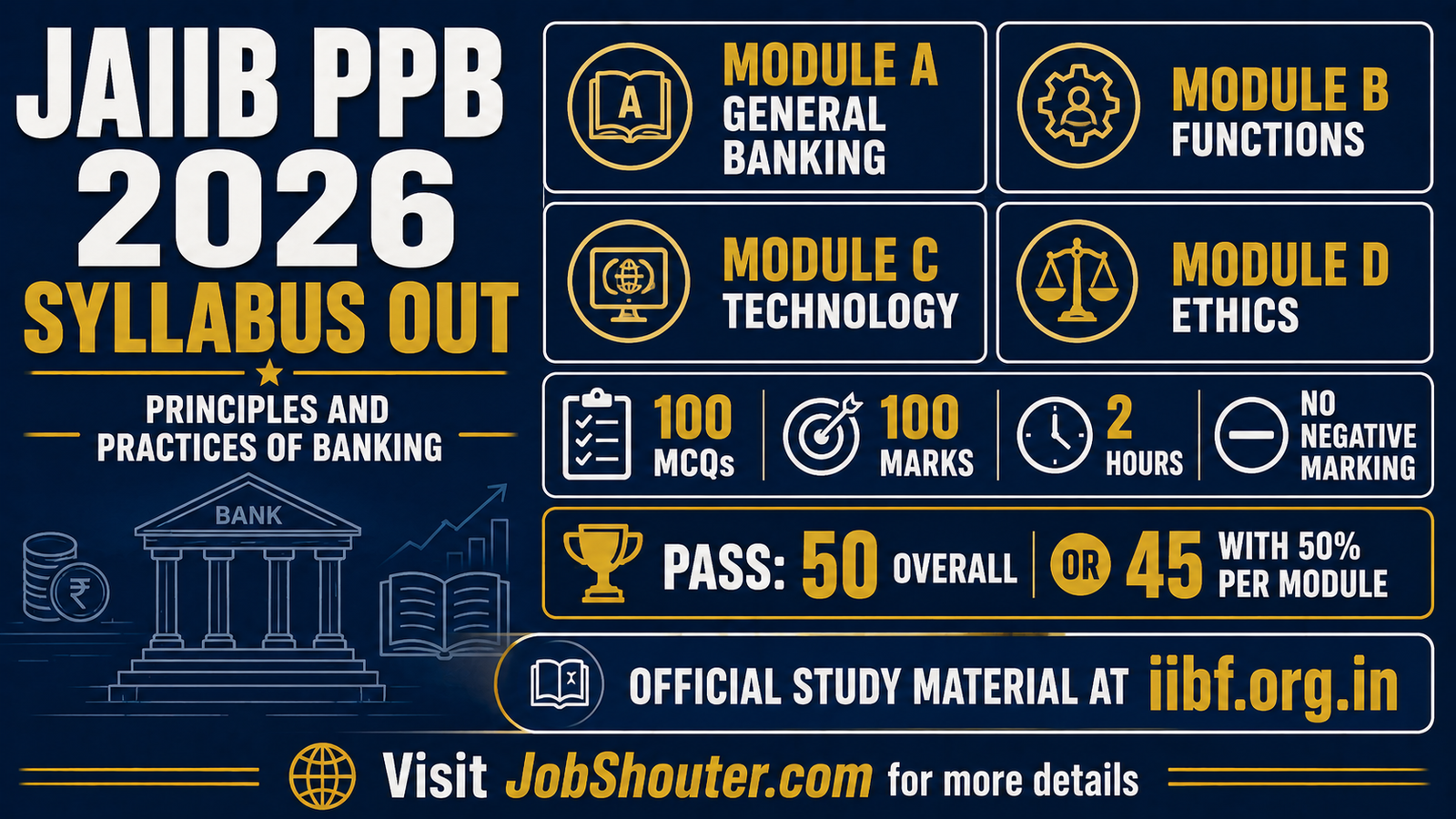
The Indian Institute of Banking and Finance (IIBF) has published the Syllabus for the Principles and Practices of Banking (PPB) paper of the Junior Associate of the Indian Institute of Bankers (JAIIB) Examination 2026. PPB is one of the four core papers of the JAIIB. It tests a candidate’s knowledge of banking operations, credit and lending functions, banking technology, and professional ethics. The exam is online, objective type (MCQ), 100 questions for 100 marks in 2 hours, with no negative marking, conducted in English or Hindi. The syllabus covers four modules: Module A – General Banking Operations, Module B – Functions of Banks, Module C – Banking Technology and Module D – Ethics in Banks and Financial Institutions. Passing criteria is either 50 marks out of 100 overall, or 45 marks overall provided the candidate scores at least 50% in each of the four individual modules.
Important Note: Three things every JAIIB candidate must understand about the PPB paper before starting preparation. First, there is no negative marking – this is one of the few banking sector exams where attempting all 100 questions is always the right strategy. Even an educated guess on an uncertain question carries no risk. Never leave a question unattempted. Second, there are two ways to pass – you pass if you score 50 or above out of 100, or if you score 45 to 49 provided you score at least 50% (i.e., at least 12.5 marks) in each of the four modules. This means even a lower aggregate can qualify you if your preparation is balanced across all four modules. Ignoring any single module risks disqualification even with a high aggregate. Third, the IIBF official study material is the most reliable source and the questions are drawn closely from topics covered in it. The PPB syllabus is broad and conceptual, covering everything from KYC and NPA to NPCI digital payment systems and ethics at individual and organisational level – use the official material from iibf.org.in as the primary source, supplemented by RBI and Government of India circular updates.
JAIIB PPB Syllabus 2026 – Overview
| Particulars | Details |
|---|---|
| Exam Name | JAIIB – Principles and Practices of Banking (PPB) |
| Conducting Body | Indian Institute of Banking and Finance (IIBF) |
| Paper Type | One of four core papers of the JAIIB Exam |
| Exam Mode | Online, objective type (MCQ) |
| Total Questions | 100 |
| Total Marks | 100 |
| Duration | 2 hours (120 minutes) |
| Number of Modules | 4 (Module A, B, C, D) |
| Medium | English and Hindi |
| Negative Marking | None |
| Passing Criteria | 50 marks or above out of 100, OR 45 to 49 marks with at least 50% in each individual module |
| Official Website | iibf.org.in |
JAIIB PPB Exam Pattern 2026
| Component | Details |
|---|---|
| Modules | Module A – General Banking Operations; Module B – Functions of Banks; Module C – Banking Technology; Module D – Ethics in Banks and Financial Institutions |
| Questions | 100 objective MCQs |
| Marks | 100 (1 mark per question) |
| Duration | 2 hours |
| Negative Marking | No negative marking |
| Passing Criteria | Option 1: 50 marks or above overall. Option 2: 45 marks or above overall, provided minimum 50% is scored in each module separately |
| Medium | English or Hindi |
Since there is no negative marking, attempt every single question. Do not leave any question blank.
Passing Criteria – Explained
| Scenario | Overall Score | Module-wise Condition | Result |
|---|---|---|---|
| Option 1 | 50 or above | No module-wise minimum required | PASS |
| Option 2 | 45 to 49 | Must score at least 50% in each of all 4 modules | PASS |
| Fail | Below 45 | – | FAIL |
| Fail | 45 to 49 | Even one module below 50% | FAIL |
The module-wise condition in Option 2 makes balanced preparation across all four modules important even for candidates targeting 45 to 49.
Module A – General Banking Operations
This module covers the foundational aspects of banking including customer relationships, regulatory compliance, KYC, AML, foreign exchange, negotiable instruments, digital banking basics and customer service.
Major topic areas:
Banker-Customer Relationship covering requirements to be called a bank, bank as trustee, agent, bailee, lessor, different deposit products and investor services; AML and KYC Guidelines covering PMLA obligations, FATF-identified jurisdictions, FATCA and CRS reporting, correspondent banking, risk management and secrecy obligations; Operational Aspects of KYC covering wire transfers, CKYCR and monitoring of transactions; Opening of Accounts for personal customers, other entities, current account norms and LEI; Operational Aspects of Deposit Accounts covering interest, inoperative accounts, unclaimed deposits, joint operations, nomination, attachment orders; Clearing, Collection and Cash Handling covering Cheque Truncation System (CTS), RBI guidelines, security arrangements at branches and ATMs; Banker’s Special Relationship covering mandate, Power of Attorney, lien, right of set-off and appropriation; Foreign Exchange covering FEMA, inward and outward remittances, Indo-Nepal remittance; Operational Aspects of NRI Business covering NRE, NRO and FCNR accounts, SNRR accounts, remittance of assets, property transactions and NRI investments; Foreign Currency Accounts covering types of accounts and FCRA 2010; Cash Management Services; Negotiable Instruments Act covering payment of cheques, endorsement, crossing, forged instruments and dishonour; Responsibility of Paying Bank and Collecting Bank; Ancillary Services covering DD, banker’s cheques, NEFT, RTGS, Electronic Benefit Transfer, mobile and digital banking, safe deposit lockers, merchant banking; Financial Inclusion and Literacy; Customer Service Guidelines covering ATM operations, counter services and special customer facilities; Grievance Redressal covering Model Policy, RBI Integrated Ombudsman Scheme 2021, Consumer Protection Act 2019, Right to Information Act 2005.
Module B – Functions of Banks
This module covers credit operations, lending principles, securities and charges, NPA management, legal recovery mechanisms and priority sector lending.
Major topic areas:
Principles of Lending and Credit Facilities covering types of borrowers, fund-based and non-fund-based facilities; Appraisal and Assessment covering credit appraisal techniques, working capital and term loan assessment; Operational Aspects of Loan Accounts covering interest rates, credit management, loan processing, accounting, recovery agents guidelines and Fair Practices Code; Types of Collaterals and Securities covering land and buildings, goods and documents of title, insurance policies, shares, debentures, book debts, term deposits, gold loans and supply bills; Modes of Charging Securities covering types of charges and registration; Documentation; Non-Performing Assets (NPA) and Stressed Assets covering definitions, income recognition, gross and net NPA, asset classification, provisioning, write-offs, resolution and restructuring; Laws Relating to Recovery covering Recovery of Debts and Bankruptcy Act 1993, SARFAESI Act, Insolvency and Bankruptcy Code (IBC), Legal Services Authorities Act and Law of Limitation; Contracts of Indemnity, Guarantee and Bank Guarantee covering types of bank guarantees, precautions and UCPDC 600; Letters of Credit and Deferred Payment Guarantee; Bills Finance; Retail Loans and Credit Cards covering home loans, personal loans and consumer loans; Priority Sector Advances covering targets, sub-targets and categories; Agricultural Finance covering crop loans, Kisan Credit Card (KCC), PMFBY and Minimum Support Price; Finance to MFIs and NBFCs covering co-lending and Scale-Based Regulation; MSME Finance covering TReDS, Credit Guarantee Fund Scheme and cluster-based financing; Government Sponsored Schemes covering DAY-NRLM, DAY-NULM, PMJDY, MUDRA and KVIC; Self-Help Groups covering SHG-Bank Linkage Programme.
Module C – Banking Technology
This module covers the technology infrastructure of banks, digital delivery channels, payments systems, cybersecurity and emerging fintech trends.
Major topic areas:
Essentials of Bank Computerisation covering networking technologies, Core Banking System (CBS), data warehousing and data mining; Operational Aspects of CBS covering Begin of Day and End of Day operations, password control, logical access control and security controls; Alternate Delivery Channels and Digital Banking covering ATMs, electromagnetic cards, electronic banking, customer protection in unauthorised electronic transactions, TAT harmonisation and compensation for failed transactions; Data Communication Network and EFT Systems covering major networks in India, SWIFT and automated clearing; Digital Payment Systems and NPCI covering NPCI-driven digital payment initiatives and electronic clearing systems in India; Impact of Technology Adoption covering trends, global banking systems and impact of IT; Security Considerations and Mitigation covering types of cyber threats, IS Audit, online fraud modus operandi, cyber security awareness, Disaster Recovery Management and the Information Technology Act; Operational Aspects of Cyber Crime and Fraud Risk Management covering incident response planning; Technology Trends covering e-RUPI, FinTech, RegTech, SupTech; Advanced Digital Banking covering social media banking, account aggregators and open banking.
Module D – Ethics in Banks and Financial Institutions
This module covers the principles of ethics and their application at the individual, organisational and banking system level.
Major topic areas:
Ethics and Business Ethics in Banking covering values, ethical principles, ethical foundation of banking, the global financial crisis context and case studies including Enron and Satyam; Ethics at the Individual Level covering values, norms, beliefs, core values, morality, personal values, the Golden Rule and ethical decision-making frameworks; Ethical Dimensions for Employees covering abuse of official position, insider trading, obligations to third parties, job discrimination, sexual harassment, conflict of interest, HRM ethics and whistleblowing law in India; Work Ethics and the Workplace covering benefits of ethical behaviour, causes and remedies for unethical behaviour, ethics of a banker; Banking Ethics and Changing Dynamics covering ethics in technology, data security and privacy, intellectual property rights and ethics of information security.
Preparation Strategy for JAIIB PPB 2026
Step 1 – Map the four modules and estimate time. Module A and Module B together cover the largest and most operationally dense portions of banking. Module C is technology-heavy and requires familiarity with current RBI/NPCI/IIBF-defined digital frameworks. Module D is conceptual and policy-oriented. Allocate proportionally more time to Modules A and B.
Step 2 – Use IIBF official study material as the primary source. All questions are drawn from the curriculum published and revised by IIBF. Access the official material at iibf.org.in. Supplement it with relevant RBI circulars, especially for topics like the Integrated Ombudsman Scheme 2021, CTS, NPCI systems and NPA provisioning norms.
Step 3 – Prioritise high-recurrence topics. In Module A: KYC and AML, Negotiable Instruments, NRI accounts and FEMA. In Module B: Principles of lending, NPA and recovery, Priority Sector, SARFAESI and IBC. In Module C: CBS operations, NPCI systems, cybersecurity basics and FinTech terms. In Module D: All sections are relatively short and high-yield for the marks they cover.
Step 4 – Attempt all 100 questions. Since there is no negative marking, skipping questions is never the right move. If unsure about an answer, eliminate the most obviously wrong options and choose the best remaining guess.
Step 5 – Maintain module-wise balance. If targeting the 45-mark pass with module conditions, ensure you do not neglect any single module. Even if your overall marks are sufficient, failing to hit 50% in one module means disqualification.
Step 6 – Practice full-length mock tests in 2-hour timed conditions. Speed is not usually a challenge for 100 MCQs in 120 minutes, but conceptual clarity across 4 modules in a single sitting needs practice.
Important Links
| Description | Link |
|---|---|
| JAIIB Official Website and Study Material | Click Here |
JAIIB PPB Syllabus 2026 – FAQs
Q1. What is JAIIB PPB?
✅ JAIIB PPB stands for Junior Associate of the Indian Institute of Bankers – Principles and Practices of Banking. PPB is one of the four core papers of the JAIIB examination conducted by the Indian Institute of Banking and Finance (IIBF) for bank employees.
Q2. How many modules are in the JAIIB PPB syllabus 2026?
✅ Four modules: Module A – General Banking Operations, Module B – Functions of Banks, Module C – Banking Technology and Module D – Ethics in Banks and Financial Institutions.
Q3. What is the exam pattern for JAIIB PPB 2026?
✅ 100 objective MCQ questions, 100 marks, 2 hours duration, online mode, English or Hindi medium, no negative marking.
Q4. Is there negative marking in JAIIB PPB?
✅ No. There is no negative marking. Candidates should attempt all 100 questions without exception.
Q5. What are the passing criteria for JAIIB PPB?
✅ Two ways to pass: Option 1 – score 50 or more out of 100 overall. Option 2 – score 45 to 49 overall, provided a minimum of 50% is scored in each of the four individual modules. Scoring below 45 in total, or below 50% in any single module when overall score is 45 to 49, results in failure.
Q6. What are the main topics in Module A – General Banking Operations?
✅ Banker-Customer Relationship, KYC and AML compliance, Opening of Accounts, Deposit Account operations, Clearing and Collection, Negotiable Instruments, Paying Bank and Collecting Bank responsibilities, NRI Accounts, Foreign Exchange, Cash Management Services, Ancillary Services, Financial Inclusion, Customer Service and Grievance Redressal including the RBI Integrated Ombudsman Scheme 2021.
Q7. What does Module B – Functions of Banks cover?
✅ Principles of Lending, Credit Appraisal, Types of Securities and Charges, Documentation, NPA and Stressed Assets management, SARFAESI and IBC, Contracts of Guarantee and Letters of Credit, Priority Sector Lending, Agricultural Finance, MSME Finance, Government Sponsored Schemes and SHG-Bank Linkage.
Q8. What does Module C – Banking Technology cover?
✅ Core Banking System (CBS), Alternate Delivery Channels including ATMs and digital banking, Data Communication and EFT Systems, NPCI and digital payment initiatives, Impact of Technology on Banking, Cybersecurity and Fraud Risk Management, and emerging trends including e-RUPI, FinTech, RegTech, SupTech and open banking.
Q9. What is Module D – Ethics in Banks about?
✅ Business ethics in banking, individual-level ethics and value systems, ethical issues for bank employees (insider trading, conflict of interest, whistleblowing), work ethics, and ethics in the context of technology including data privacy and intellectual property rights.
Q10. Where can I get the official JAIIB PPB study material?
✅ From the Indian Institute of Banking and Finance (IIBF) official website at iibf.org.in. IIBF publishes the official textbook for each JAIIB paper, which is the most reliable and examination-aligned source for preparation.
Disclaimer
The information above relates to the Principles and Practices of Banking (PPB) syllabus and exam pattern for the JAIIB Examination 2026 as conducted by the Indian Institute of Banking and Finance (IIBF). The official JAIIB syllabus, study material and any updates to the examination structure are published only on the official IIBF website iibf.org.in, which is the sole authoritative source. The JAIIB is a professional certification examination for bank employees and is not a government recruitment examination. All links above lead only to the official IIBF website.