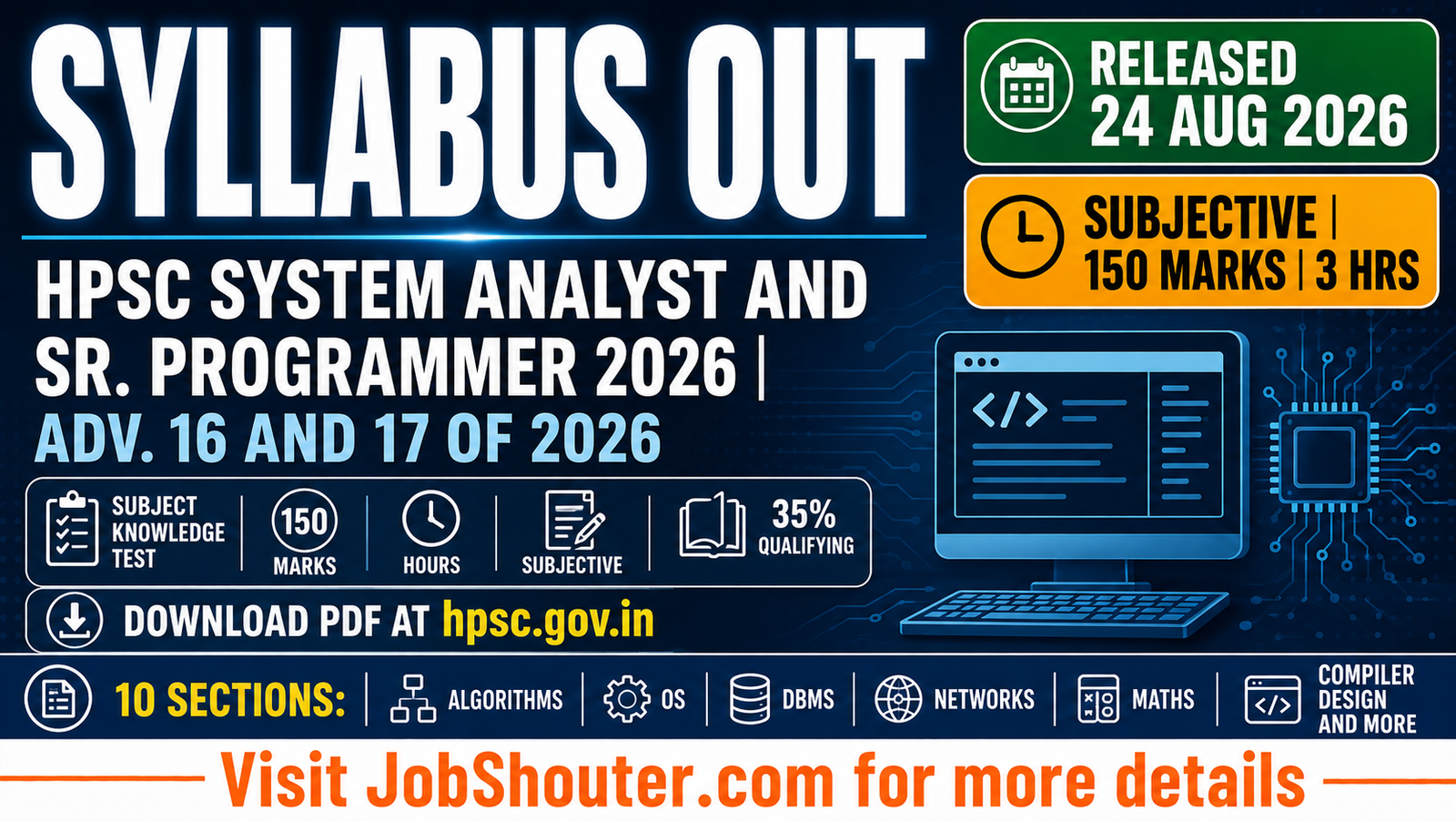
The Haryana Public Service Commission (HPSC) released the official Scheme/Pattern of Exam and Syllabus for the Subject Knowledge Test on 24 August 2026 for two recruitment advertisements – System Analyst and Senior Programmer (Advt. No. 16/2026) and Jr. System Analyst/Programmer in HSIIDC (Advt. No. 17/2026). The same syllabus applies to both advertisements. The Subject Knowledge Test is a 150-mark subjective paper of 3 hours duration, conducted in English, covering 10 core computer science and engineering sections. Candidates must secure a minimum of 35% marks in the Subject Knowledge Test to be called for interview. The test carries 87.5% weightage and the interview carries 12.5% in the final merit list. The exam date has not yet been announced.
Important: The Subject Knowledge Test is subjective – not multiple choice. This is a significant difference from most competitive exams and changes the preparation strategy completely. You need to practise writing full-length descriptive answers within the 3-hour window, not just solving objective questions. Also note that clearing 35% is the minimum gate to the interview – but since only 3x the number of posts are called for interview, the effective cut-off will likely be much higher. Prepare to score comfortably above 35%.
HPSC System Analyst Syllabus 2026 – Overview
| Particulars | Details |
|---|---|
| Conducting Body | Haryana Public Service Commission (HPSC) |
| Posts | System Analyst/Senior Programmer (Advt. 16/2026); Jr. System Analyst/Programmer in HSIIDC (Advt. 17/2026) |
| Syllabus Released | 24 August 2026 |
| Test Name | Subject Knowledge Test |
| Total Marks | 150 |
| Duration | 3 hours |
| Type of Paper | Subjective |
| Medium | English |
| Qualifying Marks for Interview | Minimum 35% |
| Subject Knowledge Test Weightage | 87.5% |
| Interview Weightage | 12.5% |
| Interview Shortlisting Ratio | 3x the number of posts (including bracketed candidates, subject to 35% qualifying) |
| Exam Date | Not yet announced – check hpsc.gov.in |
| Official Website | hpsc.gov.in |
Selection Process
Selection is in two stages for both Advt. 16/2026 and Advt. 17/2026.
| Stage | Details | Weightage |
|---|---|---|
| Subject Knowledge Test | 150-mark subjective paper, 3 hours, English, minimum 35% to qualify | 87.5% |
| Interview/Viva-Voce | Called for candidates who clear 35% in the Subject Knowledge Test; 3x posts called (including bracketed candidates) | 12.5% |
The final merit list is prepared by combining marks from both stages. Attendance at every stage is mandatory.
Exam Pattern
| Particulars | Details |
|---|---|
| Total Marks | 150 |
| Duration | 3 hours |
| Type | Subjective (descriptive and analytical answers) |
| Medium | English only |
| Minimum Qualifying Marks | 35% (52.5 marks out of 150) |
| Applicable To | Both Advt. No. 16/2026 and Advt. No. 17/2026 |
Syllabus – 10 Sections
The syllabus is common for both posts and covers 10 sections of core computer science and engineering.
Section 1 – Engineering Mathematics
| Sub-topic | Key Areas |
|---|---|
| Discrete Mathematics | Propositional and first order logic; sets, relations, functions, partial orders and lattices; monoids, groups; graphs – connectivity, matching, colouring; combinatorics – counting, recurrence relations, generating functions |
| Linear Algebra | Matrices, determinants, system of linear equations, eigenvalues and eigenvectors, LU decomposition |
| Calculus | Limits, continuity and differentiability, maxima and minima, mean value theorem, integration |
| Probability and Statistics | Random variables; uniform, normal, exponential, Poisson and binomial distributions; mean, median, mode and standard deviation; conditional probability and Bayes theorem |
Section 2 – Digital Logic
- Boolean algebra
- Combinational and sequential circuits
- Minimization
- Number representations and computer arithmetic (fixed and floating point)
Section 3 – Computer Organization and Architecture
- Machine instructions and addressing modes
- ALU, data-path and control unit
- Instruction pipelining and pipeline hazards
- Memory hierarchy – cache, main memory and secondary storage
- I/O interface (interrupt and DMA mode)
Section 4 – Programming and Data Structures
- Programming in C
- Recursion
- Arrays, stacks, queues, linked lists, trees, binary search trees, binary heaps, graphs
Section 5 – Algorithms
- Searching, sorting, hashing
- Asymptotic worst case time and space complexity
- Algorithm design techniques – greedy, dynamic programming and divide-and-conquer
- Graph traversals, minimum spanning trees, shortest paths
Section 6 – Theory of Computation
- Regular expressions and finite automata
- Context-free grammars and push-down automata
- Regular and context-free languages, pumping lemma
- Turing machines and undecidability
Section 7 – Compiler Design
- Lexical analysis, parsing, syntax-directed translation
- Runtime environments
- Intermediate code generation
- Local optimisation; data flow analyses – constant propagation, liveness analysis, common sub-expression elimination
Section 8 – Operating System
- System calls, processes, threads, inter-process communication, concurrency and synchronization
- Deadlock
- CPU and I/O scheduling
- Memory management and virtual memory
- File systems
Section 9 – Databases
- ER-model
- Relational model – relational algebra, tuple calculus, SQL
- Integrity constraints, normal forms
- File organization, indexing (B and B+ trees)
- Transactions and concurrency control
Section 10 – Computer Networks
- Concept of layering – OSI and TCP/IP protocol stacks
- Packet, circuit and virtual circuit switching
- Data link layer – framing, error detection, medium access control, Ethernet bridging
- Routing protocols – shortest path, flooding, distance vector and link state routing
- Fragmentation and IP addressing, IPv4, CIDR notation, ARP, DHCP, ICMP, NAT
- Transport layer – flow control, congestion control, UDP, TCP, sockets
- Application layer – DNS, SMTP, HTTP, FTP, Email
The official syllabus does not specify section-wise marks weightage. Candidates should prepare all 10 sections thoroughly.
Preparation Strategy
- Subjective format is the single biggest factor. Practise writing complete descriptive answers with examples within the 3-hour time limit. Reading alone will not build exam-day speed for a subjective paper.
- Core sections to prioritise: Programming and Data Structures, Algorithms, Databases, Operating Systems and Computer Networks are typically the most application-heavy sections in computer science subjective papers.
- Foundational sections: Engineering Mathematics and Digital Logic are easier to lose marks on if left for late preparation. Revise them systematically as separate units.
- Theory of Computation and Compiler Design are conceptually dense but scoring if prepared from standard textbooks (Sipser for ToC, Dragon Book for Compiler Design).
- GATE computer science syllabus is the closest analog to this syllabus. Use GATE CS resources for topic coverage and practice problems, but convert your output to descriptive answers rather than selecting options.
- 35% qualifying threshold may look low, but given the 3x interview shortlisting ratio and the competitiveness of HPSC technical posts, aim for 50% or above as a practical target.
Important Links
| Description | Link |
|---|---|
| Download Syllabus and Exam Pattern PDF | Get PDF |
| HPSC Official Website | Click Here |
Frequently Asked Questions – HPSC System Analyst Syllabus 2026
Q1. Has HPSC released the syllabus for System Analyst and Senior Programmer 2026?
✅ Yes. HPSC released the official Scheme/Pattern of Exam and Syllabus for the Subject Knowledge Test on 24 August 2026 for both System Analyst/Senior Programmer (Advt. 16/2026) and Jr. System Analyst/Programmer in HSIIDC (Advt. 17/2026).
Q2. Is the syllabus the same for both Advt. 16/2026 and Advt. 17/2026?
✅ Yes. The same 10-section Subject Knowledge Test syllabus and exam pattern apply to both advertisements as per the official HPSC announcement.
Q3. What is the exam pattern for the HPSC System Analyst Subject Knowledge Test?
✅ 150 marks, 3 hours duration, subjective (descriptive/analytical) answers, conducted in English. Minimum 35% marks required to be eligible for the interview stage.
Q4. What is the weightage of the Subject Knowledge Test vs Interview?
✅ Subject Knowledge Test carries 87.5% weightage and the Interview carries 12.5% in the final merit list.
Q5. What are the 10 sections in the HPSC System Analyst Syllabus 2026?
✅ Engineering Mathematics, Digital Logic, Computer Organization and Architecture, Programming and Data Structures, Algorithms, Theory of Computation, Compiler Design, Operating System, Databases and Computer Networks. All 10 sections are detailed in the official PDF linked above.
Q6. How many candidates are called for interview?
✅ Three times the number of advertised posts (including bracketed candidates), subject to securing a minimum of 35% in the Subject Knowledge Test.
Q7. Is the Subject Knowledge Test multiple choice or subjective?
✅ Subjective. Candidates need to write descriptive and analytical answers. This requires practising full-length answer writing within the 3-hour window, not just solving objective questions.
Q8. When is the HPSC System Analyst exam date?
✅ The exam date has not been announced yet. Monitor the official HPSC website for schedule updates.
Q9. What is the minimum qualifying mark in the Subject Knowledge Test?
✅ 35% – that is 52.5 marks out of 150. Candidates who do not meet this minimum are not called for the interview stage regardless of their overall performance.
Q10. Where can I download the official HPSC System Analyst Syllabus PDF?
✅ The direct PDF link is in the Important Links table above, hosted on the official HPSC website. The PDF contains the complete subject-wise syllabus and exam pattern.
Disclaimer: This article is based on the official Scheme/Pattern of Exam and Syllabus notice released by the Haryana Public Service Commission (HPSC) on 24 August 2026 for the Subject Knowledge Test for System Analyst/Senior Programmer (Advt. No. 16/2026) and Jr. System Analyst/Programmer in HSIIDC (Advt. No. 17/2026). The syllabus and exam pattern are as published by HPSC and candidates must download the official PDF from hpsc.gov.in for the complete and authoritative content. The exam date has not yet been announced. JobShouter.com is not associated with HPSC in any manner.