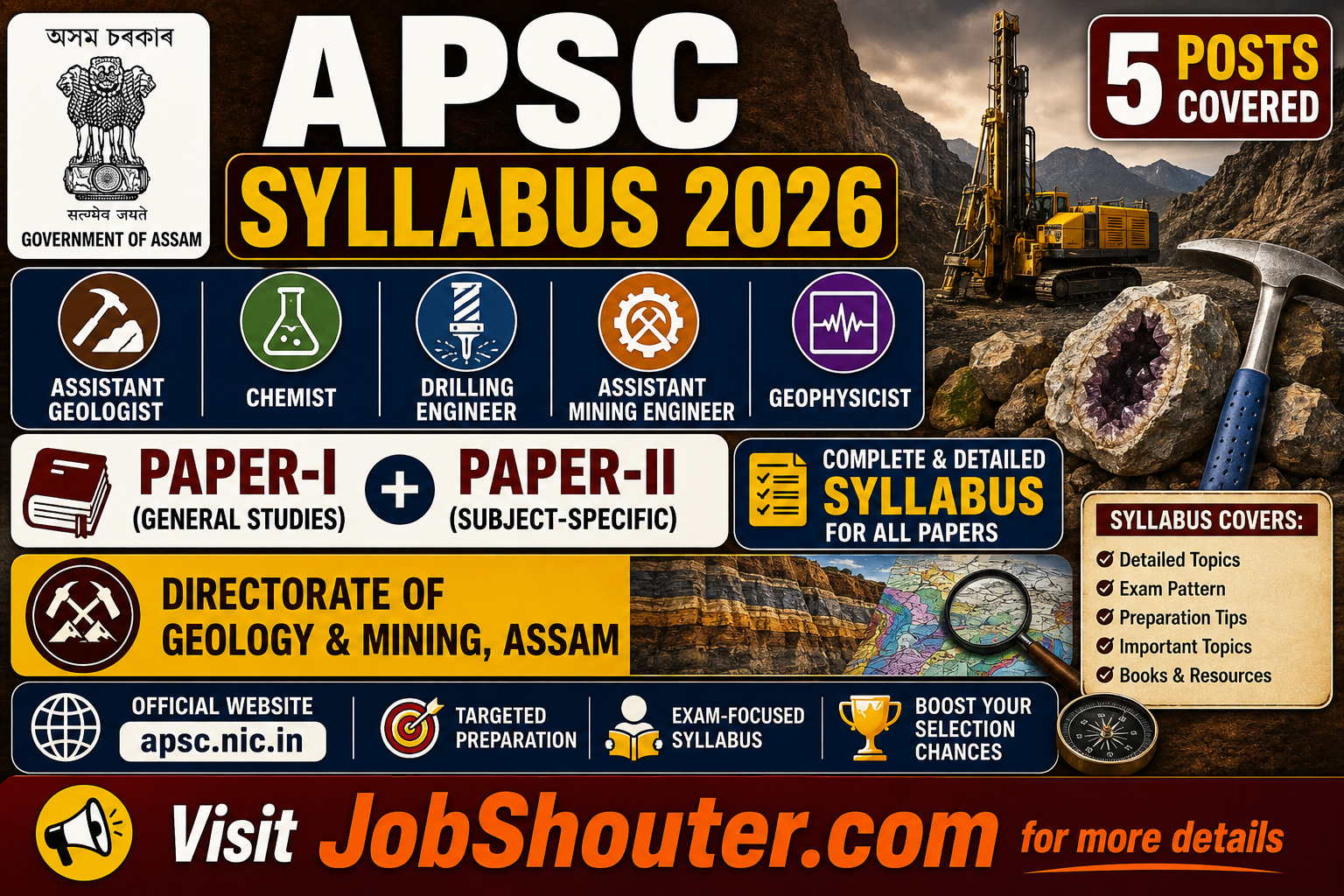
The Assam Public Service Commission (APSC) has released the syllabus for the Screening Test for recruitment to five posts under the Directorate of Geology and Mining, Assam, Mines and Minerals Department: Assistant Geologist, Chemist, Drilling Engineer, Assistant Mining Engineer, and Geophysicist. This guide covers the APSC Assistant Geologist syllabus 2026 in detail, along with the syllabus for the other four posts released under the same notification (dated 17 July 2026). Since all five posts share a common Paper-I and have separate subject-specific Paper-II syllabi, checking the syllabus and exam pattern together helps candidates plan their preparation stage by stage.
Important Note: This is a syllabus-only notification. The number of questions for Paper-II is NOT specified in the official notification for any of the five posts – only Paper-I’s question count (100) is confirmed. Candidates should refer to the separate detailed recruitment advertisements for each post (vacancy count, application dates, eligibility, and complete selection process), which are notified individually and separately from this syllabus release.
Overview
| Particulars | Details |
|---|---|
| Conducting Body | Assam Public Service Commission (APSC) |
| Department | Directorate of Geology and Mining, Assam (Mines and Minerals Department) |
| Posts Covered | Assistant Geologist, Chemist, Drilling Engineer, Assistant Mining Engineer, Geophysicist |
| Test Name | Screening Test |
| Syllabus Notification Date | 17 July 2026 |
| Number of Papers | Paper-I (General Studies) and Paper-II (Post-specific subject) |
| Total Questions per Paper | 100 objective type questions (Paper-I); not specified for Paper-II |
| Marks per Paper | 100 marks each |
| Duration per Paper | 2 hours each |
| Question Type | Multiple Choice Questions (Objective Type) |
| Official Website | apsc.nic.in |
APSC Exam Pattern 2026
The exam pattern is common in structure across all five posts, since each post has the same Paper-I and a post-specific Paper-II. Each paper is conducted separately.
Paper-I Exam Pattern (Common for All Posts) – General Studies
| Subject | Marks | Duration | Question Type |
|---|---|---|---|
| General Studies | 100 | 2 hours | Objective (MCQ), 100 questions |
Paper-II Exam Pattern (Post-Wise) – Subject Paper
| Post | Subject | Marks | Duration |
|---|---|---|---|
| Assistant Geologist | Geology | 100 | 2 hours |
| Chemist | Chemistry (based on Gauhati University syllabus) | 100 | 2 hours |
| Drilling Engineer | Mechanical Engineering | 100 | 2 hours |
| Assistant Mining Engineer | Mining and Geology | 100 | 2 hours |
| Geophysicist | Geophysics | 100 | 2 hours |
The number of questions for Paper-II is not specified in the official notification for any of the five posts.
Paper-I: General Studies (Common for All Five Posts)
- Constitution and Political System of India
- Current events of National and International Importance
- Indian Economy and Planning Process of India
- Geography of India, Assam and World
- Role of Science and Technology in India
- Culture and History of Assam, India and World
- Indian National Movement with special reference to Assam
1. Assistant Geologist Syllabus – Paper-II: Geology
(A) Structural Geology and Seismology: stress and strain, ductile/brittle deformation, faults and folds, thrust systems, strike-slip faults, shear zones, rheology; earthquake terminology, seismic waves, magnitude scales, focal depth, PGA/PGV, palaeoseismology
(B) Mineralogy, Crystal Chemistry and Thermodynamics: chemical composition of minerals, X-ray crystallography, ionic bonding, mineral transformation; laws of thermodynamics, Gibbs free energy, Clausius-Clapeyron equation, Raoult’s and Henry’s laws
(C) Geoinformatics, Geomorphology and Quaternary Geology: remote sensing, photogrammetry, image processing, GIS; Quaternary Period divisions, dating methods, Quaternary climate/tectonics, stratigraphy
(D) Hydrogeology, Climatology and Oceanography: hydrologic cycle, groundwater occurrence/movement, Darcy’s law, well hydraulics; atmospheric composition, precipitation, weather disturbances, ocean classification
(E) Igneous and Metamorphic Petrology: magma generation, geochemical characteristics, phase equilibria, IUGS classification; regional metamorphic textures, P-T-t paths, geothermometry/geobarometry
(F) Geochemistry, Isotope Geology and Engineering Geology: crust-mantle geochemical systems, radiogenic/stable isotopes, statistics in geology; engineering properties of soil/rocks, dams, reservoirs, tunnel construction geotechnics
(G) Economic Geology: genesis of ore deposits, metallic/non-metallic mineral deposits of India, radioactive minerals, mineral prospecting/exploration/mining methods
(H) Sedimentology, Surveying and Mapping: textural elements, sedimentary structures, depositional environments; types of surveys, GPS/GNSS, geologic surveying and field mapping
(I) Stratigraphy and Geodynamics: principles of stratigraphy, Indian stratigraphy (Precambrian to Cenozoic), stratigraphy of Northeast India; plate tectonics, sea-floor spreading, Himalayan tectonics, planetary geology
(J) Palaeontology and Fuel Geology: micropalaeontology, foraminifers, vertebrate palaeontology, palynology; origin, sampling, petrography/utilization of coal; petroleum origin, reservoir rocks, drilling/exploration
(K) Fluvial System and Environmental Geology: drainage basin evolution, fluvial processes/landforms, fluvial depositional environments; pollution/hazards from mining, landslides, floods, water pollution
2. Chemist Syllabus – Paper-II: Chemistry (Based on Gauhati University Syllabus)
Group 1 – Inorganic Chemistry: bonding in polyhedral boranes/carboranes, organoboranes, chemistry of Al/Ga/In/Tl; fullerenes, silicates, clays, zeolites; chemistry of second/third transition series, bonding in coordination compounds (VBT, CFT, ligand field theory); electronic spectra and magnetic properties; mechanism of inorganic reactions, nuclear/radiochemistry, solid state chemistry; organometallic chemistry (metal carbonyls, alkyls, carbenes, catalytic reactions)
Group 2 – Modern Methods of Analysis: IR, Raman, NMR, EPR, Mössbauer, UV-visible, MS, LC-MS; thermal methods (TGA, DTA, DTG, DSC), diffraction techniques (powder/single crystal XRD); separation techniques (GC, HPLC, GPC); electro-analytical methods (polarography, cyclic voltammetry)
Group 3 – Physical Chemistry: equilibrium/non-equilibrium thermodynamics, statistical thermodynamics, polymer chemistry; sampling and data analysis
Group 4 – Conductometric Titrations: strength comparison, degree of hydrolysis, concentration determination
Group 5 – Spectroscopy: absorption/emission spectroscopy, rotational/vibrational/Raman spectroscopy, electronic spectroscopy including fluorescence/phosphorescence
Group 6 – Organic Chemistry: oxidation reactions (Sharpless, Jacobsen, Shi epoxidation, Baeyer-Villiger, Wacker oxidation); reduction reactions; qualitative analysis of binary mixtures
Group 7 – Catalysis Science and Technology: catalyst synthesis, zeolites, mesoporous materials/clays; oil refining, steam reforming, hydrotreating, fuel cells
Group 8 – X-ray Crystallography: crystalline state, principles of X-ray diffraction, powder/single-crystal applications, macromolecular crystallography
Group 9 – Green Chemistry: principles and metrics, waste production/prevention, catalysis and sustainability, feedstock chemicals from biomass
3. Drilling Engineer Syllabus – Paper-II: Mechanical Engineering
Statics (equilibrium equations); Dynamics (equations of motion, SHM, work-energy-power); Theory of Machines (links/mechanisms, gears, governors, balancing, vibration); Mechanics of Solids (stress-strain, Hooke’s law, bending moments, shear force, torsion); Manufacturing Science (metal cutting, machining, casting, welding); Production Management (method/time study, product design, break-even analysis, routing); Thermodynamics (laws, Carnot/Rankine/Otto/Diesel cycles); Fluid Mechanics (hydrostatics, continuity equation, Bernoulli’s theorem, laminar/turbulent flow); Heat Transfer (conduction, fins, heat transfer coefficient, exchangers); Energy Conversion (compressors, pumps, turbines, boilers, power plant layout); Environmental Control (refrigeration cycles, refrigerants, psychrometrics).
4. Assistant Mining Engineer Syllabus – Paper-II: Mining and Geology
Unit 1: Mining terminology, mineral/energy resources, ore and gangue, ore formation, Indian mineral deposits, seismic zones of India
Unit 2: Methods of access to deposits, underground drivage, drilling principles/machines, explosives/blast design; mine surveying (levelling, theodolite, tacheometry, triangulation, GPS/DGPS, GIS/drone survey)
Unit 3: Geotechnical properties of rocks, rock mass classification, theories of rock failure, subsidence, rock bursts; pillar design, roof supporting systems, mine filling
Unit 4: Surface mining layout/mechanization, underground coal mining (bord and pillar, longwall), underground metal mining; mining machinery (haulages, conveyors, hoisting systems, crushers, continuous miners)
Unit 5: Air/water/soil pollution control, Environmental Impact Assessment, mine ventilation systems/networks; underground hazards from mine gases, fires, explosions, dust, inundation; mine rescue and safety
Unit 6: Mineral resource classification, discounted cash flow analysis, mine valuation/investment analysis; sampling methods, reserve estimation, cutoff grade, pit planning, PERT/CPM, budgetary control
Unit 7: Approval of Mining Plan/Mine Closure Plan, grant of mining lease, environment/forest clearances; National Mineral Policy 2019, Mineral Concession Rules, Mines Act 1952, Coal Mine Regulation 2017, DGMS circulars
5. Geophysicist Syllabus – Paper-II: Geophysics
Mathematics and Physics (vector calculus, differential equations, Fourier analysis, numerical methods, classical mechanics, electromagnetism); General Geology (physical geology, geomorphology, mineralogy, petrology, structural geology, stratigraphy, plate tectonics); Gravity and Magnetic Methods (Earth’s fields, anomalies, corrections, data processing/interpretation); Seismic Methods (elastic wave theory, refraction/reflection, seismology, crustal studies); Electrical and Electromagnetic Methods (resistivity, self-potential, induced polarization, TEM/FDEM/MT, borehole geophysics); Radiometric and Thermal Methods (natural radioactivity, gamma-ray surveys, geothermal/heat-flow studies); Applied and Exploration Geophysics (mineral, coal, groundwater, oil and gas exploration; engineering/environmental geophysics); Remote Sensing, GIS and Computing (principles, applications, geophysical modeling/inversion); Field Work and Practical (instruments, field survey techniques, technical report writing).
How to Prepare for APSC Assistant Geologist and Related Exams 2026
- Start with the official syllabus PDF and mark out topics under each group so you know exactly what to cover, rather than relying on generic reference books alone.
- Since Paper-I (General Studies) is common across all five posts, build a separate, ongoing routine for current affairs and Assam-specific history/culture rather than leaving it for the last week.
- Break Paper-II preparation into the lettered groups/units and set weekly targets for each group.
- Use standard postgraduate-level textbooks aligned to your subject (Geology, Chemistry, Mechanical Engineering, Mining Engineering, or Geophysics), since the exam is objective and topic-specific.
- Practice previous year APSC screening test question papers for technical posts to get familiar with difficulty level and question style, even though PYQs specific to this exact notification aren’t yet available.
- Revise diagram-based and numerical topics (structural geology diagrams, thermodynamics equations, spectroscopy principles) separately, since these are commonly tested through applied questions rather than direct definitions.
Important Links
| Action | Link |
|---|---|
| Download Assistant Geologist Syllabus 2026 | Click Here |
| Download Chemist Syllabus 2026 | Click Here |
| Download Drilling Engineer Syllabus 2026 | Click Here |
| Download Assistant Mining Engineer Syllabus 2026 | Click Here |
| Download Geophysicist Syllabus 2026 | Click Here |
| Official APSC Website | Click Here |
Frequently Asked Questions (FAQs)
Q1. What is the APSC Exam syllabus 2026?
✅ The syllabus covers Paper-I General Studies (Constitution, current affairs, Indian economy, geography, science and technology, culture and history of Assam, and the national movement) and Paper-II, which is post-specific – Geology, Chemistry, Mechanical Engineering, Mining and Geology, or Geophysics.
Q2. What is the exam pattern for APSC Exam Syllabus 2026?
✅ The exam is a Screening Test with two papers, each carrying 100 marks and a duration of 2 hours. Paper-I has 100 objective type questions. The number of questions in Paper-II is not specified in the official notification.
Q3. How many questions are asked in the APSC Assistant Geologist exam?
✅ Paper-I (General Studies) has 100 objective type questions, as stated in the official syllabus. The exact number of questions for Paper-II (Geology) is not specified in the official notification.
Q4. Where can I download the APSC Exam syllabus PDF?
✅ The official syllabus PDFs are available on the APSC website (apsc.nic.in). Direct links to the syllabus PDFs for all five posts are provided in the Important Links section above.
Q5. Is the APSC Assistant Geologist syllabus the same as the syllabus for Chemist, Drilling Engineer, Assistant Mining Engineer, or Geophysicist?
✅ Paper-I (General Studies) is identical across all five posts. Paper-II differs by post: Geology for Assistant Geologist, Chemistry for Chemist, Mechanical Engineering for Drilling Engineer, Mining and Geology for Assistant Mining Engineer, and Geophysics for Geophysicist.
Q6. Which subjects require postgraduate-level preparation?
✅ Most Paper-II subjects reflect postgraduate/university-level depth – Chemistry (based on Gauhati University syllabus), Geology’s advanced groups (isotope geology, geodynamics, palaeontology), and Geophysics all require detailed subject expertise beyond undergraduate coverage.
Q7. Does this syllabus notification include vacancy details and application dates?
✅ No. This is a syllabus-only notification. Vacancy count, application dates, eligibility, and complete selection process are notified separately for each of the five posts through individual recruitment advertisements.
Disclaimer: All information provided is for reference purposes only. Candidates are advised to verify the complete and updated syllabus, exam pattern, and recruitment details from the official APSC website at apsc.nic.in and the respective detailed recruitment advertisements before beginning their preparation.