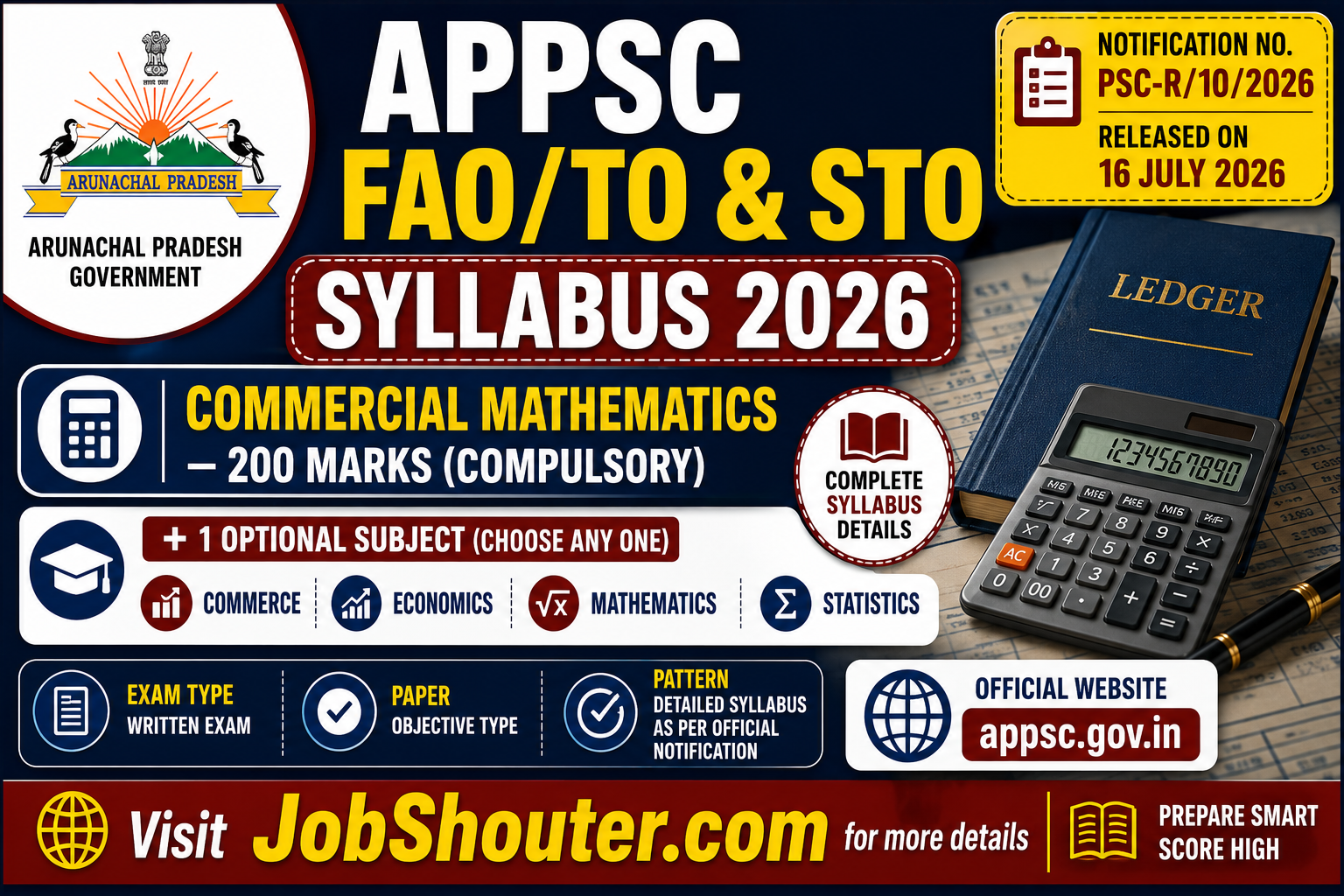
The Arunachal Pradesh Public Service Commission (APPSC) has notified the syllabus for direct recruitment to the posts of Finance and Accounts Officer/Treasury Officer (FAO/TO) and Sub-Treasury Officer (STO), vide Notification No. PSC-R/10/2026 dated 16 July 2026. The written test – referred to as the Recruitment Test (RT) – includes a compulsory Commercial Mathematics paper (200 Marks) along with one optional subject chosen by the candidate from Commerce, Economics, Mathematics, or Statistics, each carrying two papers. This guide breaks down the complete subject-wise syllabus, exam pattern, and preparation approach for FAO/TO and STO aspirants.
Important Note: This is a syllabus notification, not the full recruitment advertisement – the notification confirms Commercial Mathematics carries 200 Marks, but the number of questions, exam duration, and marks for the optional papers are NOT specified in the official syllabus release. Candidates should refer to the detailed recruitment advertisement (separate from this syllabus notice) for total vacancies, application dates, and complete exam scheme.
Overview
| Particulars | Details |
|---|---|
| Conducting Body | Arunachal Pradesh Public Service Commission (APPSC) |
| Posts | Finance and Accounts Officer/Treasury Officer (FAO/TO) and Sub-Treasury Officer (STO) |
| Recruitment Type | Direct Recruitment |
| Notification No. | PSC-R/10/2026 |
| Notification Date | 16 July 2026 |
| Exam Stage Named in Notification | Recruitment Test (RT) |
| Compulsory Paper | Commercial Mathematics – 200 Marks |
| Optional Subjects | Commerce, Economics, Mathematics, Statistics (each with Paper I and Paper II) |
| Official Website | appsc.gov.in |
APPSC FAO/TO and STO Exam Pattern 2026
Commercial Mathematics Paper (Recruitment Test)
| Paper | Marks |
|---|---|
| Commercial Mathematics | 200 |
Optional Subject Papers
| Optional Subject | Papers |
|---|---|
| Commerce | Paper I, Paper II |
| Economics | Paper I, Paper II |
| Mathematics | Paper I, Paper II |
| Statistics | Paper I, Paper II |
Note: The number of questions, duration, and marks for the optional subject papers are not specified in the official syllabus notification. Candidates should check the detailed recruitment advertisement for this information.
APPSC FAO/TO and STO Syllabus 2026 – Subject-Wise
1. Commercial Mathematics (Annexure-I – Recruitment Test, 200 Marks)
- Percentage: Conversion between fraction, decimal, percentage; percentage increase/decrease; comparison of percentages; successive percentage change; relationship between quantities using percentage
- Profit, Loss and Discount: Cost Price (CP), Selling Price (SP); profit/loss percentage; Marked Price (MP); trade discount; successive discount; profit or loss after discounts; equal profit and loss situations
- Simple Interest (SI): Principal, Rate, Time relationship; finding rate, time, principal; interest over different periods; multiple loans at different rates
- Compound Interest (CI): Annual compounding; half-yearly/quarterly compounding; difference between SI and CI; CI for fractional periods
- Banker’s Discount and Bills of Exchange: Bill of exchange; True Discount; Banker’s Discount; Banker’s Gain; present worth of a bill; time of bill
- Partnership and Division of Money: Investment sharing; profit distribution; division of sum with equal interest conditions; loans at different rates
- Ratio and Proportion: Ratio formation; ratio from percentage difference; comparison between numbers; proportion relationships; direct/indirect proportions
- Time and Interest Applications: Time value of money; settling accounts; present value calculations; interest for fractional time periods
- Probability: Probability formula; coin toss probability; simple problems on event outcome
- Linear Equations/Algebraic Word Problems: Forming equations from statements; solving single-variable equations, quadratic equations; percentage equations
- Time and Work: Arithmetic Mean, problems on Average Speed, Average Age, etc.; work rate problems; efficiency comparison; work-wages problems
- Basic Statistics: Mean; Median; Mode
2. Optional Paper – Commerce (Annexure-II)
(A) Paper I – Accounting and Finance, Taxation & Auditing
- Financial Accounting: Accounting as a financial information system; impact of behavioural sciences; Accounting Standards for Depreciation, Inventories, R&D Costs, Long-term Construction Contracts, Revenue Recognition, Fixed Assets, Contingencies, Foreign Exchange Transactions, Investments, Government Grants, Cash Flow Statement; accounting for share capital transactions including Bonus/Rights Shares; ESOP and Buy-Back of Securities; company final accounts; amalgamations, absorption and reconstruction
- Cost Accounting: Nature and functions of cost accounting; cost accounting system installation; cost concepts related to income measurement, profit planning, cost control and decision making; Job/Contract/Process/Activity-Based Costing; volume-cost-profit relationship; differential costing; budgeting, standard costing and variance analysis; responsibility accounting
- Taxation: Income Tax basis of charge; incomes not forming part of total income; computation of total income and tax liability (individuals) – Salaries, House Property, Business/Profession, Capital Gains, other sources; set-off and carry forward of loss; deductions from Gross Total Income; VAT and GST provisions
- Auditing: Internal check and control; Company Audit (Divisible Profits, Dividends, Special investigations, Tax audit); Audit of Banking, Insurance, Non-Profit Organizations and Charitable Trusts
(B) Paper I – Financial Management, Financial Institutions and Markets
- Financial Management: Finance function – nature, scope, objectives; risk and return; ratio analysis, funds-flow, cash-flow; capital budgeting; cost of capital, CAPM; capital structure theories (NI, NOI, MM, Traditional); leverages, EBIT-EPS analysis; dividend decisions (Walter’s, MM, Gordon’s, Lintner’s Models); working capital management
- Financial Markets and Institutions: Indian Financial System overview; Money Markets – RBI regulation, banking reforms, monetary/credit policy; Capital Market – primary/secondary, SEBI regulation; Financial Services – mutual funds, venture capital, credit rating, insurance, IRDA
(C) Paper II – Organisation Theory and Behaviour, HRM and Industrial Relations
- Organisation Theory: External environment; organisational goals; classical, neo-classical and system approaches; organisational design, structure and culture; power sources and structure; IT’s impact on organisational design
- Organisation Behaviour: Personality theories; perception; motivation theories; leadership theories/styles; QWL, Quality Circles; conflict management; transactional analysis; organisational effectiveness; change management
- Human Resources Management: HR planning; job analysis/description/specification; recruitment and selection; orientation, training and development; performance appraisal and 360° feedback; salary/wage administration; job evaluation; employee welfare; promotions/transfers/separations
- Industrial Relations: Trade unions and legislation; trade union movement in India; impact of liberalization; industrial disputes – strikes, lockouts; workers’ participation in management; adjudication, reconciliation, collective bargaining; absenteeism and labour turnover; ILO functions
3. Optional Paper – Economics (Annexure-III)
(A) Paper I
- Advanced Micro-Economics: Marshallian and Walrasian price determination; distribution theories (Ricardo, Kaldor, Kaleeki); market structures – monopolistic competition, duopoly, oligopoly; welfare criteria (Pareto, Hicks, Scitovsky); Arrow’s Impossibility Theorem; Sen’s Social Welfare Function
- Advanced Macro-Economics: Classical, Keynes’ IS-LM, neo-classical synthesis, new classical approaches; interest rate theories
- Money-Banking and Finance: Demand/supply of money; quantity theory (Fisher, Pigou, Friedman); Keynes’ demand for money theory; monetary management goals; public finance role; government revenue/taxation/subsidies; public expenditure
- International Economics: Trade theories – comparative advantage, terms of trade, offer curve; gravity model, outsourcing; tariffs and quotas; BOP adjustment theories; WTO (TRIMS, TRIPS)
- Growth and Development: Harrod’s model, Lewis model, balanced-unbalanced growth; economic development processes; welfare indicators (HDI, basic needs); environmental sustainability
(B) Paper II
- Indian Economy – Post-Independence Era: Land system changes; commercialization of agriculture; drain theory; manufacture and transport
- Pre-Liberalization Era: Mahalanobis, Vakil, Gadgil, V.K.R.V. Rao contributions; land reforms, Green Revolution; industry composition/growth; national income patterns; poverty and inequality measures
- Post-Liberalization Era: Agriculture and WTO; industrialization strategy, privatization, FDI; trade policy, TRIPS/TRIMS/GATS; exchange rate regime; FRBM Act, fiscal federalism; monetary system role of RBI; central to indicative planning; employment/poverty alleviation schemes
4. Optional Paper – Mathematics (Annexure-IV)
(A) Paper I
- Linear Algebra: Vector spaces, linear transformations, matrices, eigenvalues/eigenvectors, Cayley-Hamilton theorem, symmetric/Hermitian/orthogonal matrices
- Calculus: Limits, continuity, differentiability, mean-value theorem, Taylor’s theorem, maxima-minima; functions of multiple variables; Riemann integrals, double/triple integrals
- Analytic Geometry: Cartesian/polar coordinates in 3D; straight lines, planes, sphere, cone, cylinder, paraboloid, ellipsoid, hyperboloid
- Ordinary Differential Equations: First-order/first-degree equations; Clairaut’s equation; second/higher order linear equations; Laplace transforms
- Dynamics and Statics: Rectilinear motion, SHM, projectiles; Kepler’s laws; equilibrium of particles; virtual work
- Vector Analysis: Gradient, divergence, curl; Gauss and Stokes’ theorems; Serret-Frenet’s formulae
(B) Paper II
- Algebra: Groups, rings, ideals, fields, homomorphisms, Lagrange’s Theorem, Cayley’s theorem
- Real Analysis: Sequences, series, convergence; continuity, Riemann integral; partial derivatives
- Complex Analysis: Analytic functions, Cauchy-Riemann equations, Cauchy’s integral formula, Laurent’s series, residue theorem
- Linear Programming: Basic/feasible/optimal solutions; graphical and simplex methods; duality
- Partial Differential Equations: Quasilinear PDEs, Cauchy’s method; second-order linear PDEs; vibrating string, heat and Laplace equations
- Numerical Analysis and Computer Programming: Bisection, Regula-Falsi, Newton-Raphson; Gaussian Elimination; interpolation, numerical integration; binary systems, Boolean algebra
- Mechanics and Fluid Dynamics: Lagrange’s equations; Hamilton equations; moment of inertia; Navier-Stokes equation
5. Optional Paper – Statistics (Annexure-V)
(A) Paper I
- Probability: Sample space, distribution functions, expectation and moments; law of large numbers; central limit theorem; standard probability distributions
- Statistical Inference: Consistency, unbiasedness, efficiency, sufficiency; UMVU estimation; maximum likelihood; hypothesis testing, Neyman-Pearson lemma; goodness of fit tests; Wald’s SPRT
- Linear Inference and Multivariate Analysis: Least squares, analysis of variance; regression analysis; multivariate normal distribution, Hotelling’s T²
- Sampling Theory and Design of Experiments: SRS, stratified, systematic, cluster sampling; CRD, RBD, LSD; BIBD, factorial experiments
(B) Paper II
- Industrial Statistics: Control charts; sampling plans for attributes/variables; reliability functions; life testing
- Optimization Techniques: Linear Programming, simplex method; transportation/assignment problems; queuing theory; Markov chains
- Quantitative Economics and Official Statistics: Trend/seasonal/cyclical analysis; Box-Jenkins method, ARIMA models; index numbers (Laspeyre’s, Paasche’s, Fisher’s); OLS/GLS methods
- Demography and Psychometry: Census/registration data; vital rates, life tables; population growth curves; factor analysis, path analysis
How to Prepare for APPSC FAO/TO and STO Exam 2026
- Start with the Commercial Mathematics syllabus first, since it’s compulsory for every candidate regardless of the optional subject chosen – build speed on Percentage, SI/CI, Profit-Loss and Time-Work problems, as these cover the bulk of the 200-mark paper.
- Pick your optional subject (Commerce, Economics, Mathematics or Statistics) based on your academic background, since each has two full papers with postgraduate-level depth.
- Make a topic-wise timetable that maps each Annexure to weekly targets, rather than studying subjects randomly.
- Practice previous APPSC question papers and other state PSC finance-related papers to get familiar with the question style, since official past papers for this specific post are not yet available.
- Revise standard postgraduate-level reference textbooks for your chosen optional subject, since topics like Statistical Inference, Complex Analysis, and Financial Management match university-level depth.
- Keep a separate revision file for formulas (Commercial Mathematics) and theorems (Mathematics/Statistics optional), and revise it in the last month before the exam.
Important Links
| Action | Link |
|---|---|
| Download APPSC FAO/TO and STO Syllabus PDF | Click Here |
| Official APPSC Website | Click Here |
Frequently Asked Questions (FAQs)
Q1. What is the APPSC FAO/TO and STO syllabus 2026?
✅ The syllabus covers Commercial Mathematics (200 Marks) as a compulsory paper in the Recruitment Test, plus one optional subject – Commerce, Economics, Mathematics, or Statistics (each with two papers) – as notified by APPSC on 16 July 2026.
Q2. What is the exam pattern for APPSC FAO/TO and STO 2026?
✅ The official notification confirms Commercial Mathematics carries 200 Marks. The number of questions, exam duration, and marks for the optional papers are not specified in the official notification.
Q3. Is the APPSC FAO/TO syllabus the same as the APPSC STO syllabus?
✅ Yes. The official notification issues one common syllabus (Commercial Mathematics plus optional subject papers) for both Finance and Accounts Officer/Treasury Officer (FAO/TO) and Sub-Treasury Officer (STO) posts.
Q4. How many optional subjects can I choose for the APPSC FAO/TO and STO exam?
✅ The notification lists four optional subjects – Commerce, Economics, Mathematics, and Statistics. It does not explicitly state whether more than one optional subject can be chosen; candidates should refer to the detailed recruitment advertisement for this clarification.
Q5. Where can I download the APPSC FAO/TO and STO syllabus PDF?
✅ The official syllabus PDF is available on the APPSC website at appsc.gov.in.
Q6. What topics dominate the Commercial Mathematics paper?
✅ Key areas include Percentage, Profit-Loss-Discount, Simple and Compound Interest, Banker’s Discount, Partnership, Ratio and Proportion, Probability, Linear Equations, Time and Work, and Basic Statistics – covering the full 200-mark compulsory paper.
Q7. Which optional subject should I choose for this exam?
✅ Choose based on your academic background – Commerce (Accounting, Finance, Taxation, HRM), Economics (Micro/Macro theory, Indian economy), Mathematics (Algebra, Calculus, Differential Equations), or Statistics (Probability, Inference, Sampling Theory) – each demands postgraduate-level depth.
Q8. Does this syllabus notification include the total vacancies and application dates?
✅ No. This is a syllabus-only notification. Total vacancies, application start/end dates, and fee details are not part of this release – candidates should check the separate detailed recruitment advertisement from APPSC.
Disclaimer: All information provided is for reference purposes only. Candidates are advised to verify the complete and updated syllabus, exam pattern, and recruitment details from the official APPSC website at appsc.gov.in and the detailed recruitment advertisement before beginning their preparation.