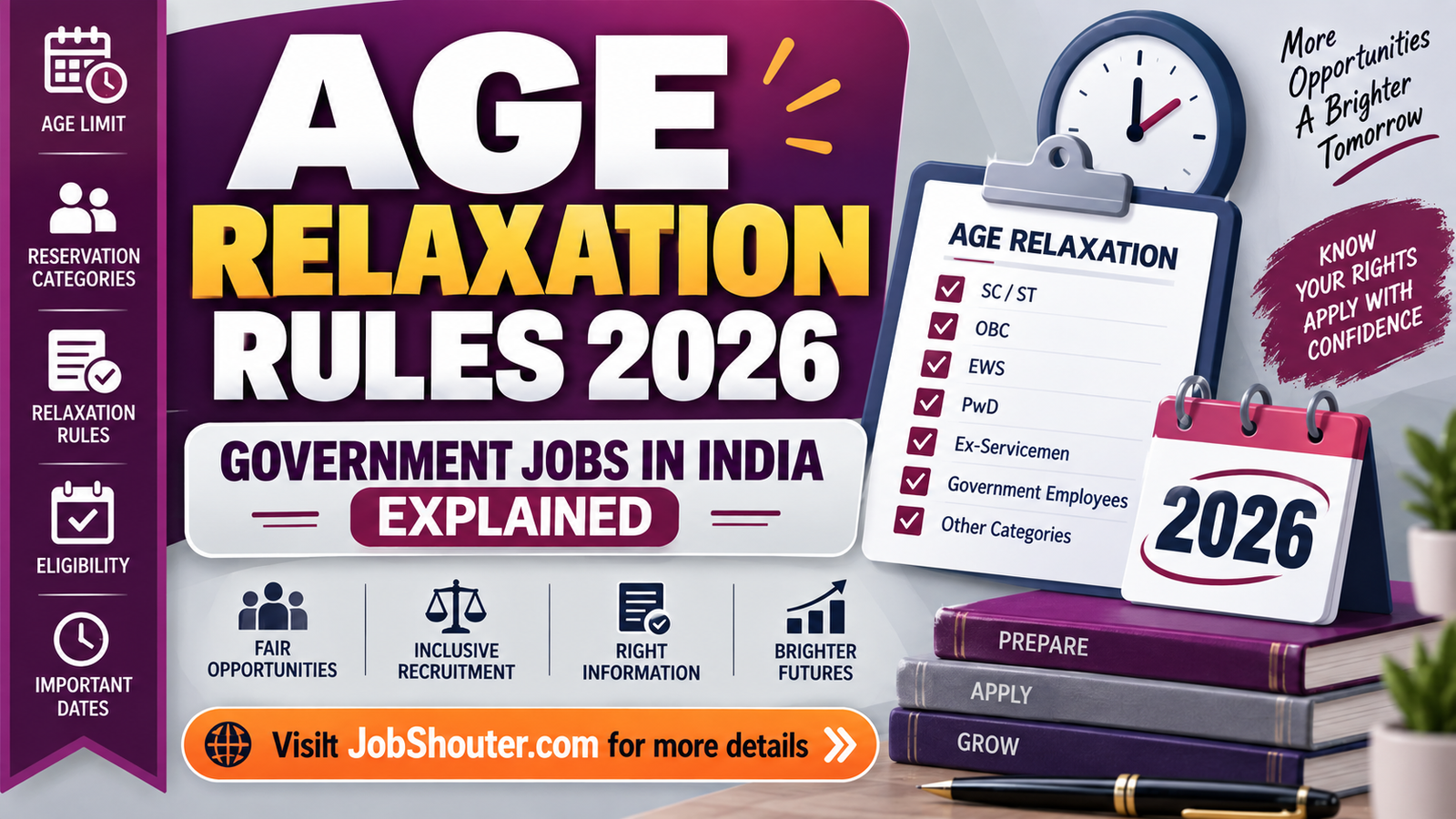
One of the most searched questions among government job aspirants in India is about age limit and age relaxation, since eligibility for almost every recruitment, from SSC and Railways to State PSCs and Police, depends heavily on how old a candidate is and which reservation category they belong to. This complete guide explains the standard age relaxation rules applicable in most central and state government recruitments in India for 2026, covering OBC, SC/ST, EWS, PwBD, Ex-Servicemen, government employees, and other special categories.
Why Age Limit Matters in Government Jobs
Almost every government recruitment notification specifies a minimum and maximum age limit as of a particular cutoff date, and candidates falling outside this range are not eligible to apply regardless of their qualifications. Since India’s reservation policy also extends to age relaxation, candidates from reserved categories often get additional years added to the standard upper age limit, which significantly widens their eligibility window compared to general category candidates.
Standard Age Relaxation by Category
OBC (Non-Creamy Layer) Candidates
OBC candidates belonging to the non-creamy layer typically receive an age relaxation of 3 years over the general category upper age limit. To claim this relaxation, candidates must possess a current, valid OBC Non-Creamy Layer certificate that explicitly states the non-creamy layer status, since a caste certificate without this specific mention is usually not accepted for reservation purposes.
SC/ST Candidates
Scheduled Caste and Scheduled Tribe candidates typically receive an age relaxation of 5 years over the general category upper age limit across most central government exams. Unlike the OBC certificate, the SC/ST caste certificate issued by a competent authority does not require annual renewal and remains valid as a permanent document.
EWS (Economically Weaker Section) Candidates
Economically Weaker Section candidates generally do not receive any age relaxation, since the EWS category provides only 10 percent reservation in vacancies and follows the same age limit as the general category. Candidates should not confuse EWS reservation with a relaxation in age eligibility.
PwBD (Persons with Benchmark Disability) Candidates
Persons with Benchmark Disability, holding a certified disability of 40 percent or more, typically receive a base age relaxation of 10 years over the general category limit. This relaxation is also combinable with other category relaxations, so a PwBD candidate who also belongs to OBC may get a combined relaxation of around 13 years, and a PwBD candidate belonging to SC/ST may get a combined relaxation of around 15 years, though exact combined figures should always be verified against the specific recruitment notification.
Ex-Servicemen
Ex-servicemen applying for Group C and Group D posts typically get age relaxation equal to the length of their military service, plus 3 years, subject to the condition that the resultant age does not exceed the upper age limit for the post by more than 3 years. The exact relaxation formula can vary slightly between central and state recruitments.
Government Employees
Candidates already working in government service often receive an age relaxation of up to 5 years when applying for posts through open competitive examinations, and a relaxation of up to 3 years when applying through recruitment channels specific to serving employees, though this varies by recruiting body and specific notification.
Widows, Divorced, and Judicially Separated Women
In several state and central recruitments, widowed, divorced, or judicially separated women who have not remarried are given a special age relaxation, sometimes extending the upper age limit up to 35 years for general category, 38 years for OBC, and 40 years for SC/ST candidates, though this relaxation is not universally applicable across all exams and should be checked in the specific notification.
Important Points About Age Proof and Certificates
For age verification, most recruiting bodies accept only the Class 10 (Matriculation) certificate or mark sheet showing the date of birth, and generally reject Aadhaar cards, voter ID cards, or PAN cards as valid age proof. OBC-NCL certificates typically need to be renewed annually, usually valid from April to March, so candidates should ensure their certificate is current at the time of application. EWS certificates must reflect income and asset details of the previous financial year and also require periodic renewal.
Key Points to Remember
Since age relaxation rules can vary meaningfully between different recruiting bodies, such as SSC, Railways, UPSC, banking institutions, and individual state public service commissions, candidates should always cross-check the specific relaxation rules and required certificate format mentioned in the particular recruitment notification rather than assuming a uniform rule applies everywhere. It is also advisable to keep updated category and income certificates ready well in advance, since certificate renewal can take time and delays can result in a candidate missing an application deadline.
Frequently Asked Questions (FAQs)
1. How much age relaxation do OBC candidates get in government jobs?
OBC Non-Creamy Layer candidates typically get 3 years of age relaxation over the general category upper age limit.
2. How much age relaxation do SC/ST candidates get?
SC/ST candidates typically get 5 years of age relaxation over the general category upper age limit.
3. Do EWS candidates get any age relaxation?
No, EWS candidates generally do not get any age relaxation and follow the same age limit as the general category.
4. How much age relaxation do PwBD candidates get?
PwBD candidates typically get a base relaxation of 10 years, which can combine with other category relaxations depending on the specific recruitment rules.
5. What age relaxation do ex-servicemen get in government jobs?
Ex-servicemen typically get relaxation equal to their military service period plus 3 years, subject to a cap on the resultant age.
6. Which document is accepted as age proof in government job applications?
The Class 10 (Matriculation) certificate or mark sheet showing date of birth is generally the only accepted age proof; Aadhaar and voter ID are usually not accepted.
7. Does age relaxation apply uniformly across all government exams?
No, age relaxation rules can vary between recruiting bodies, so candidates should always verify the specific rule mentioned in each notification.
8. Is there age relaxation for widows and divorced women in government jobs?
Yes, some recruitments offer special age relaxation for widowed, divorced, or judicially separated women, though this is not universal and should be checked per notification.
9. Does OBC-NCL certificate need to be renewed every year?
Yes, OBC Non-Creamy Layer certificates typically need to be renewed annually to remain valid for reservation and age relaxation purposes.
10. Can PwBD and category-based age relaxation be combined?
Yes, in most cases PwBD relaxation can combine with OBC or SC/ST relaxation, but candidates should confirm the exact combined figure from the specific recruitment notification.
Disclaimer: JobShouter.com is not affiliated with any government recruiting body. Shared for informational purposes only, please verify details on the official website.