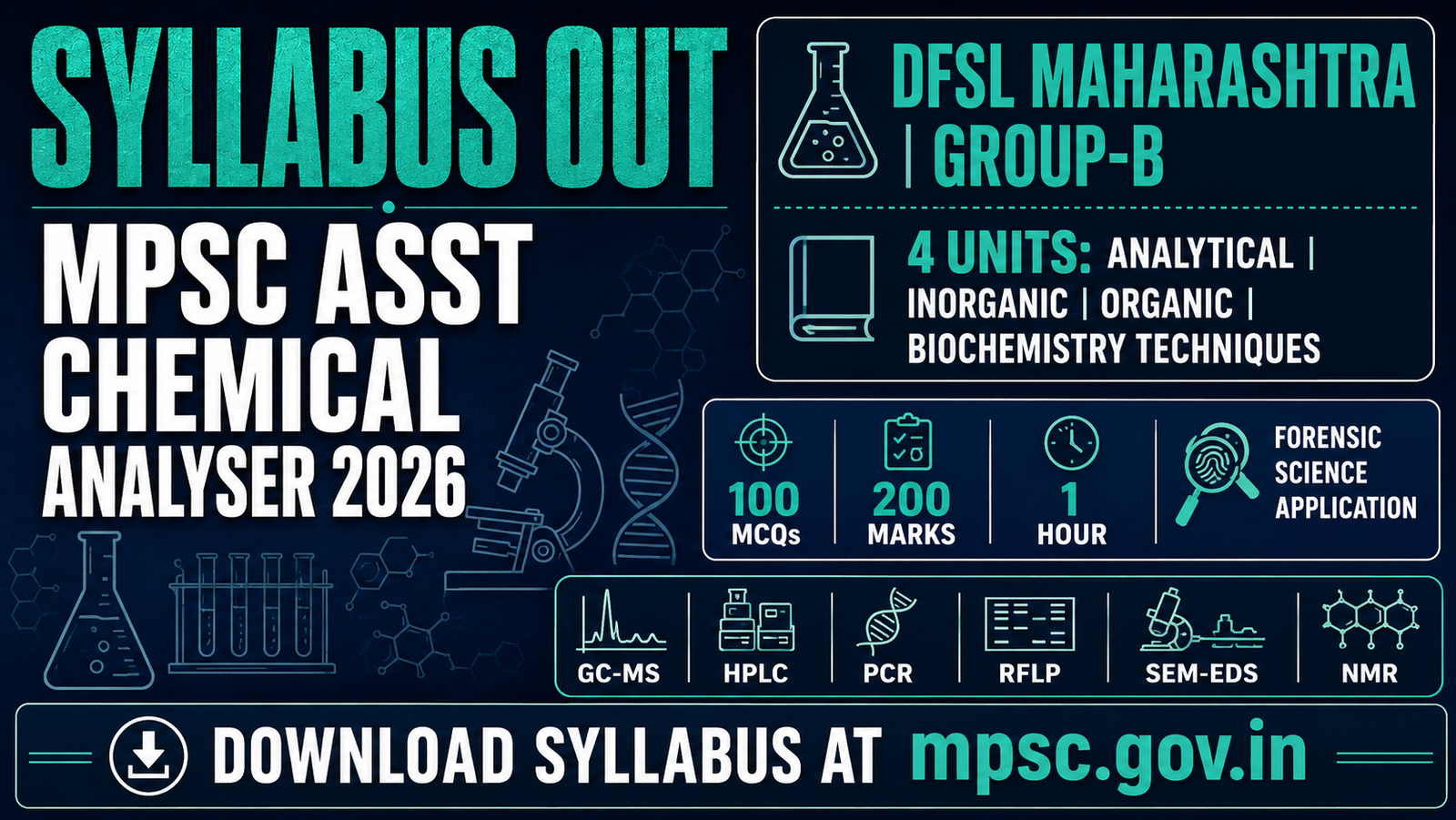
The Maharashtra Public Service Commission (MPSC) has released the Syllabus for the post of Assistant Chemical Analyser under the Directorate of Forensic Science Laboratories (DFSL), General State Services, Group-B, Home Department, Government of Maharashtra. The syllabus covers 4 subject areas: Analytical Chemistry (basic aspects, statistics, titrimetry, gravimetry and separation techniques), Analytical Techniques in Inorganic Chemistry (spectroscopy, microscopy and electroanalytical methods), Analytical Techniques in Organic Chemistry (spectroscopy, chromatography and organic sample analysis), and Analytical Techniques in Biochemistry (biomolecules, molecular biology, electrophoresis, isotope tracer technique, enzymes and biological sample examination). The exam is 100 objective questions for 200 marks in a duration of 1 hour, as per the syllabus document. Candidates should verify the complete exam pattern and marks distribution from the official MPSC portal at mpsc.gov.in since a detailed official notification may contain further specifics.
Important Note: Three things every candidate preparing for this exam must understand from the start. First, this is a forensic science application post – the syllabus is structured around how chemistry techniques are applied to forensic samples (drugs, poisons, biological fluids, soil, glass, metals), not just theoretical chemistry. Questions will test whether you know which instrument to use for which sample type in a forensic context. The Organic Chemistry unit specifically lists pharmaceutical and narcotic drugs, alcohol estimation, petroleum products, pesticides and insecticides – all of which are real forensic analysis scenarios. Prepare with that application lens, not just from a pure chemistry textbook. Second, the Biochemistry unit is as important as the Chemistry units – Unit 4 covering DNA isolation, PCR, RFLP, ELISA, SDS-PAGE, blood grouping, semen and hair examination is forensic biology in application, and is directly relevant to a DFSL role. Do not underweight it as a secondary topic. Third, the exam is 100 questions in 1 hour – that is only 36 seconds per question if all 100 are attempted. Speed and accuracy together are critical. Practise solving analytical chemistry and instrumentation MCQs under timed conditions, not just reading the concepts.
MPSC Assistant Chemical Analyser Syllabus 2026 – Overview
| Particulars | Details |
|---|---|
| Conducting Body | Maharashtra Public Service Commission (MPSC) |
| Post | Assistant Chemical Analyser |
| Department | Directorate of Forensic Science Laboratories (DFSL), Home Department, Government of Maharashtra |
| Service Category | General State Services, Group-B |
| Number of Syllabus Units | 4 |
| Total Questions | 100 |
| Total Marks | 200 |
| Exam Duration | 1 hour (60 minutes) |
| Exam Type | Objective (MCQ) |
| Official Website | mpsc.gov.in |
Exam Pattern
| Component | Details |
|---|---|
| Number of Questions | 100 |
| Total Marks | 200 (2 marks per question) |
| Duration | 1 hour |
| Type | Objective MCQ |
| Negative Marking | Not specified in the syllabus document; verify from the official MPSC notification at mpsc.gov.in |
| Medium | As per MPSC norms – verify from official notification |
The exam pattern details (particularly negative marking and exam medium) should be confirmed from the official detailed notification on mpsc.gov.in before the exam.
Complete Syllabus – Unit-wise
Unit 1 – Analytical Chemistry
(A) Basic Aspects
Sampling of solid, liquid and gas samples; molecular and equivalent weight; molarity, molality and normality; solution preparation in w/w, w/v and v/v terms; mole concept, concentrations in ppm, ppb and ppt; calibration and validation – calibration curve, regression analysis, external standard, internal standard and standard addition method.
(B) Statistical Treatment of Results
Accuracy, precision, sensitivity and detection limit; types of errors; mean, median, standard deviation and relative standard deviation; Gaussian curve, t-test, F-test and confidence interval; criteria for selection of analytical methods – accuracy, precision, sensitivity, selectivity, specificity and detection limit.
(C) Titrimetry
Types of titrations – acid-base, complexometric, redox and precipitation; primary and secondary standards used for standardisation; potentiometric and conductometric titrations and their applications.
(D) Gravimetric and Thermogravimetric Analysis
Precipitation and different precipitants in gravimetric analysis; pH requirement for precipitation; quantitative analysis; thermogravimetric analysis; mass spectrometry for qualitative and quantitative analysis, and related problems.
(E) Separation Techniques
Extraction methods; distillation methods – vacuum distillation, steam distillation and fractional distillation; purification and identification of substances.
Unit 2 – Analytical Techniques in Inorganic Chemistry for Different Inorganic Samples
(A) Spectroscopy and Chromatography
Atomic Absorption Spectroscopy (AAS); Atomic Emission Spectroscopy (AES); Inductively Coupled Plasma-AES (ICP-AES) and ICP-Mass Spectrometry (ICP-MS); UV-Visible spectroscopy for qualitative and quantitative analysis, Job’s Method and applications; Ion exchange chromatography for analysis of inorganic cations and anions.
(B) Microscopy for Inorganic Sample Analysis
Trace and heavy metal, glass, soil and liquid sample analysis using Scanning Electron Microscopy (SEM) and Energy Dispersive Spectroscopy (EDS).
(C) Electroanalytical Techniques
Coulometry and its types; amperometry; voltammetry; cyclic voltammetry; stripping voltammetry; polarography.
Unit 3 – Analytical Techniques in Organic Chemistry
(A) Spectroscopy
Theory and application of UV-Visible, IR (FTIR), Raman, NMR and Mass Spectrometry; interpretation of spectra and structure elucidation.
(B) Separation Techniques
TLC and HPTLC; GC (Gas Chromatography) and GC-MS; LC-MS and HRMS; column chromatography and paper chromatography; HPLC – ion exchange chromatography, adsorption chromatography, normal and reverse phase chromatography, solid phase extraction.
(C) Organic Analysis – Forensic Applications
Pharmaceutical and narcotic drugs and psychotropic substances; alcohol estimation; petroleum products, paints and dyes, rubber, plastic and fibres; organic poisons including insecticides, pesticides and herbicides.
Unit 4 – Analytical Techniques in Biochemistry
(A) Biomolecules
Structure, functions and estimation of carbohydrates, lipids, proteins and nucleic acids; biological buffers.
(B) Molecular Biology Techniques
DNA isolation and DNA quantification; PCR (Polymerase Chain Reaction); RT-PCR; RFLP (Restriction Fragment Length Polymorphism); ELISA (Enzyme-Linked Immunosorbent Assay); RIA (Radio Immuno Assay); antigen-antibody reactions.
(C) Separation and Electrophoresis Techniques
SDS-PAGE; one-dimensional and two-dimensional PAGE; isoelectric focusing; gel filtration chromatography; affinity chromatography; high voltage electrophoresis; agarose electrophoresis; capillary electrophoresis.
(D) Isotope Tracer Technique
Basic concepts and principles; advantages, limitations and applications in biochemistry.
(E) Enzymes
Enzyme classification and isoenzymes; DNA polymerase; enzyme kinetics (basic).
(F) Biological Sample Examination – Forensic Applications
Blood group systems; semen examination; saliva, urine, hair and sweat analysis; biological stains and their preservation; human and animal blood and body fluid differentiation.
Key Instruments and Techniques to Know Well
| Technique or Instrument | Unit | Forensic Application |
|---|---|---|
| ICP-AES and ICP-MS | 2 | Trace metal analysis, gunshot residue, soil |
| SEM-EDS | 2 | Glass fragments, metal particles, fibre analysis |
| GC-MS | 3 | Drug identification, alcohol, petroleum products |
| HPLC (reverse phase and ion exchange) | 3 | Pharmaceutical drugs, pesticides |
| FTIR and Raman | 3 | Paint, fibre, drug identification without destruction |
| NMR | 3 | Structure elucidation of organic compounds |
| PCR and RT-PCR | 4 | DNA profiling, biological evidence |
| RFLP | 4 | DNA fingerprinting in forensic biology |
| ELISA and RIA | 4 | Drug screening in blood or urine |
| SDS-PAGE and 2D-PAGE | 4 | Protein profiling, species identification |
| ABO and other blood group systems | 4 | Identification of biological evidence |
Preparation Strategy for MPSC Assistant Chemical Analyser 2026
Step 1 – Build a strong foundation in Analytical Chemistry (Unit 1) first. Statistical treatment of results (t-test, F-test, standard deviation, confidence interval) and titration types are foundational topics. Every later unit assumes this base.
Step 2 – Study instruments by principle, working and forensic application. For GC-MS, know not just the principle but what types of samples it handles in a forensic lab. For SEM-EDS, know trace metal analysis use cases. MPSC DFSL questions test application, not just textbook definitions.
Step 3 – Do not underweight Unit 4 (Biochemistry). PCR, RFLP, ELISA, SDS-PAGE, blood grouping, semen and hair examination are all standard DFSL procedures. Questions on biological evidence and its analysis are very likely.
Step 4 – Speed is critical. 100 questions in 60 minutes means 36 seconds per question. Practise MCQs in chemistry and forensic science under strict time conditions. Do not attempt mock tests without a timer.
Step 5 – Revise electrophoresis and chromatography techniques systematically. Unit 4 has multiple electrophoresis variants (SDS-PAGE, 2D-PAGE, agarose, capillary, high voltage). Know which is used for what biological matrix and why.
Step 6 – Check mpsc.gov.in for exam date, admit card and any changes to the notified exam pattern, especially negative marking and medium. All updates are on the official MPSC portal.
Important Links
| Description | Link |
|---|---|
| MPSC Official Website and Syllabus | Click Here |
| DFSL Maharashtra Official Website | Click Here |
MPSC Assistant Chemical Analyser Syllabus 2026 – FAQs
Q1. What is the MPSC Assistant Chemical Analyser Syllabus 2026?
✅ It is the official syllabus released by the Maharashtra Public Service Commission (MPSC) for the post of Assistant Chemical Analyser under the Directorate of Forensic Science Laboratories (DFSL), Home Department, Government of Maharashtra, Group-B General State Services. The syllabus covers 4 units: Analytical Chemistry, Inorganic Chemistry Techniques, Organic Chemistry Techniques and Biochemistry Techniques.
Q2. What is the exam pattern for MPSC Assistant Chemical Analyser?
✅ As per the syllabus document: 100 objective MCQ questions, 200 marks, 1-hour duration. Negative marking and exam medium are not specified in the syllabus document; verify from the official MPSC notification on mpsc.gov.in.
Q3. What are the 4 units in the syllabus?
✅ Unit 1 – Analytical Chemistry: Basic concepts, statistical treatment, titrimetry, gravimetry and separation techniques. Unit 2 – Inorganic Chemistry Techniques: AAS, ICP-AES, ICP-MS, SEM-EDS, UV-Vis, ion exchange chromatography and electroanalytical methods. Unit 3 – Organic Chemistry Techniques: UV-Vis, FTIR, Raman, NMR, Mass Spec, GC, GC-MS, HPLC, LC-MS, TLC, and forensic organic sample analysis. Unit 4 – Biochemistry Techniques: Biomolecules, DNA isolation, PCR, RFLP, ELISA, electrophoresis, enzymes and forensic biological sample examination.
Q4. Which department does the Assistant Chemical Analyser work under?
✅ The Directorate of Forensic Science Laboratories (DFSL), Home Department, Government of Maharashtra. The DFSL conducts scientific examination of physical evidence for criminal investigations, including chemical, biological and physical evidence analysis.
Q5. Is there negative marking in the MPSC Assistant Chemical Analyser exam?
✅ The syllabus document does not specify negative marking. This must be confirmed from the official detailed notification on mpsc.gov.in before the exam.
Q6. What is the time per question given the exam pattern?
✅ With 100 questions in 60 minutes, there are on average 36 seconds per question. This is a very short window and demands speed and accuracy through consistent MCQ practice under timed conditions.
Q7. Which topics in the Organic Chemistry unit are most forensically relevant?
✅ Pharmaceutical and narcotic drugs, psychotropic substances, alcohol estimation, petroleum products, paints and dyes, and organic poisons including insecticides, pesticides and herbicides – all are real DFSL case types. GC-MS, HPLC and FTIR are the primary instruments used in these analyses.
Q8. What molecular biology techniques are in the syllabus?
✅ DNA isolation and quantification, PCR (Polymerase Chain Reaction), RT-PCR, RFLP (Restriction Fragment Length Polymorphism), ELISA (Enzyme-Linked Immunosorbent Assay), RIA (Radio Immuno Assay) and antigen-antibody reactions, all covered in Unit 4.
Q9. What biological sample types are in the syllabus?
✅ Blood group systems, semen, saliva, urine, hair, sweat, biological stains and their preservation, and differentiation of human versus animal origin biological samples. These form the core of forensic serology and biology, examined in Unit 4.
Q10. Where can I download the MPSC Assistant Chemical Analyser Syllabus PDF?
✅ From the official Maharashtra Public Service Commission website at mpsc.gov.in. Candidates should also check dfsl.maharashtra.gov.in for any department-specific recruitment notices.
Disclaimer
The information above relates to the syllabus released by the Maharashtra Public Service Commission (MPSC) for the post of Assistant Chemical Analyser under the Directorate of Forensic Science Laboratories (DFSL), Home Department, Government of Maharashtra, General State Services, Group-B. The exam pattern details (100 questions, 200 marks, 1 hour) are as stated in the syllabus document. Negative marking, exam medium and other exam-day specifics must be confirmed from the official detailed notification on mpsc.gov.in. The official MPSC portal at mpsc.gov.in is the sole authoritative source for all recruitment and exam details. All links above lead only to the official MPSC and DFSL Maharashtra Government websites.