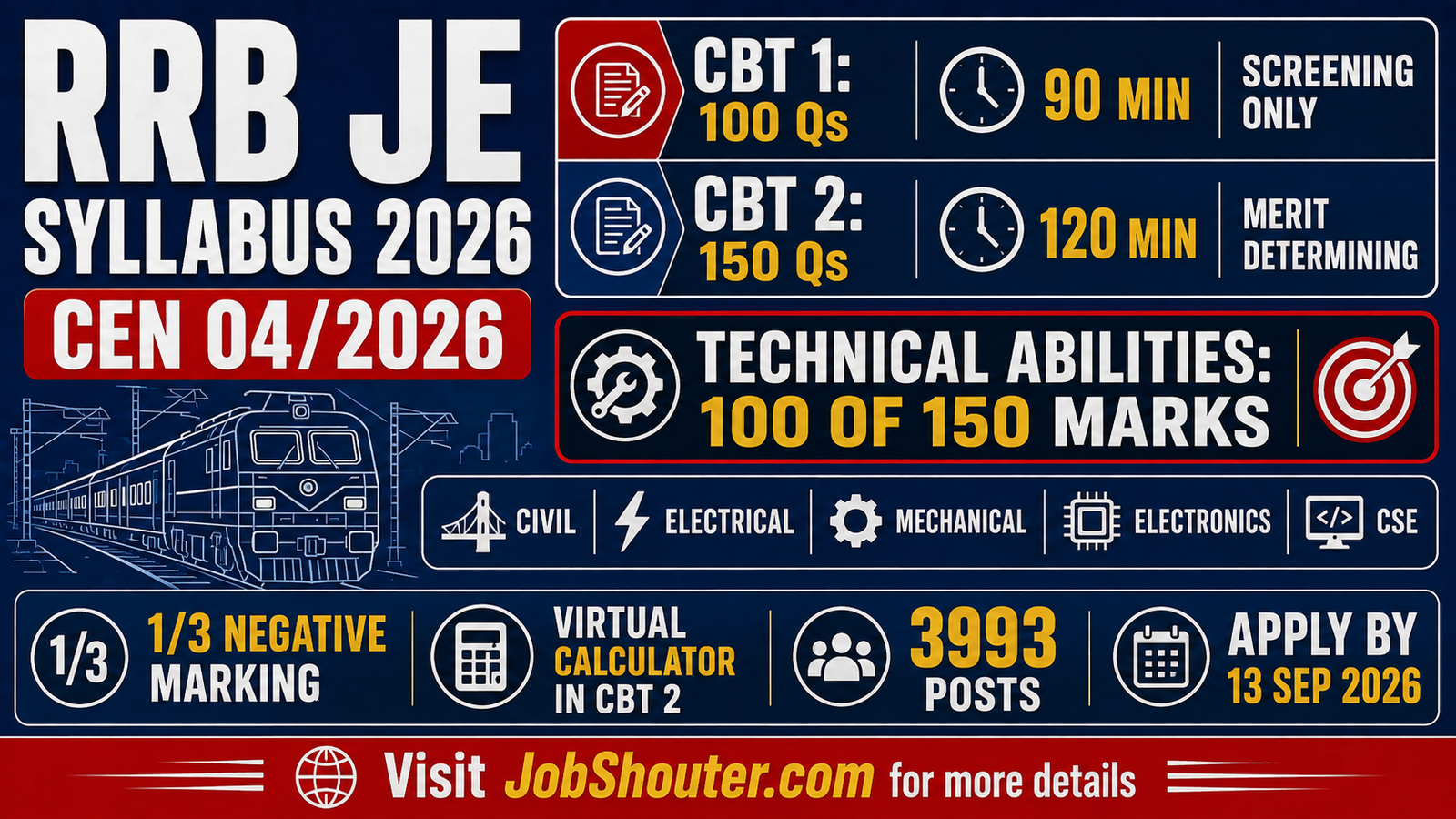
The Railway Recruitment Boards (RRBs), Ministry of Railways, Government of India, have released the complete Syllabus and Exam Pattern for RRB JE CEN 04/2026 covering 3993 Junior Engineer (JE) and Depot Material Superintendent (DMS) posts across Indian Railways. The selection process consists of a 1st Stage CBT (CBT 1) used purely for screening, followed by a 2nd Stage CBT (CBT 2) on which final merit is based, followed by Document Verification and Medical Examination. CBT 1 has 100 questions for 100 marks in 90 minutes. CBT 2 has 150 questions for 150 marks in 120 minutes, of which 100 marks are from branch-specific Technical Abilities. Both stages have negative marking of 1/3 mark per wrong answer. The branch-wise Technical Abilities syllabus for CBT 2 covers Civil and Allied Engineering, Electrical and Allied Engineering, Electronics and Telecommunication Engineering, Mechanical and Allied Engineering, Computer Science and Information Technology, Printing Technology and Chemical and Metallurgical Assistant (CMA).
Important Note: Three things every RRB JE aspirant must keep in mind from day one of preparation. First, CBT 1 is a screening test and its marks are NOT counted in final merit – only CBT 2 marks determine your final ranking. This means clearing CBT 1 is a binary gate – you either pass and move to CBT 2, or you don’t. Do not over-prepare for CBT 1 at the cost of CBT 2 technical preparation, especially since only 15 times the vacancy count is shortlisted to CBT 2. Second, Technical Abilities in CBT 2 accounts for 100 out of 150 marks – it is by far the dominant section in the merit-determining stage. A candidate who scores 85 in Technical Abilities and 50 in the remaining four sections will consistently outperform a candidate who scores 65 in Technical Abilities but aces the common sections. Concentrate the bulk of your preparation time on your specific branch’s technical topics. Third, a virtual calculator is available in CBT 2 – use this facility for numerical technical questions rather than rushing through them. In CBT 1, no calculator is available, so practise mental arithmetic for the Mathematics section.
RRB JE Syllabus and Exam Pattern 2026 – Overview
| Particulars | Details |
|---|---|
| Conducting Body | Railway Recruitment Boards (RRBs), Ministry of Railways, Government of India |
| Recruitment | CEN 04/2026 (JE and DMS) |
| Posts | Junior Engineer (JE), Depot Material Superintendent (DMS) |
| Total Vacancies | 3993 |
| Application Window | 14 August 2026 to 13 September 2026 |
| Selection Stages | CBT 1 (screening), CBT 2 (merit), Document Verification, Medical Examination |
| CBT 1 Total Questions and Marks | 100 questions, 100 marks, 90 minutes |
| CBT 2 Total Questions and Marks | 150 questions, 150 marks, 120 minutes |
| Negative Marking | 1/3 mark per wrong answer (both stages) |
| Merit Determination | CBT 2 marks only |
| Virtual Calculator | Available in CBT 2 only |
| Official Website | rrb.indianrailways.gov.in |
Selection Process
| Stage | Nature | Details |
|---|---|---|
| 1st Stage CBT (CBT 1) | Screening | 100 MCQs, 90 minutes. Shortlists up to 15 times the vacancy to CBT 2 |
| 2nd Stage CBT (CBT 2) | Merit determination | 150 MCQs, 120 minutes. Branch-specific technical paper. Final merit based on this |
| Document Verification | Eligibility check | Shortlisting at 1:1 ratio (equal to vacancy count) from CBT 2 merit list |
| Medical Examination | Fitness check | Post-specific medical standard (A-3, B-1, B-2 or C-1 as per Annexure A of CEN) |
CBT 1 marks are not added to CBT 2 marks for final merit.
CBT 1 Exam Pattern
| Subject | Questions | Marks |
|---|---|---|
| Mathematics | 30 | 30 |
| General Intelligence and Reasoning | 25 | 25 |
| General Awareness | 15 | 15 |
| General Science | 30 | 30 |
| Total | 100 | 100 |
Duration: 90 minutes (120 minutes for candidates using a scribe). Negative marking: 1/3 mark per wrong answer. All MCQ type.
CBT 2 Exam Pattern
| Subject | Questions | Marks |
|---|---|---|
| General Awareness | 15 | 15 |
| Physics and Chemistry | 15 | 15 |
| Basics of Computer Applications | 10 | 10 |
| Basics of Environment and Pollution Control | 10 | 10 |
| Technical Abilities (branch-specific) | 100 | 100 |
| Total | 150 | 150 |
Duration: 120 minutes (160 minutes for candidates using a scribe). Negative marking: 1/3 mark per wrong answer. Virtual calculator provided on screen. All MCQ type.
Minimum Qualifying Marks in CBT 2
| Category | Minimum Qualifying Percentage |
|---|---|
| UR and EWS | 40% |
| OBC-NCL and SC | 30% |
| ST | 25% |
PwBD candidates may receive up to 2 marks relaxation from the above thresholds in case of shortage against reserved vacancies.
CBT 1 Syllabus – Subject-wise Topics
Mathematics (30 questions)
Number systems, BODMAS, decimals, fractions, LCM and HCF, ratio and proportion, percentages, mensuration, time and work, time and distance, simple and compound interest, profit and loss, algebra, geometry, trigonometry, elementary statistics, square root, age calculations, calendar and clock, pipes and cisterns.
General Intelligence and Reasoning (25 questions)
Analogies, alphabetical and number series, coding and decoding, mathematical operations, relationships, syllogism, jumbling, Venn diagrams, data interpretation and sufficiency, conclusions and decision-making, similarities and differences, analytical reasoning, classification, directions, statements with arguments and assumptions.
General Awareness (15 questions)
Current affairs, Indian geography, culture and history of India including the freedom struggle, Indian polity and constitution, Indian economy, environmental issues concerning India and the world, sports, general scientific and technological developments.
General Science (30 questions)
Physics, Chemistry and Life Sciences up to Class 10 CBSE syllabus level.
CBT 2 Syllabus – Common Sections
General Awareness (15 questions)
Same scope as CBT 1 General Awareness. Questions may be updated to reflect developments at the time of the examination.
Physics and Chemistry (15 questions)
Physics and Chemistry topics up to Class 12 standard CBSE syllabus level. Higher difficulty than the CBT 1 General Science section.
Basics of Computer Applications (10 questions)
Computers and their architecture, input and output devices, MS Office (Word, Excel, PowerPoint), storage devices, operating systems, internet and email, websites and web browsers, networking, computer virus.
Basics of Environment and Pollution Control (10 questions)
Basics of environment, adverse effects of environmental pollution, pollution control strategies, types of pollution, waste management, global warming, acid rain, ozone depletion.
CBT 2 Syllabus – Branch-wise Technical Abilities (100 questions)
The following covers the topic areas for each branch. For the complete topic-by-topic breakdown, refer to Annexure B of the official CEN 04/2026 PDF at rrb.indianrailways.gov.in.
(A) Civil and Allied Engineering
Engineering Mechanics (force systems, equilibrium, friction, centroid, centre of gravity, simple machines); Building Construction (substructure, superstructure, load-bearing and framed structures); Building Materials (masonry, timber, steel, glass, bitumen, PVC, CPVC, PPF); Substructure Construction (earthwork, foundation types, dewatering, bearing capacity); Superstructure Construction (masonry types, cavity walls, doors and windows, stairs, scaffolding); Building Finishes (floor finishes, plastering, painting, roofing including RCC); Building Maintenance (cracks, grouting, guniting, epoxy, settlement remedies); Building Drawing (planning principles, byelaws, plan, elevation, section, perspective drawing); Concrete Technology (cement grades, aggregates, mix design, testing, admixtures, special concretes); Surveying (chain, compass, levelling, contouring, plane table, theodolite, tacheometry, curves, aerial survey, remote sensing); Computer-Aided Design (AutoCAD, Auto Civil, 3D Max); Geotechnical Engineering (soil properties, permeability, seepage, shear strength, bearing capacity, compaction); Hydraulics (fluid properties, hydrostatics, pipe flow, open channel flow, flow measurement, hydraulic machines); Irrigation Engineering (hydrology, reservoir planning, percolation tanks, diversion headworks); Mechanics of Structures (stress, strain, shear force, bending moment, moment of inertia, trusses, strain energy); Theory of Structures (direct and bending stresses, slope and deflection, fixed and continuous beams, moment distribution, columns); Design of Concrete Structures (working stress and limit state methods, reinforced sections, shear, bond, T-beams, footings); Design of Steel Structures (IS codes, connections, tension and compression members, trusses, beams, columns); Transportation Engineering (railway, bridge, tunnel engineering); Highway Engineering (road investigation, geometric design, pavement construction, traffic engineering, drainage, maintenance); Environmental Engineering (pollution control, water supply, sewage, solid waste management); Advanced Construction Techniques (prefabrication, earth-moving machinery, fibres, plastics, advanced concreting, formwork); Estimating and Costing; Contracts and Accounts (tender documents, payment, specifications).
(B) Electrical and Allied Engineering
Basic Concepts (resistance, inductance, capacitance, current, voltage, power, energy, units); Circuit Law (Kirchhoff’s laws, network theorems); Magnetic Circuits (flux, mmf, reluctance, magnetic materials, electromagnetic induction, self and mutual induction); AC Fundamentals (instantaneous, peak, RMS, average values, sinusoidal waveforms, series and parallel AC circuits, resonance, poly-phase systems, star and delta connection); Measurement and Instruments (power and energy measurement, wattmeter methods, frequency and phase measurement, ammeters, voltmeters, multimeters, Megger, AC bridges, CRO, CT, PT); Electrical Machines (DC machines, transformers – construction, equivalent circuit, tests, efficiency; 3-phase induction motors, single-phase motors); Synchronous Machines (EMF generation, armature reaction, voltage regulation, parallel operation); Generation, Transmission and Distribution (power stations, load factor, tariffs, faults, switchgear, protection, Buchholz relay, Merz-Price system, lightning arresters, cables); Estimation and Costing (lighting scheme estimation, electric installation, IE rules, earthing); Utilization of Electrical Energy (illumination, electric heating, welding, electroplating, electric drives); Basic Electronics (diodes, transistors, BJT, JFET, simple circuits).
(C) Electronics and Telecommunication Engineering
Electronic Components and Materials (conductors, semiconductors, insulators, magnetic materials, cells, batteries, relays, switches, MCBs); Electronic Devices and Circuits (PN junction diodes, thyristors, transistors, amplifiers, oscillators, multivibrators, counters, rectifiers, inverters, UPS); Digital Electronics (number systems, binary codes, Boolean algebra, logic gates, combinational and sequential circuits, A to D and D to A converters, memories); Linear Integrated Circuits (operational amplifiers, linear and non-linear applications, voltage regulators, timers, phase-locked loops); Microprocessor and Microcontroller (8085 microprocessor, assembly language programming, peripherals, microcontrollers); Electronic Measurements (measuring systems, range extension, CRO, LCD and LED panels, transducers); Communication Engineering (modulation, multiplexing, wave propagation, transmission lines, OFC, public address systems, radar, satellite communication); Data Communication and Network (hardware and interface, LAN and WAN, networking devices, internetworking); Computer Programming (C and C++ fundamentals, operators, control statements, functions, arrays, strings, pointers, data structures, DBMS); Basic Electrical Engineering (DC circuits, AC fundamentals, magnetic, thermal and chemical effects of current, earthing).
(D) Mechanical and Allied Engineering
Engineering Mechanics (resolution of forces, equilibrium, friction, moment of inertia, Newton’s laws, projectile motion, D’Alembert’s principle); Material Science (mechanical properties of materials, classification of steels, heat treatment); Strength of Materials (stress, strain, factor of safety, thermal stresses, shear force and bending moment diagrams, torsion); Machining (lathe operations, cutting tools, shaper, slotter, planer, milling, gear manufacture); Welding (arc and gas welding, soldering, brazing, MIG and TIG welding, defects); Grinding and Finishing Processes (abrasives, grinding machines, honing, lapping, electroplating); Metrology (linear and angle measurement, comparators, surface roughness measurement, interferometry); Fluid Mechanics and Hydraulic Machinery (fluid properties, Bernoulli’s equation, venturimeters, pitot tubes, centrifugal pumps). The Mechanical branch also includes Industrial Management and Thermal Engineering topics (thermodynamics laws, IC engines, refrigeration cycles) – refer to Annexure B of the official CEN 04/2026 PDF for the complete list.
(E) Computer Science and Information Technology
PC Software (MS Windows, MS Word, MS Excel, MS PowerPoint); Computer Fundamentals (evolution of computers, hardware and software, internet); C Language (structure, loops, control statements, arrays, pointers, functions, structures, unions, files); Computer Organisation (number systems, logic gates, flip-flops, Boolean algebra, DMA, instruction sets); Data Structures using C++ (OOP concepts, stacks, queues, linked lists, searching and sorting algorithms); DBMS Fundamentals (data models, RDBMS, relational algebra, SQL, PL and SQL, cursors, triggers); Operating Systems Linux (Unix and Linux architecture, file system, commands, system administration); Web Technologies (internet and intranet, LAN, routers, HTML basics, web servers, browsers, security); Data and Network Communication (OSI model, TCP and IP, transmission media, error detection and correction, Ethernet); Java Programming (JVM, data types, classes, objects, inheritance, threads, applets); Software Engineering (life cycle models, requirements analysis, design principles, testing strategies, project management).
(F) Printing Technology
Covers printing systems, printing materials, flexographic, gravure and screen printing, printing finishing processes, image processing, design and advertising in print media, sheet-fed and web offset machines, publishing software, colour separation, plate-making methods and printer’s accounting. Refer to Annexure B of the official CEN 04/2026 PDF for the complete topic list.
(G) Chemical and Metallurgical Assistant (CMA)
General science at intermediate level including: measurements, units, dimensions and errors; light (reflection, refraction, interference, diffraction, polarization); heat (transmission, expansion, calorimetry, latent heat); sound (propagation, characteristics, resonance, Doppler effect); mechanics (motion, friction, Newton’s laws, momentum, gravitation); magnetism, electricity and electromagnetism; modern physics (atomic models, radioactivity, nuclear reactions); electronics and communications (semiconductors, diodes, transistors, logic gates); matter, chemical reactions, acids, bases and salts; atomic structure and periodic classification; chemical bonding; carbon and its compounds; environmental chemistry and metallurgy.
Preparation Strategy
Step 1 – Clear CBT 1 efficiently, not exhaustively. CBT 1 is screening only. Clear it by systematic revision of Class 10 Mathematics, Reasoning and General Science. Set a daily 2-hour slot for this. Do not over-invest.
Step 2 – Prioritise Technical Abilities from day one. With 100 of 150 CBT 2 marks from Technical Abilities, your branch syllabus is where the race is won. Start branch-specific revision from standard Diploma or Degree-level engineering textbooks matching each topic.
Step 3 – Use the virtual calculator in CBT 2. Practice solving technical numerical questions using a virtual calculator to build comfort with that interface before exam day.
Step 4 – Cover CBT 2 common sections in parallel. The 50 marks from General Awareness, Physics and Chemistry, Computer Applications and Environment sections are relatively easier to prepare and maintain with weekly revision.
Step 5 – Practise negative-marking discipline. With 1/3 negative marking, the standard strategy is to skip questions where your confidence is below 60%. Build this habit through timed mock tests, not just through content study.
Step 6 – Use PYQs for both CBT stages. Previous year RRB JE CBT 1 and CBT 2 papers reveal recurring difficulty levels and topic patterns. At least 2 to 3 PYQ papers per stage should be solved in timed conditions before the actual exam.
Important Links
| Description | Link |
|---|---|
| Official CEN 04/2026 Notification PDF (includes full branch-wise Technical Syllabus in Annexure B) | Click Here |
| Apply Online (rrbapply.gov.in) | Click Here |
| RRB Official Website | Click Here |
RRB JE Syllabus 2026 – FAQs
Q1. What is the RRB JE Syllabus 2026?
✅ The RRB JE 2026 syllabus under CEN 04/2026 covers two CBT stages. CBT 1 tests Mathematics (30), General Intelligence and Reasoning (25), General Awareness (15) and General Science (30) – 100 questions, 100 marks, 90 minutes. CBT 2 tests General Awareness (15), Physics and Chemistry (15), Computer Applications (10), Environment and Pollution Control (10) and branch-specific Technical Abilities (100) – 150 questions, 150 marks, 120 minutes.
Q2. What is the exam pattern for RRB JE CBT 1 and CBT 2?
✅ Both CBTs are objective MCQ type with 1 mark per correct answer and 1/3 mark negative marking per wrong answer. CBT 1: 100 questions, 100 marks, 90 minutes. CBT 2: 150 questions, 150 marks, 120 minutes. A virtual calculator is available in CBT 2 only.
Q3. Are CBT 1 marks added to CBT 2 marks for final merit?
✅ No. CBT 1 is screening only. Final merit is based entirely on CBT 2 marks. CBT 1 qualifiers are shortlisted up to 15 times the vacancy count to appear for CBT 2.
Q4. How many marks does the Technical Abilities section carry in CBT 2?
✅ 100 marks out of the total 150 marks in CBT 2. This is the dominant section and the primary determinant of final merit. The remaining four sections (General Awareness, Physics and Chemistry, Computer Applications and Environment) together carry 50 marks.
Q5. Which branches are covered under Technical Abilities in CBT 2?
✅ Seven branch groups: Civil and Allied Engineering, Electrical and Allied Engineering, Electronics and Telecommunication Engineering, Mechanical and Allied Engineering, Computer Science and Information Technology, Printing Technology, and Chemical and Metallurgical Assistant (CMA). Each candidate appears in the Technical Abilities section for the branch they applied under.
Q6. What are the minimum qualifying marks for CBT 2?
✅ 40% for UR and EWS, 30% for OBC-NCL and SC, and 25% for ST candidates. PwBD candidates may receive up to 2 marks relaxation in case of shortage against reserved vacancies.
Q7. Is there a virtual calculator in the RRB JE exam?
✅ A virtual calculator is available in CBT 2 only, not in CBT 1. Candidates should familiarise themselves with the virtual calculator interface before the actual exam.
Q8. What standard of questions should I expect for each section?
✅ CBT 1 Mathematics and General Science are up to Class 10 CBSE level. CBT 2 Physics and Chemistry are up to Class 12 CBSE level. Technical Abilities in CBT 2 are at Diploma or Degree engineering standard in the respective branch. Computer Applications is at general user-proficiency level.
Q9. Where can I download the official RRB JE Syllabus PDF?
✅ The full branch-wise Technical Abilities syllabus is in Annexure B of the official CEN 04/2026 notification PDF, available at the official RRB portal. The direct PDF link is provided in the Important Links section above.
Q10. How many candidates are shortlisted from CBT 1 to CBT 2?
✅ Up to 15 times the number of vacancies per RRB, per category (including all candidates tied at the cutoff), are shortlisted from CBT 1 to CBT 2.
Disclaimer
The information above relates to the Syllabus and Exam Pattern for the Railway Recruitment Board Junior Engineer recruitment under Centralised Employment Notice (CEN) No. 04/2026 (JE and DMS), issued by the Railway Recruitment Boards, Ministry of Railways, Government of India, for 3993 Junior Engineer and Depot Material Superintendent posts. The complete branch-wise Technical Abilities syllabus is in Annexure B of the official CEN 04/2026 notification PDF on rrb.indianrailways.gov.in, which is the sole authoritative source. CBT 1 is a screening stage and its marks are not counted for final merit. All links above lead only to the official Railway Recruitment Board portal and the official online application portal.