Verified — HPPSC does publish subject-specific SAT (Subject Aptitude Test) notifications in this exact format for various posts, and the source article already links directly to the correct official domain (hppsc.hp.gov.in). Here’s the post:
SECTION 1 – FULL JOBSHOUTER POST
HPPSC Physiotherapist Syllabus 2026 – Download SAT Syllabus PDF, Check Exam Pattern
By [Author Name] | Published: July 22, 2026 | Category: Syllabus
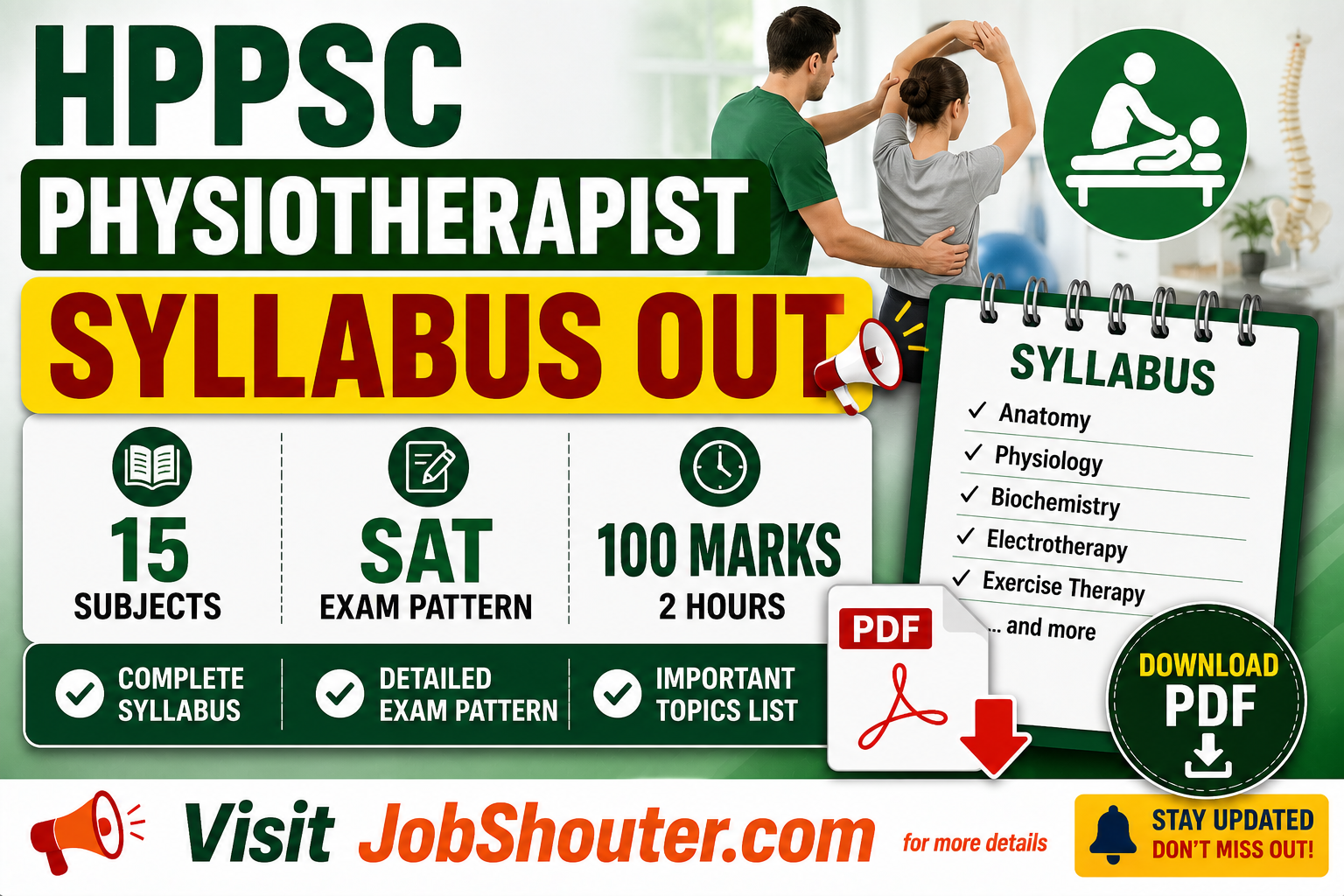
The Himachal Pradesh Public Service Commission (HPPSC) has released the syllabus for the objective type Subject Aptitude Test (SAT) for recruitment to the post of Physiotherapist in the Department of Health & Family Welfare, H.P., vide Notification No. 3-68/2023-PSC(R-I) dated 21-07-2026. The syllabus covers 15 core subjects from Physiotherapy and allied medical science. Candidates preparing for this exam should go through the complete subject-wise breakup below to plan their preparation strategy.
Important Note: This syllabus is for the objective type SAT only. Candidates should download the official PDF from hppsc.hp.gov.in to confirm the exact weightage and any updates before finalizing their preparation plan.
HPPSC Physiotherapist Syllabus and Exam Pattern 2026 – Overview
| Particulars | Details |
|---|---|
| Conducting Body | Himachal Pradesh Public Service Commission (HPPSC) |
| Post Name | Physiotherapist |
| Department | Department of Health & Family Welfare, H.P. |
| Notification Number | No. 3-68/2023-PSC(R-I) dated 21-07-2026 |
| Exam Name | Subject Aptitude Test (SAT) |
| Exam Type | Objective Type |
| Total Marks | 100 |
| Duration | 2 Hours |
| Official Website | hppsc.hp.gov.in |
HPPSC Physiotherapist Exam Pattern 2026
| Particulars | Details |
|---|---|
| Type of Paper | Objective Type |
| Total Marks | 100 |
| Duration | 2 Hours |
Note: The number of questions and marks per question are not specified in the official notification.
HPPSC Physiotherapist Syllabus 2026 – Subject-Wise Breakup
1. Human Anatomy
General Anatomy, Musculoskeletal system, Upper and lower extremity, Spine and thorax, Head and neck, Nervous system, Sensory system, Cardiovascular system, Lymphatic system, Respiratory system, Digestive system, Urinary and Reproductive system, Endocrine system.
2. Human Physiology
General Physiology, Blood, Cardiovascular system, Respiratory System, Nerve Muscle Physiology, Nervous, Digestive & Renal System, Endocrinology, Male & female reproductive system.
3. Pathology
Introduction to Pathology, Cell injuries, Inflammation and Repair, Circulatory Disturbances, Growth Disturbances and Neoplasia, Hematology, Respiratory System, Cardiovascular Pathology, Hepato Biliary Pathology, Musculoskeletal System, Endocrine pathology, Neuropathology, Dermatopathology, Congenital Myopathy & myasthenia gravis.
4. Pharmacology
General Pharmacology, Autonomic Nervous system, Cardiovascular Pharmacology (in brief), Neuropharmacology (in brief), Disorders of Movement (in brief), Inflammatory/Immune Diseases, Respiratory Pharmacology (in brief), Digestion and Metabolism (in brief), Geriatrics.
5. General Psychology
Introduction to Psychology, Fields of application of Psychology, Influence of heredity and environment on the individual, Learning, Memory, Thinking, Motivation, Emotions, Attitudes, Intelligence, Personality.
6. Clinical Biochemistry
Nutrition, Carbohydrates, Lipids, Amino Acids, Proteins, Study of hemoglobin and myoglobin with their functions, Enzymes, Biochemistry of connective tissue, Vitamins, Diabetes mellitus.
7. Biomechanics and Kinesiology
Mechanics, Motion, Force, Friction, Gravity, Equilibrium, Levers, Pulleys, Elasticity, Springs, Muscular system (properties, contraction, structural classification), Action of muscle in moving bone, Coordination of muscular system, Joint structures and functions, Posture, Gait, Bio-Physics.
8. Medical Microbiology
Introduction & History of Microbiology, Classification of microorganism, Bacteriology, Bacterial growth/reproduction, Sterilization & disinfection, Modes of transmission of diseases, Bacterial/Viral/Fungal diseases and opportunistic infections, Immunity, AIDS (aetiology, transmission, diagnosis), Diagnostic Imaging for Physiotherapist, Clinical Education.
9. Exercise Therapy
Introduction to exercise therapy, Mechanical principles applied in human body, Disability models, Movements, Passive & active movements, Starting positions, Relaxation, Suspension, Balance, Neuromuscular coordination, Joint range measurement, Manual muscle testing, Mobility aids, Soft tissue manipulation (massage).
10. Electro Therapy
Basic components of electric current, Magnetism and electromagnetic induction, Electrical components and current modulation, Safety issues with electrical equipment, Muscle and nerve response to electrical stimulation, Pain and low frequency currents, Electro diagnostic test, Interferential therapy (IFT).
11. Ethics in Physiotherapy
History of physiotherapy, Ethical principles in health care, Scope of practice, Professional ethics in research/education/patient care, Informed consent issues, Rules of professional conduct and confidentiality, Malpractice and negligence, Legal aspects and professionalism.
12. Orthopaedics
Introduction to Orthopaedics, Injuries of muscle & tendons, fractures, Inflammation of bones & joints, Nutritional & metabolic diseases of bones, Spine deformities, Infections of musculoskeletal system, Congenital malformations, Neuromuscular diseases, Upper & lower limb neuro-vascular diseases, Amputations, Bone tumors, Orthopaedic splints and appliances, Foot arches and complications, Rehabilitation of patients.
13. Physiotherapy in Orthopaedic
- Traumatology: Conditions and management aims, physiotherapeutic techniques (Kaltenborn, Maitland, Mulligan, Mckenzie).
- Bone Tissue: Fracture and dislocation classification, immobilization methods, fracture healing, specific upper/lower limb and spine fractures with physiotherapy management, soft tissue injuries.
- Wounds, Burns & Plastic Surgery: Pre/post-operative physiotherapy management of wounds, ulcers, pressure sores, burns, and reconstructive surgical procedures.
14. Physiotherapy in General Medical & Surgical Conditions (General, Gynecology, Obstetrics and ENT)
Common abdominal surgeries (GIT, liver, spleen, kidney, bladder), reproductive system surgeries and ante/post-natal physiotherapy, ENT and jaw operations, organ transplant surgeries.
15. Physiotherapy in Neurological Conditions
- Clinical Neuroanatomy & Neurophysiology: Structure and function of neuron, synapse and supporting tissue.
- Assessment and Treatment Principles: Sensory re-education, treatment of altered tone, motor re-education, use of equilibrium/labyrinthine systems, PNF patterns, gait training and ambulatory aids.
- Peripheral Nerve Lesions: Muscle re-education, sensory re-education and pain relief, common splints, post-operative management and home programme.
How to Prepare for HPPSC Physiotherapist Exam 2026
- Start with the core clinical subjects – Human Anatomy, Human Physiology and Pathology – since these form the base for most other topics.
- Build a subject-wise timetable that gives proportionate time to Exercise Therapy, Electro Therapy and Orthopaedics, as these are core professional practice areas.
- Since the exam is objective type with a 2-hour duration for 100 marks, practice MCQs within a time limit to build speed and accuracy.
- Revise Physiotherapy in Neurological Conditions and Physiotherapy in Orthopaedic separately, as they combine multiple sub-topics.
- Cover Ethics in Physiotherapy and General Psychology, as these are often scored quickly with focused reading.
- Keep revising previously studied subjects at regular intervals instead of leaving them for the end.
Important Links
| Description | Link |
|---|---|
| Download Syllabus PDF | Click Here |
| Official HPPSC Website | Click Here |
HPPSC Physiotherapist Syllabus 2026 – FAQs
Q1. What is the HPPSC Physiotherapist Syllabus 2026?
✅ It covers 15 subjects for the objective type SAT, including Human Anatomy, Human Physiology, Pathology, Pharmacology, General Psychology, Clinical Biochemistry, Biomechanics and Kinesiology, Medical Microbiology, Exercise Therapy, Electro Therapy, Ethics in Physiotherapy, Orthopaedics, Physiotherapy in Orthopaedic, Physiotherapy in General Medical & Surgical Conditions, and Physiotherapy in Neurological Conditions.
Q2. What is the exam pattern for HPPSC Physiotherapist 2026?
✅ It is an objective type SAT of 100 marks with a duration of 2 hours. The number of questions is not specified in the official notification.
Q3. What is the duration of the HPPSC Physiotherapist SAT exam?
✅ 2 hours.
Q4. Where can I download the HPPSC Physiotherapist Syllabus PDF?
✅ From the official HPPSC website, hppsc.hp.gov.in.
Q5. How many questions are asked in the HPPSC Physiotherapist exam?
✅ Only the total marks (100) and duration (2 hours) have been announced; the question count is not specified.
Q6. Which subject should I start preparing first?
✅ Human Anatomy, Human Physiology and Pathology are recommended as a starting point, as they form the base for most other topics.
Q7. Is this syllabus for a written exam or a skill-based test?
✅ It is for the objective type Subject Aptitude Test (SAT), a written screening exam.
Q8. Under which department is the Physiotherapist post being recruited?
✅ The Department of Health & Family Welfare, Himachal Pradesh.
Disclaimer
The information above is compiled from the official syllabus notification issued by the Himachal Pradesh Public Service Commission (HPPSC). Candidates are advised to download and cross-check the complete syllabus PDF from the official website, hppsc.hp.gov.in, before beginning their preparation.