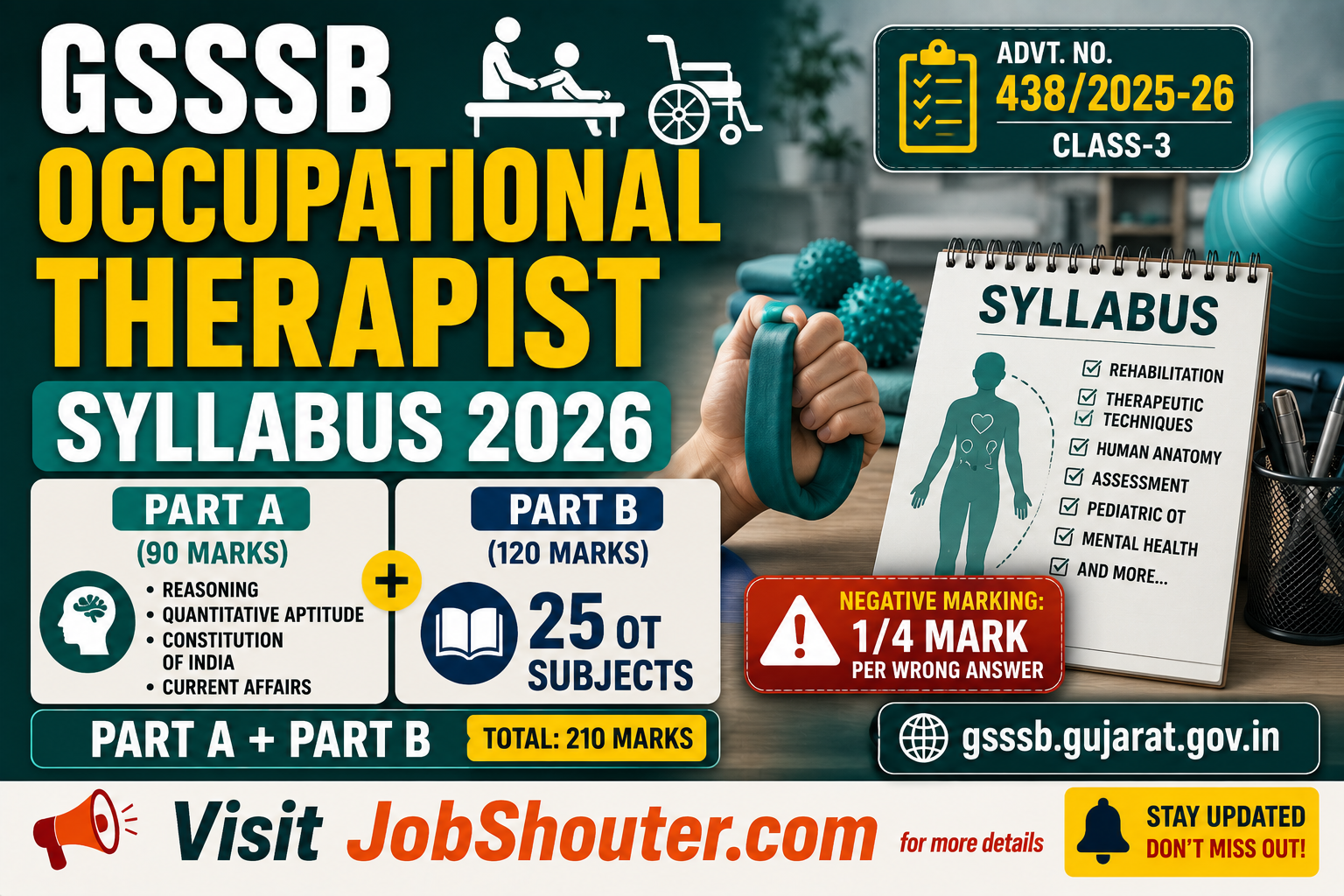
The Gujarat Gaun Seva Pasandgi Mandal (GSSSB) has released the detailed syllabus for the Occupational Therapist, Class-3 cadre competitive examination through Advertisement No. 438/2025-26. Candidates preparing for this post must go through the official syllabus and exam pattern carefully, since both together decide how marks are distributed across subjects and how the paper is structured. This article covers the complete GSSSB Occupational Therapist Syllabus 2026, including the Part A and Part B breakdown, subject-wise topics, marking scheme, and preparation tips, based entirely on the official notification.
Important Note: This is a syllabus-only document – candidates should refer to the separate GSSSB Occupational Therapist Recruitment 2026 notification (Advt. No. 438/2025-26, closing 27 July 2026, for 1 post) for vacancy details, eligibility, age limit, and full selection process. There is no mention of separate CBT/CBAT-style stages in this syllabus notification – both Part A and Part B appear to be part of the same paper.
Overview
| Particulars | Details |
|---|---|
| Conducting Body | Gujarat Gaun Seva Pasandgi Mandal (GSSSB), Gandhinagar |
| Post Name | Occupational Therapist, Class-3 |
| Advertisement Number | 438/2025-26 |
| Total Questions | 210 (Part A: 90, Part B: 120) |
| Total Marks | 210 (Part A: 90 marks, Part B: 120 marks) |
| Negative Marking | Yes, 1/4th mark deducted for every wrong answer |
| Official Website | gsssb.gujarat.gov.in |
GSSSB Occupational Therapist Exam Pattern 2026
The written competitive exam is divided into Part A and Part B, each carrying its own weightage.
Part A Exam Pattern (90 Marks)
| Subject | Questions | Marks |
|---|---|---|
| Reasoning & Data Interpretation | 30 | 30 |
| Quantitative Aptitude | 30 | 30 |
| Constitution of India | 10 | 10 |
| Current Affairs | 10 | 10 |
| Comprehension (Gujarati 5 marks & English 5 marks) | 10 | 10 |
| Total | 90 | 90 |
Language of Part A: Questions on Reasoning & Data Interpretation, Quantitative Aptitude, Constitution of India, and Current Affairs will be asked in both Gujarati and English. Gujarati Comprehension questions will be in Gujarati only, and English Comprehension questions will be in English only.
Part B Exam Pattern (120 Marks)
| Section | Questions | Marks |
|---|---|---|
| Questions related to Educational Qualification (25 subjects, listed below) | 120 | 120 |
Language of Part B: Questions related to the educational qualification subjects will be asked in both Gujarati and English.
Negative Marking and Qualifying Criteria
- For every wrong answer, 1/4th of the marks allotted to that question will be deducted from the candidate’s score.
- If any question is cancelled after the final answer key is published, the marks of that question will be redistributed on a pro-rata basis among the remaining questions.
GSSSB Occupational Therapist Syllabus 2026 – Part A (General Subjects)
1. Reasoning & Data Interpretation (30 Marks)
Coding-Decoding, Blood Relation, Problem on Age and Height, Direction Knowledge, Clock and Calendar, Venn Diagram, Rank and Position, Arithmetic Progression, Logical Sequence of Words, Insert the missing Character, Word/Numerical/General Analogy, Picture-Based Logical Questions, Probability, Data Interpretation (charts, graphs, tables) and Data Sufficiency, Symmetry, Mathematical Operations, Mathematical Modeling, Proofs in Mathematics, Logical and Mathematical Analytical Ability, Statement and Prediction.
2. Quantitative Aptitude (30 Marks)
Number System, LCM and HCF, Percentage and Partnership, Profit-Loss, Simple and Compound Interest, Ratio and Proportion, Time and Work/Wages/Chain Rule, Time-Speed-Distance, Average/Mean/Mode/Median, Brackets and Expansions, Squares/Square Roots/Cubes/Cube Roots/Exponents, Polynomials and Factorisation, Pair of Linear Equations in Two Variables and Quadratic Equations, Area/Surface Area/Volume (Square, Rectangle, Triangle, Circle, Cube, Cuboid, Cylinder, Cone, Hemisphere, Sphere), Coordinate Geometry and Trigonometry.
3. Constitution of India (10 Marks)
Concept of Political Science, Preamble of the Constitution, Fundamental values of Democracy/Nationalism/Secularism/Rights/Citizenship, Indian Constitution Framing and Characteristics, Fundamental Rights/Duties/Directive Principles of State Policy, Legislature/Executive/Judiciary in India at Union and State Level, Local Self-Government Institutions, Nature of Party System in India, Elections in India, Indian Democracy Challenges and Response, Development and Democracy.
4. Current Affairs (10 Marks)
Current events of state, national, and international importance.
5. Comprehension – Gujarati & English (10 Marks)
Assessment of comprehension, interpretation, and inference skills; a paragraph will be given with questions based on it, or statement/assertion-type questions may be asked.
GSSSB Occupational Therapist Syllabus 2026 – Part B (25 Educational Qualification Subjects, 120 Marks)
(A) Anatomy & Physiology (3 Marks)
Anatomy (2 marks) – General Anatomy, Connective Tissue, Cartilage, Bone, Joints, Embryology, Regional Anatomy (Lower Limb, Thorax, Cranial Nerves); General Physiology (1 mark) – Cell and tissue, Body Fluid, Cardio-Vascular System, Respiratory System, Digestive System, Reproductive System, Endocrine System, Excretory System, Skin Structure & Functions.
(B) Fundamentals of Occupational Therapy (6 Marks)
Principles & techniques of Therapeutic Exercise and its relation with development of therapeutic activities; Principles of Maturation, adaptation & assistive technology; Cephalo-caudal, Proximal-distal, Medial-lateral patterns of development; Therapeutic Activities (definition, classification, characteristics, scope); Remedial activities for physical & intellectual need.
(C) Sociology (2 Marks)
Definition of Sociology, uses of the study of Sociology; Application of knowledge of Sociology in Occupational Therapy; Socialization and social groups, Family, Social problems of the disabled.
(D) Pathology (1 Mark)
Cell injury, degeneration, necrosis, gangrene; Inflammation, Blood disorders; CVS diseases; Respiratory diseases (COPD, Asthma, Bronchiectasis, Emphysema); PNS/Muscle diseases (Neuropathies, Poliomyelitis, Myopathies); CNS diseases (Infection, Demyelinating/Degenerative disease).
(E) Microbiology (2 Marks)
Introduction and History of Microbiology; Infection – source, entry, and spread.
(F) Pharmacology (1 Mark)
General Pharmacology; Drugs affecting peripheral (somatic) nervous system, Anti-inflammatory drugs.
(G) Occupational Therapy & Industrial Rehabilitation (12 Marks)
Ergonomics concept, principles & process; Body mechanics in industrial injuries; Preparation of patients to return to job; Employees’ Compensation Act, PWD Act 1995; Occupational injuries of back.
(H) Occupational Therapy & Mental Health (4 Marks)
Basic techniques, OT in mental health, types of therapy, ADL training in mentally challenged; OT in common mental disorders (schizophrenia, psychosis, substance abuse, attention deficit).
(I) Psychology (7 Marks)
General Psychology methods; Memory, Emotion, Motivation, Intelligence, Personality, Child Psychology; Applied Psychology (industrial and rehabilitation psychology).
(J) Psychiatry (4 Marks)
Definition/criteria of Normality and Abnormality; OT scope and practices in common psychiatric disorders.
(K) Community Medicine (3 Marks)
General concepts of health and diseases; CBR and institutional-based rehabilitation; CBR in relation to different medical & surgical conditions.
(L) Biomechanics & Kinesiology (2 Marks)
Essential concepts of movement, kinetic aspects of limb movement; Biomechanics of upper/lower extremity and spine, normal GAIT biomechanics.
(M) Orthopaedics in Occupational Therapy (5 Marks)
Fracture dislocations, inflammatory joint/bone conditions; Osteomyelitis, TB, pyogenic infections, Osteoarthritis; Tendon transfer principles; Reconstructive surgery OT role.
(N) Surgery Including Obstetrics & Gynaecology in OT (5 Marks)
Pre/post-operative OT principles; Burns management and reconstructive surgery; Tendon transplant, cosmetic surgery, grafts, hand surgery OT emphasis.
(O) Medicine in Occupational Therapy (4 Marks)
Respiratory diseases (COPD, bronchial asthma); OT in CRF; Vascular disorders, joint/connective disorders.
(P) Paediatrics (3 Marks)
Growth and development of a child (birth to 12 years); Associated defects – mental retardation, microcephaly, blindness, hearing/speech impairment, squint, convulsions.
(Q) Neurology & Neurosurgery in Occupational Therapy (8 Marks)
Neurological/neurophysiological diagnosis principles; Cerebrovascular diseases, Parkinsonism, multiple sclerosis; Neurosurgery (head injury, subdural/epidural/intracranial bleeding); Paraplegia, hemiplegia, quadriplegia OT management.
(R) Functional Assessment & Outcome Measures (4 Marks)
Behavioural, Biomechanical, Cognitive Disability, Developmental, Rehabilitation, Psychodynamic, Spatiotemporal approaches; Occupational Adaptation integrative approach.
(S) Clinical Rehabilitation (6 Marks)
Introduction to rehabilitation medicine; Present rehabilitation services in India, PWD Act legislations; Prosthetics/orthotics concepts, wheelchair prescription, assistive devices, ADL.
(T) Occupational Therapy in Orthopaedic Conditions (8 Marks)
OT objectives in deformities, joint/bone disorders including trauma; Inflammatory joint conditions, metabolic bone diseases, amputation; ADL testing and training.
(U) Occupational Therapy in Surgical Conditions Including Obstetrics & Gynaecology (4 Marks)
OT in burns rehabilitation; Thoracic surgery pre/post-op rehabilitation; Plastic surgery principles, radical mastectomy OT role.
(V) Occupational Therapy in Medical Conditions (13 Marks)
Review of medical conditions and OT treatment role; OT objectives in Rheumatoid arthritis, Leprosy, cardiac diseases, geriatric conditions, cardio-pulmonary conditions, AIDS; Home care programme in severely disabled.
(W) Occupational Therapy in Neurological & Developmental Conditions (11 Marks)
Cerebral palsy, Hydrocephalus, Poliomyelitis, cerebrovascular accidents; Peripheral/spinal/cranial nerve affections, Motor neuron diseases, Multiple sclerosis; Peripheral nerve injuries, neuropathies, neural tube defects.
(X) Current Trends and Recent Advancements in the Above Fields (2 Marks)
How to Prepare for GSSSB Occupational Therapist Exam 2026
- Start with the official syllabus and mark each Part A and Part B topic as you cover it, rather than relying on generic study material.
- Give Part B extra study time since it carries 120 of the 210 total marks – focus first on high-weightage subjects like Occupational Therapy in Medical Conditions (13 marks), Occupational Therapy & Industrial Rehabilitation (12 marks), and Neurological & Developmental Conditions (11 marks).
- Build a subject-wise timetable that allocates time in proportion to the marks each subject carries.
- Practice previous year GSSSB question papers and mock tests once released, to get familiar with the question format in both Gujarati and English.
- Since 1/4th mark is deducted for wrong answers, attempt only those questions you are reasonably confident about.
- Revise Constitution of India and Current Affairs regularly, since these carry fixed weightage but change with current events.
Important Links
| Action | Link |
|---|---|
| Download GSSSB Occupational Therapist Syllabus 2026 PDF | Click Here |
| Official GSSSB Website | Click Here |
Frequently Asked Questions (FAQs)
Q1. What is the GSSSB Occupational Therapist syllabus 2026?
✅ The syllabus covers two parts: Part A (90 marks) with Reasoning & Data Interpretation, Quantitative Aptitude, Constitution of India, Current Affairs, and Comprehension; and Part B (120 marks) with 25 Occupational Therapy subjects related to the educational qualification.
Q2. Is there negative marking in the GSSSB Occupational Therapist exam?
✅ Yes. As per the official notification, 1/4th mark is deducted from the awarded marks for every wrong answer.
Q3. Where can I download the GSSSB Occupational Therapist syllabus PDF?
✅ The official syllabus is available on the GSSSB website and can be downloaded from the link provided in the Important Links section above.
Q4. In which languages will the GSSSB Occupational Therapist exam be conducted?
✅ Part A questions on Reasoning & Data Interpretation, Quantitative Aptitude, Constitution of India, and Current Affairs will be in both Gujarati and English. Gujarati Comprehension questions will be in Gujarati only, and English Comprehension questions will be in English only. Part B questions will be asked in both Gujarati and English.
Q5. What topics are covered under Part B of the GSSSB Occupational Therapist syllabus?
✅ Part B covers 25 subjects related to the Occupational Therapy educational qualification, including Anatomy, Physiology, Fundamentals of Occupational Therapy, Sociology, Pathology, Microbiology, Pharmacology, Psychology, Psychiatry, Neurology, Orthopaedics, Paediatrics, Clinical Rehabilitation, and related clinical subjects.
Q6. Which subject carries the highest marks in Part B?
✅ Occupational Therapy in Medical Conditions carries the highest weightage at 13 marks, followed by Occupational Therapy & Industrial Rehabilitation (12 marks) and Neurological & Developmental Conditions (11 marks).
Q7. Does this syllabus notification include vacancy and application details?
✅ No. This is a syllabus-only document. Candidates should refer to the separate GSSSB Occupational Therapist Recruitment 2026 notification (Advt. No. 438/2025-26) for vacancy, eligibility, age limit, and application details.
Disclaimer: All information provided is for reference purposes only. Candidates are advised to verify the complete and updated syllabus, exam pattern, and recruitment details from the official GSSSB website at gsssb.gujarat.gov.in and the detailed recruitment advertisement before beginning their preparation.