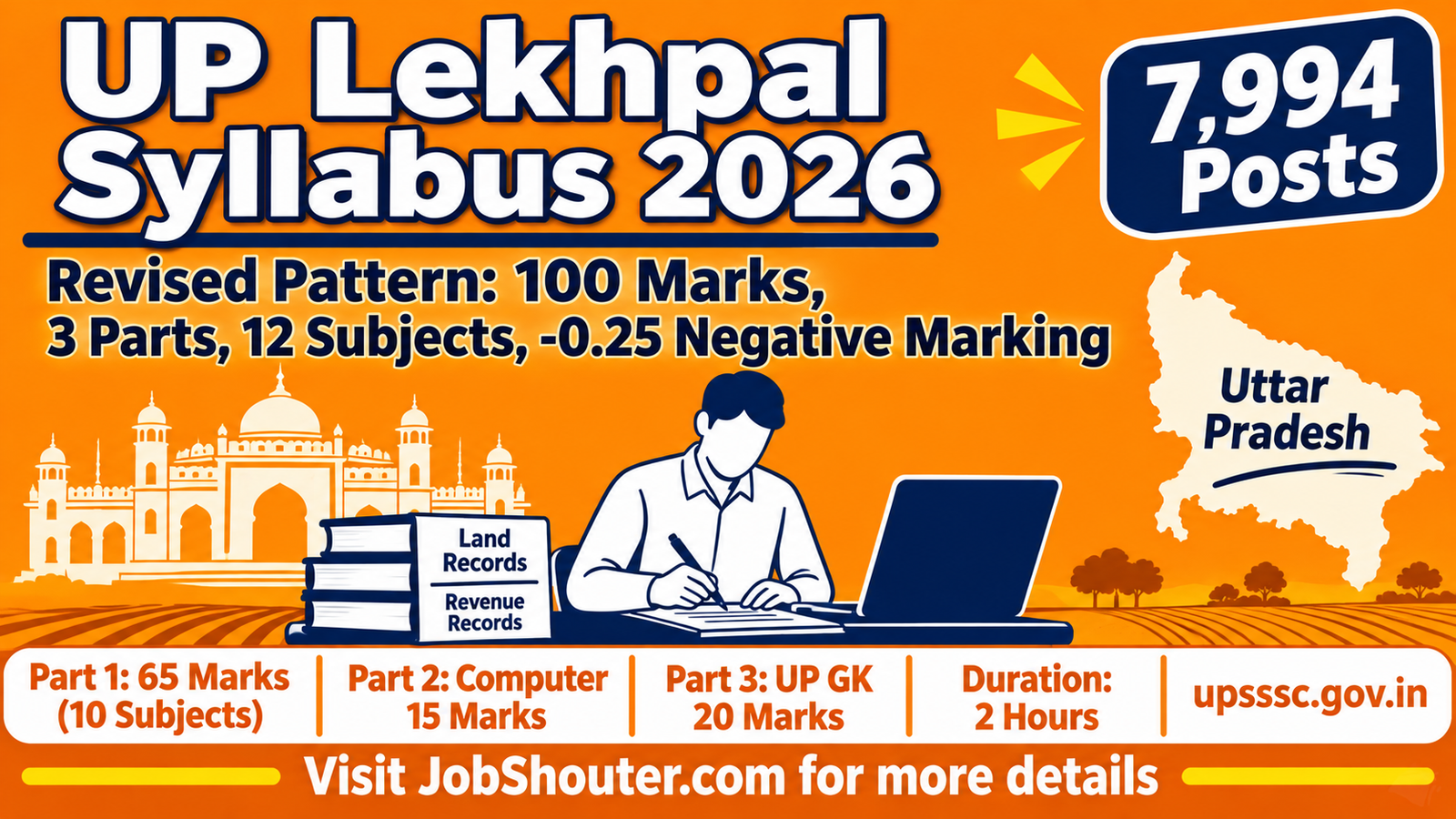
The Uttar Pradesh Subordinate Services Selection Commission (UPSSSC) conducts the Revenue Lekhpal (Rajasva Lekhpal) examination for 7,994 posts. The revised exam pattern is a single OMR-based written paper of 100 objective questions and 100 marks in 2 hours, divided into three parts covering 12 subjects, with one-quarter negative marking per wrong answer. Part 1 covers ten General Studies subjects for 65 marks, Part 2 covers Computer and Information Technology for 15 marks, and Part 3 covers General Information Related to Uttar Pradesh for 20 marks. This article explains the revised exam pattern, part-wise marks, complete subject-wise syllabus and preparation strategy.
Important Note
1. The exam pattern described here is revised. The earlier Lekhpal examination had a different structure. Verify the current pattern from the official UPSSSC notification at upsssc.gov.in before final preparation to ensure no updates have been made.
2. General Information about Uttar Pradesh (Part 3, 20 marks) is the single highest-scoring section in the paper. Candidates who cover the state’s history, culture, geography, economy and administration comprehensively are well placed on this section alone.
3. The negative marking is one-quarter of the question’s marks. Since each question carries one mark, one wrong answer deducts 0.25 marks. Four wrong answers cancel one correct answer. Avoid guessing in unfamiliar areas.
For candidates who qualify in the written examination
Prelims PET 2025 is a qualifying prerequisite. The written examination determines merit. No interview is conducted.
Exam Pattern: Part-Wise and Subject-Wise Marks
Part
Subject
Questions
Marks
Part 1
General Hindi
10
10
Part 1
Data Interpretation
10
10
Part 1
History of India and Indian National Movement
5
5
Part 1
Indian Polity and Indian Constitution
5
5
Part 1
Geography of India and the World
5
5
Part 1
Indian Economy and Social Development
5
5
Part 1
Rural Society and Development
5
5
Part 1
Current Events of National and International Importance
5
5
Part 1
Science and Technology
5
5
Part 1
Environmental Ecology and Disaster Management
10
10
Part 1 Total
65
65
Part 2
Computer and Information Technology Concepts
15
15
Part 2 Total
15
15
Part 3
General Information Related to Uttar Pradesh
20
20
Part 3 Total
20
20
Grand Total
100
100
Marks Distribution by Section Size
Marks
Subjects
20 marks
General Information about Uttar Pradesh (single section)
15 marks
Computer and IT
10 marks
General Hindi, Data Interpretation, Environmental Ecology and Disaster Management
5 marks each
History, Polity, Geography, Economy, Rural Society, Current Events, Science and Technology
Subject-Wise Syllabus
1. General Hindi (10 Marks)
Topic
Coverage
Official Correspondence
Letters, notifications, office orders and circulars (official, semi-official, personal and professional)
Letters and Sounds
Pronunciation, writing, vowels, consonants, matras and sound classification
Word Formation
Sandhi, sandhi viched, samas, prefixes and suffixes
Word Types
Tatsam, ardhtatsam, tadbhav, deshaj and foreign words; noun, pronoun, adjective, verb and indeclinables
Word Knowledge
Synonyms, antonyms, word pairs with different meanings, one word for a phrase, similar-sounding words, appropriate word choice
Word Correction
Shabd shuddhi
Grammatical Categories
Case markers, gender, number, person, tense, mood, aspect and voice
Sentence Structure
Simple, compound and complex sentences, sentence correction
Punctuation
Correct use of punctuation marks
Idioms and Proverbs
Common Hindi idioms and proverbs
2. Data Interpretation (10 Marks)
Topic
Coverage
Data Analysis
Interpretation and analysis of statistical data
Graphs and Diagrams
Drawing conclusions from bar charts, line graphs, pie charts, tables and other graphical formats
3. History of India and Indian National Movement (5 Marks)
Topic
Coverage
Indian History
Social, cultural, economic and political aspects from ancient to modern India
Indian National Movement
Freedom struggle, rise of nationalism, roles of key leaders and attainment of independence
4. Indian Polity and Indian Constitution (5 Marks)
Topic
Coverage
Constitution
Constitutional development, Preamble, Fundamental Rights, Fundamental Duties, Directive Principles
Government
Parliament, executive, judiciary
Governance
Political system and governance reforms
Local Bodies
Panchayati Raj, urban local bodies
Public Policy
Key public policies and community development
5. Geography of India and the World (5 Marks)
Topic
Coverage
Indian Geography
Physical, social and economic geography; agriculture, horticulture, forestry and animal husbandry; population and urbanisation
Smart Cities
Smart cities and smart villages
World Geography
General physical and economic geography of the world
6. Indian Economy and Social Development (5 Marks)
Topic
Coverage
Economic Planning
Objectives and achievements of economic planning; NITI Aayog; Sustainable Development Goals
Government Finance
Budget components, financial system
Sector Development
Agriculture, industry, trade and commerce development
Reforms
Land reforms; effects of globalisation and liberalisation
Industrial Policy
Industrial policy changes and their impact
Infrastructure
Power, ports, roads, airports and railways
7. Rural Society and Development (5 Marks)
Topic
Coverage
Rural Development
Rural development in the Indian context
Programmes and Schemes
Rural development programmes, schemes and management
Research
Rural development research systems
Health
Rural health schemes
Social Development
Rural social development
Land Reforms
Land reforms in rural India
Government Schemes
Central and state government schemes for rural development
8. Current Events of National and International Importance (5 Marks)
Recent developments in national and international affairs including government schemes, economic events, sports, awards, science and other significant happenings.
9. Science and Technology (5 Marks)
Topic
Coverage
Applications
Science and technology in everyday life
National Security
Development and national security
Indian Achievements
Indian scientists and achievements; indigenisation of technology
New Technologies
Emerging technologies of practical use
Space and Defence
Space technology, ISRO; defence technology, DRDO
Energy
Renewable energy sources; nanotechnology; microbiology and biotechnology
Intellectual Property
IPR and digital rights awareness
10. Environmental Ecology and Disaster Management (10 Marks)
Topic
Coverage
Environment
Environmental protection, ecosystems and biodiversity
Pollution
Environmental pollution, degradation and impact assessment
Climate Change
Climate change and mitigation
Disaster Management
Disaster management as a non-traditional security challenge
Legislation
Disaster Management Act 2005
Authorities
NDMA, SDMA, NDRF, SDRF and other agencies
Global Efforts
International disaster mitigation efforts and achievements
11. Computer and Information Technology (15 Marks)
Topic
Coverage
History and Basics
History, introduction and applications of computers; internet and World Wide Web
Hardware and Software
Hardware, software, input and output devices, IP address, gadgets
Email and Printing
Creating and using email; operating printer, tablet and mobile
Office Applications
MS Word and MS Excel key elements
Operating Systems
Operating systems, social networking and e-governance
Digital Finance
Digital financial tools and applications
Future Skills
Cyber security; AI, Big Data, Deep Learning, Machine Learning, IoT
India’s Achievements
India’s achievements in computer and IT innovation
12. General Information about Uttar Pradesh (20 Marks)
Topic
Coverage
History
History of Uttar Pradesh
Culture and Art
Architecture, festivals, folk dances, literature and regional languages
Heritage
Social customs and tourism
Geography and Environment
Geographical landscape, natural resources, climate, soil, forests and wildlife
History, Polity, Geography, Economy, Rural Society, Current Events, Science and Technology (35 marks)
Day 24 to 27
Mock Tests
Full-length practice with OMR, applying 0.25 negative marking
Day 28 to 30
Revision
Weak areas, UP current events update and final revision
Preparation Tips
UP General Information carries 20 marks and is the single largest section. Make a dedicated set of revision notes covering UP-specific topics and update them with current events.
Computer and IT (15 marks) is straightforward and limited in scope. Cover it systematically for reliable marks.
General Hindi and Environmental Ecology are 10 marks each. Practise Hindi grammar and writing regularly.
Apply the 0.25 negative-marking rule during all practice sessions to build the correct answering discipline.
Solve previous-year UPSSSC Lekhpal question papers to understand the question style and difficulty level.
Download the official syllabus from upsssc.gov.in to verify any recent updates.
The revised UP Lekhpal syllabus covers 12 subjects across three parts: Part 1 has 10 General Studies subjects for 65 marks, Part 2 covers Computer and IT for 15 marks, and Part 3 covers UP General Information for 20 marks.
What is the revised UP Lekhpal Exam Pattern?
100 objective MCQ questions, 100 marks, 2 hours, OMR-based, three parts, 0.25 negative marking per wrong answer.
Which section carries the most marks in the UP Lekhpal exam?
General Information about Uttar Pradesh (Part 3) carries 20 marks, the highest of any single section.
Is there negative marking in UP Lekhpal 2026?
Yes. Each wrong answer deducts one-quarter of the question’s marks, which is 0.25 marks per wrong answer.
How many questions are there in each part?
Part 1 has 65 questions, Part 2 (Computer and IT) has 15 questions and Part 3 (UP General Information) has 20 questions.
Where can I download the UP Lekhpal Syllabus PDF?
From the official UPSSSC website at upsssc.gov.in. The syllabus is available in Hindi.
Disclaimer
This article is based on the UPSSSC Revenue Lekhpal (Rajasva Lekhpal) revised exam pattern and syllabus for 7,994 posts. Candidates should verify the current exam pattern from the official UPSSSC notification at upsssc.gov.in before final preparation. JobShouter is not associated with the Uttar Pradesh Subordinate Services Selection Commission (UPSSSC). This article is for informational purposes only.
Anoushka Sah covers the latest government job notifications, admission forms, and recruitment updates at JobShouter. An undergraduate Commerce degree student, she has been tracking Sarkari Naukri notifications since 2024 and is prepared for SSC/banking exams herself, so she writes with an aspirant's questions in mind. Every article she publishes is verified against the official notification PDF before it goes live.