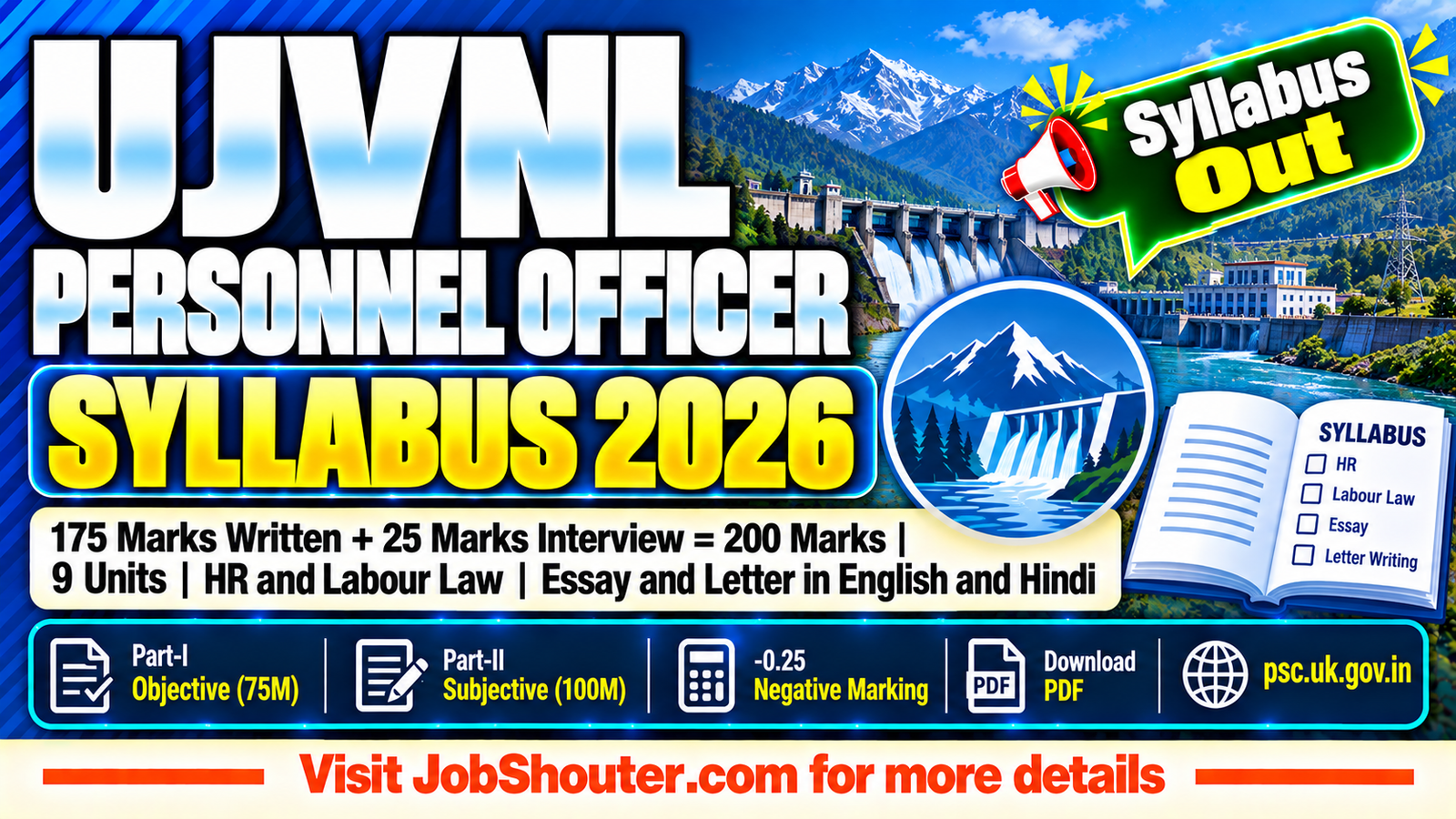
The Uttarakhand Jal Vidyut Nigam Limited (UJVNL) has released the official Exam Scheme and Syllabus for the Personnel Officer (Karmik Adhikari) recruitment as a bilingual (English and Hindi) document. The syllabus covers the complete written examination pattern, negative marking rules, nine unit-wise topic areas for Industrial Relations, Personnel Management and HRM, and indicative essay and letter writing topics in both English and Hindi. The written exam carries 175 marks and the interview carries 25 marks, making a grand total of 200 marks.
Important Note: Three things every candidate must know before starting preparation. First, the written exam has two parts: Part-I is objective type (75 marks, 1 hour) with negative marking of 0.25 per wrong answer, and Part-II is subjective/descriptive (100 marks, 2 hours) without negative marking. Prepare both styles for the same nine subject units. Second, Part-II Section B (Essay and Letter Writing) is compulsory in BOTH English and Hindi. Candidates who practise only one language will lose 20 out of 40 marks in this section. Third, the essay and letter topics listed in the document are indicative only — other relevant topics may also appear. Refer to the official syllabus PDF for the complete bilingual version.
UJVNL Personnel Officer Syllabus 2026: Quick Overview
| Particulars | Details |
|---|---|
| Organisation | Uttarakhand Jal Vidyut Nigam Limited (UJVNL) |
| Post | Personnel Officer (Karmik Adhikari) |
| Exam Conducting Body | Uttarakhand Public Service Commission (psc.uk.gov.in) |
| Syllabus Document | Exam Scheme and Syllabus (16 pages, English and Hindi bilingual) |
| Written Exam Marks | 175 |
| Interview Marks | 25 |
| Grand Total | 200 |
| Parts in Written Exam | Part-I (Objective) + Part-II (Subjective) |
| Negative Marking | Yes, 1/4 mark per wrong answer in Part-I only |
| Languages for Essay and Letter | English and Hindi both compulsory |
| Official Website | psc.uk.gov.in |
UJVNL Personnel Officer Exam Pattern 2026
Overview of Written Exam
| Part | Subject | Questions | Marks | Duration | Type |
|---|---|---|---|---|---|
| Part-I (i) | General Studies and General Aptitude | 25 (GS: 10, GA: 15) | 25 | 1 hour (combined for Part-I) | Objective MCQ |
| Part-I (ii) | Industrial Relations, Personnel Management and HRM | 50 | 50 | 1 hour (combined for Part-I) | Objective MCQ |
| Part-II | Industrial Relations, PM and HRM + Essay and Letter Writing | Subjective | 100 | 2 hours | Subjective/Descriptive |
| Total (Written) | 175 | ||||
| Interview (Personality Test) | 25 | ||||
| Grand Total | 200 |
Part-II Marks Distribution
| Section | Content | Marks |
|---|---|---|
| Section A | Industrial Relations, Personnel Management and HRM (Subjective) | 60 |
| Section B | Essay Writing and Letter Drafting (English and Hindi) | 40 |
| Total Part-II | 100 |
Section B Detailed Breakup
| Component | Language | Word Limit | Marks |
|---|---|---|---|
| Essay Writing | English | 150 words | 10 |
| Essay Writing | Hindi | 150 words | 10 |
| Letter Drafting | English | 100 words | 10 |
| Letter Drafting | Hindi | 100 words | 10 |
| Total Section B | 40 |
Interview (Personality Test)
25 marks. Called after the written exam. Final merit is based on Part-I (objective) + Part-II (subjective) + Interview marks.
Negative Marking Rules
- Negative marking applies ONLY to Part-I (objective type).
- Deduction: 1/4 (one-fourth) of the marks assigned to the question.
- Since each Part-I question carries 1 mark, the deduction per wrong answer is 0.25 mark.
- If a candidate marks more than one answer to the same question, the deduction applies even if one of the answers is correct.
- There is NO negative marking in Part-II (subjective).
- Avoid guessing in Part-I. Unattempted questions carry zero marks and incur no deduction.
Example calculation: 60 correct + 10 wrong + 5 unattempted in Part-I = 60 – (10 x 0.25) = 60 – 2.5 = 57.5 marks.
UJVNL Personnel Officer Syllabus 2026: Part-I (i) – General Studies and General Aptitude
General Studies (10 Questions, 10 Marks)
- Current events and matters of everyday observation and experience, especially their scientific aspects (as expected of an educated person)
- History, politics and geography of India and Uttarakhand (no specialised study required)
- Basic knowledge or general information about computer usage
General Aptitude (15 Questions, 15 Marks)
Questions on general intelligence, both verbal and non-verbal:
- Analogies, similarities and differences
- Space visualisation
- Problem solving, analysis, judgement and decision making
- Visual memory, discrimination and observation
- Relationship concepts
- Arithmetical reasoning
- Verbal and figure classification
- Arithmetical number series
- Ability to deal with abstract ideas, symbols and their relationships, arithmetical computations and analytical functions
UJVNL Personnel Officer Syllabus 2026: Nine Core Subject Units
The same nine units form the syllabus for both Part-I (ii) (objective, 50 marks) and Part-II Section A (subjective, 60 marks). The content is identical – only the question format differs (MCQ vs answer writing).
Unit 1: Personnel Management
- Evolution of Personnel Management in the UK, USA and India
- Objectives, scope, characteristics, philosophy and principles of Personnel Management
- Subject matter, functions and responsibilities of a Personnel Manager
- Personnel policies and procedures
- Difference between Human Resource Management and Personnel Management
Unit 2: Human Resource Management
- Conceptual framework
- Human Resource Planning, Recruitment and Selection
- Placement and induction
- Training and development
- Performance appraisal and job evaluation
- Job satisfaction
- Compensation management
- Employee benefits and incentives
- Recent trends and contemporary challenges in HRM
Unit 3: Human Resource Development
- Concepts, assumptions and values
- HRD mechanisms, culture and climate
- HRD interventions
- Human Resource Accounting and Audit
- Knowledge Management
- Human Resource Information System (HRIS)
- HRD and sustainable business
- HRD and diversity at the workplace
Unit 4: Organisational Behaviour
- Meaning, concept and scope
- Nature of human behaviour
- Personality, perception, learning and attitude
- Motivation and morale
- Interpersonal behaviour and group dynamics
- Leadership and communication
- Power and authority
- Organisational stress
- Organisational change and development
Unit 5: Industrial Relations and Trade Union
- Concept, scope, evolution and approaches of Industrial Relations
- Factors and principles of Industrial Relations
- Collective bargaining
- Workers’ participation in management
- Conflict management and grievance handling
- Disciplinary action and code of conduct
- Industrial Relations in the changing scenario
- Evolution, challenges and present scenario of trade unions in India
- Trade Union Act, 1926
Unit 6: Industrial Disputes and Settlement
- Industrial disputes: concept, factors, forms, causes and trends
- Prevention and settlement
- Role of State and Central labour administration
- Strikes and lockouts
- Industrial Employment (Standing Orders) Act, 1946
- The Industrial Disputes Act, 1947 and its 1984 Amendment
Unit 7: Labour Legislation
- Concept, evolution, objectives, principles and classification of labour legislation
- International Labour Organisation (ILO)
- Social Justice and Labour Law
- Indian Constitution and Labour Law
Specific Acts covered:
- The Factories Act, 1948
- The Inter-State Migrant Workmen (Regulation of Employment and Conditions of Service) Act, 1979
- The Contract Labour (Regulation and Abolition) Act, 1970
- The Building and Other Construction Workers (Regulation of Employment and Conditions of Service) Act, 1996
- The Child and Adolescent Labour (Prohibition and Regulation) Act, 1986
Unit 8: Wages and Systems of Wage Payments
- Wages: meaning, types, policies, factors, theories, differentials and methods of payment
Specific Acts covered:
- The Payment of Wages Act, 1936
- The Minimum Wages Act, 1948
- The Equal Remuneration Act, 1976
- The Payment of Gratuity Act, 1972
- The Employees’ Provident Funds and Miscellaneous Provisions (EPF and MP) Act, 1952
Unit 9: Labour Welfare and Social Security
- Labour Welfare: meaning, scope, need, types, theories, principles, statutory and non-statutory provisions, industrial social work
- Social Security: concept, evolution, scope, types
- New dynamics of labour markets in India
- Economic systems and challenges of the labour market in India
UJVNL Personnel Officer Essay Writing Topics 2026
Essay: 150 words, 10 marks each in English and Hindi. Topics are indicative only.
English Essay Topics
- Training and Capacity Building of Employees in the Era of AI (Artificial Intelligence)
- Ethics, Integrity and Accountability in Personnel Administration
- Impact of Compensation and Benefits on Employees’ Satisfaction and Retention
- Debate on Mandatory CSR and Employee Welfare
- 21st Century Is in the Hand of Smart Workers or Hard Workers
Hindi Essay Topics
- Changing dimensions of industrial relations in industrial organisations today
- Reforms in Indian labour laws: challenges and possibilities
- Process and challenges of the employee grievance redressal mechanism in public sector organisations
- Trade unions in modern-era India: relevance and future
- Challenges and opportunities of HRM in the era of globalisation
UJVNL Personnel Officer Letter Drafting Topics 2026
Letter: 100 words, 10 marks each in English and Hindi. Topics are indicative only.
English Letter Topics
- Letter to Management Regarding an Employee Grievance and Its Resolution
- Letter Regarding an Employee’s Performance Issues and Improvement Plan
- Letter Regarding an Employee’s Organisational Stress and Providing Counselling and Employee Engagement Activities
- Letter Regarding an Employee’s Breach of Workplace Ethics and Corrective Measures
- Letter Addressing Frequent Late Attendance of an Employee and Its Remedial Measures
Hindi Letter Topics
- Letter on an employee’s repeated absence and corrective measures
- Letter on an employee’s violation of safety rules and corrective compliance
- Letter on an employee’s workplace behaviour problems and remedies
- Letter on a dispute among team members and ways to resolve it
- Letter addressing an employee’s immediate training needs and development areas
Key Preparation Tips (Based on the Exam Pattern)
- Part-I (ii) and Part-II Section A cover the same nine units – prepare both MCQ style and answer-writing style simultaneously.
- Focus heavily on the specific Labour Acts listed in Units 5, 6, 7 and 8. The document names each Act individually, which means they are exam-critical.
- Practise essays within 150 words and letters within 100 words in BOTH English and Hindi. Both are compulsory.
- For Part-I General Studies: focus on Uttarakhand-specific current affairs, history and geography.
- Avoid guessing in Part-I due to 0.25 negative marking. Attempt only those questions you are confident about.
UJVNL Personnel Officer Syllabus 2026: Important Links
| Description | Link |
|---|---|
| UJVNL Personnel Officer Syllabus and Exam Pattern PDF (Direct) | Click Here |
| UJVNL/UKPSC Official Website | Click Here |
UJVNL Personnel Officer Syllabus 2026: FAQs
Q1. What is the total marks for the UJVNL Personnel Officer exam?
200 marks: Written Exam 175 marks (Part-I Objective 75 marks + Part-II Subjective 100 marks) + Interview 25 marks.
Q2. Is there negative marking in the UJVNL Personnel Officer exam?
Yes, but only in Part-I (objective). Deduction is 0.25 mark per wrong answer. Part-II (subjective) has no negative marking.
Q3. How many units are in the UJVNL Personnel Officer syllabus?
Nine units covering Personnel Management, HRM, HRD, Organisational Behaviour, Industrial Relations and Trade Unions, Industrial Disputes, Labour Legislation, Wages and Labour Welfare and Social Security.
Q4. Are essay and letter writing compulsory in both English and Hindi?
Yes. Both English and Hindi are compulsory for Essay Writing (10 marks each) and Letter Drafting (10 marks each), totalling 40 marks in Part-II Section B.
Q5. What is the word limit for essay and letter writing?
Essay Writing: 150 words each in English and Hindi. Letter Drafting: 100 words each in English and Hindi.
Q6. Which Labour Acts are specifically named in the syllabus?
Trade Union Act 1926, Industrial Employment (Standing Orders) Act 1946, Industrial Disputes Act 1947, Factories Act 1948, Minimum Wages Act 1948, EPF and MP Act 1952, Contract Labour Act 1970, Equal Remuneration Act 1976, Payment of Wages Act 1936, Payment of Gratuity Act 1972, Inter-State Migrant Workmen Act 1979, Child and Adolescent Labour Act 1986 and Building and Other Construction Workers Act 1996.
Disclaimer
The information in this article is based on the official UJVNL Personnel Officer Exam Scheme and Syllabus (bilingual, 16 pages) released on psc.uk.gov.in. Essay and letter writing topics listed are indicative only as stated in the official document. Candidates must download and read the full official syllabus PDF before beginning preparation. JobShouter is not associated with UJVNL or the Uttarakhand Public Service Commission. This article is for informational purposes only.