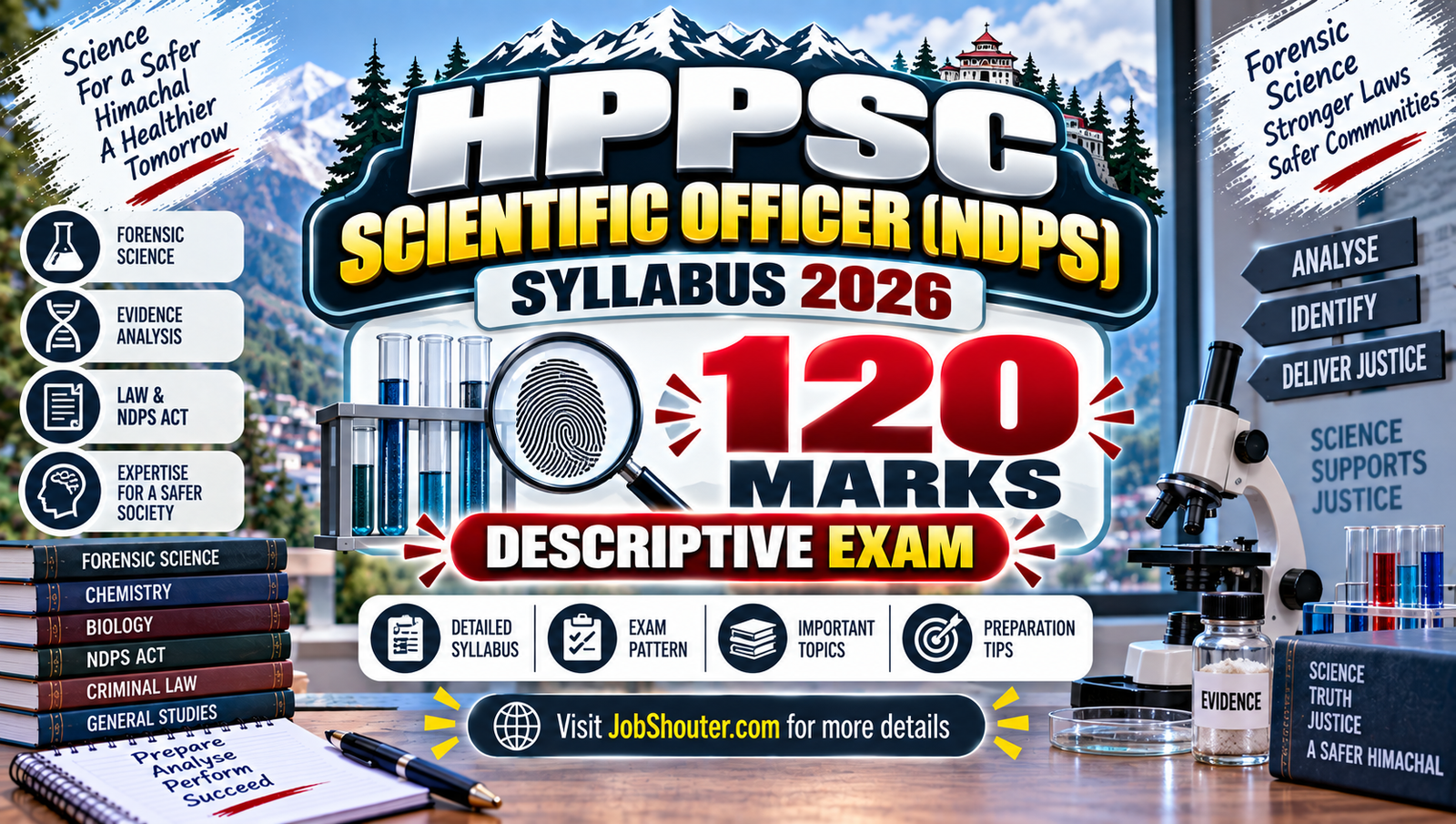
Himachal Pradesh Public Service Commission (HPPSC) has released the syllabus and exam pattern for the Subject Aptitude Test (SAT) for the post of Scientific Officer (NDPS), Group-B, under the Directorate of Forensic Services, Home Department. Candidates who applied for this single-post recruitment need a clear understanding of the descriptive exam pattern and detailed unit-wise syllabus to prepare effectively. This article provides the complete, verified breakdown of the HPPSC Scientific Officer (NDPS) syllabus and exam pattern 2026.
HPPSC Scientific Officer (NDPS) Syllabus 2026: Overview
The Scientific Officer (NDPS) post falls under the Directorate of Forensic Services and deals with forensic examination of narcotic drugs and psychotropic substances. The recruitment for this single vacancy was notified earlier in 2026, with the application window having already closed; this article is specifically for candidates who applied and are now preparing for the Subject Aptitude Test.
Organisation Name
Himachal Pradesh Public Service Commission (HPPSC)
Eligibility Criteria
Candidates must hold an M.Sc. degree (minimum 2nd class) in Forensic Science with specialization in Chemical Sciences, or in Chemistry/Bio-Chemistry, or a Pharmacy degree (M.S. Pharm./M.Pharm.), from a recognized university. In addition, candidates need a minimum of 3 years of post-qualification experience in research, training, or analytical work in the relevant subject.
Total Vacancy and Pay
| Particular | Details |
|---|---|
| Post | Scientific Officer (NDPS), Group-B |
| Total Posts | 1 |
| Monthly Salary | Rs. 28,000 |
Age Limit
The age limit is 18 to 45 years, with an additional relaxation of 5 years for SC/ST/OBC candidates of Himachal Pradesh, persons with disabilities, and HP government employees/ex-servicemen.
Exam Pattern
The Subject Aptitude Test (SAT) is a descriptive-format examination.
| Particular | Details |
|---|---|
| Total Marks | 120 |
| Duration | 3 hours |
| Format | Descriptive |
| Structure | Two parts (Part-I and Part-II), 60 marks each |
Selection Process
The selection process includes a preliminary screening test, followed by the descriptive Subject Aptitude Test, and a personality interview.
Detailed Syllabus
Part-I (60 Marks)
Unit I: Forensic Science Fundamentals
Definitions, history, organizational bodies such as CFSLs, FSLs, and INTERPOL, key principles including Locard’s Exchange Principle, types of evidence, and applications of AI/ML in forensic science.
Unit II: Crime Scene Management
Systematic crime scene investigation, photography, videography, blood stain pattern analysis, and accident reconstruction techniques.
Unit III: Dactylography
History of fingerprinting, ridge formation, the Henry classification system, the National Automated Fingerprint Identification System (NAFIS), and biometric identification methods such as face, iris, and retina recognition.
Unit IV: Instrumental Methods
Various types of microscopy, spectroscopy techniques (AAS, UV-Vis, FTIR), chromatography methods (HPLC, TLC), and specialized tools such as the Video Spectral Comparator (VSC).
Unit V: Chemometrics and Quality Management
Statistical analysis methods including t-tests and ANOVA, ISO/IEC 17025:2017 laboratory accreditation compliance, forensic report writing, and relevant legislation including the NDPS Act and the IT Act 2000.
Unit VI: Research Methodology and Ethics
Research design principles, plagiarism detection, citation indexing, and ethical responsibilities in forensic research.
Part-II (60 Marks)
Unit VII: Chemistry Basics
Organic compounds, stereochemistry, proteins, carbohydrates, and classification of alkaloids.
Unit VIII: Narcotic Drugs and Psychotropic Substances
Types of narcotic drugs, plant sources such as cannabis and coca, extraction and identification of morphine, codeine, and heroin, and provisions of the NDPS Act.
Unit IX: Forensic Chemistry
Titrimetric analysis, arson investigation techniques, petroleum product testing, and alcohol analysis.
Unit X: Analytical Chemistry
Classical and instrumental analytical methods, method validation procedures, and analysis of biological samples.
Unit XI: Sample Preparation and Separation
Liquid extraction techniques, chromatography, and advanced techniques including GC-MS, GC-MS-MS, and LC-MS-MS.
Unit XII: Forensic Pharmacology
Drug absorption, metabolism, pharmacodynamics, and drug development processes.
Important Links
| Purpose | Link |
|---|---|
| Official Syllabus PDF | Click Here |
| Official Website | Click Here |
Frequently Asked Questions (FAQs)
1. How many marks does the HPPSC Scientific Officer (NDPS) SAT carry?
The Subject Aptitude Test carries 120 marks in total, divided equally into two parts of 60 marks each.
2. What is the duration of the exam?
The exam duration is 3 hours.
3. Is the exam objective or descriptive?
The Subject Aptitude Test is in descriptive format.
4. What is the eligibility for the Scientific Officer (NDPS) post?
Candidates need an M.Sc. in Forensic Science, Chemistry/Bio-Chemistry, or a Pharmacy degree, along with 3 years of post-qualification relevant experience.
5. How many vacancies are there for this post?
There is only 1 vacancy for the Scientific Officer (NDPS) post.
6. What is the selection process for this recruitment?
Selection involves a preliminary screening test, the descriptive Subject Aptitude Test, and a personality interview.
7. Is the application window still open for this recruitment?
No, the application window for this recruitment has already closed; this syllabus is for candidates who have already applied and are preparing for the exam.
8. What topics are covered under Part-II of the syllabus?
Part-II covers Chemistry Basics, Narcotic Drugs and Psychotropic Substances, Forensic Chemistry, Analytical Chemistry, Sample Preparation and Separation, and Forensic Pharmacology.
Disclaimer: JobShouter.com is not affiliated with Himachal Pradesh Public Service Commission. Shared for informational purposes only, please verify details on the official website.