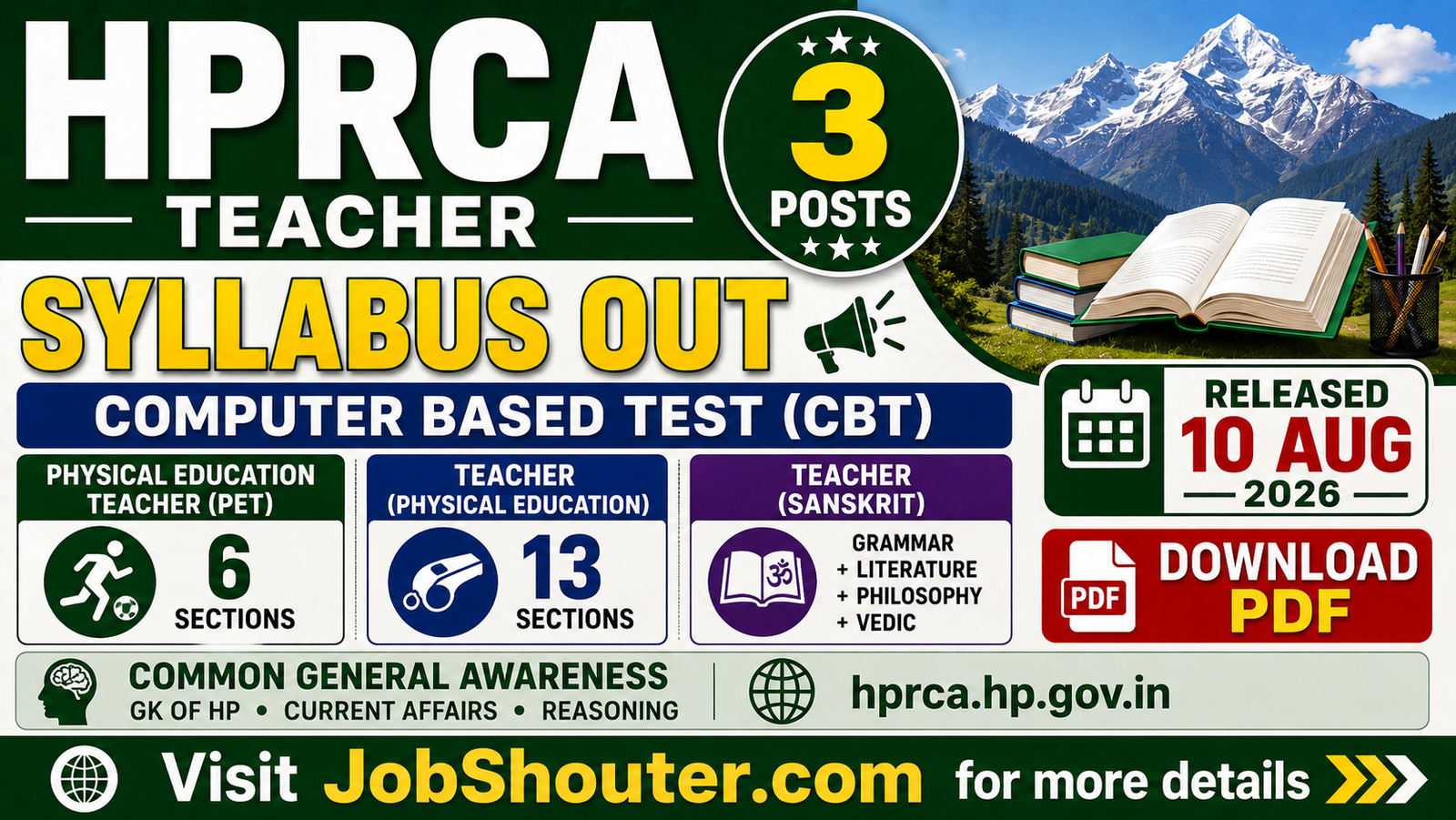
The Himachal Pradesh Rajya Chayan Aayog (HPRCA) has released the official Computer Based Test (CBT) Syllabus on 10 August 2026 for three teaching posts – Physical Education Teacher (PET), Teacher (Physical Education), and Teacher (Sanskrit) – on the official HPRCA website hprca.hp.gov.in. Three separate syllabus PDFs have been uploaded. All three syllabi share a common General Awareness section covering General Knowledge of Himachal Pradesh, Current Affairs, Everyday Science, Logical Reasoning, Social Science, General English, and General Hindi at the 10th standard level. The subject-specific content differs significantly across the three posts – the PET syllabus is organised under 6 broad sections (A to F), the Teacher (Physical Education) syllabus is more detailed with 13 sections (A to M), and the Teacher (Sanskrit) syllabus covers grammar, literature, linguistics, philosophy, Vedic literature, Dharmashastra, and one-year B.Ed subjects. The exam will be conducted in Computer Based Test (CBT) mode. Important note: the syllabus PDFs do not specify total marks, number of questions, exam duration, negative marking, or qualifying marks – candidates must watch the official HPRCA website for the detailed recruitment notification which will contain this information.
Important Note: Three things every HPRCA Teacher aspirant must keep in mind while using this syllabus. First, PET and Teacher (Physical Education) are TWO SEPARATE POSTS with separate syllabus documents – both cover Physical Education subject areas but at very different depths; the Teacher (Physical Education) syllabus (13 sections A to M) is significantly more detailed and advanced than the PET syllabus (6 sections A to F); prepare from the syllabus document of your specific applied post only, not the other. Second, the syllabus documents do not specify the exam pattern – total marks, number of questions, time duration, negative marking rules, and category-wise qualifying marks are not mentioned in the released syllabus PDFs; for this information, candidates must wait for and refer to the detailed recruitment notification/advertisement on hprca.hp.gov.in. Third, General Awareness is common to all three posts and identical across them – covering GK of HP, Current Affairs, Everyday Science, Logical Reasoning, Social Science, General English, and General Hindi at 10th standard level; preparing this section well benefits candidates for all three posts and should be started immediately regardless of which post you applied for.
HPRCA Teacher Syllabus 2026 – Overview
| Particulars | Details |
|---|---|
| Conducting Body | Himachal Pradesh Rajya Chayan Aayog (HPRCA) |
| Posts Covered | Physical Education Teacher (PET), Teacher (Physical Education), Teacher (Sanskrit) |
| Syllabus Released Date | 10 August 2026 |
| Exam Mode | Computer Based Test (CBT) |
| Total Marks/Questions/Duration | Not specified in syllabus PDFs – check detailed notification at hprca.hp.gov.in |
| Common Section (All Three Posts) | General Awareness – GK of HP, Current Affairs, Everyday Science, Logical Reasoning, Social Science, English and Hindi (10th standard) |
| PET Syllabus Structure | 6 sections (A to F) + General Awareness |
| Teacher Physical Education Syllabus | 13 sections (A to M) + General Awareness |
| Teacher Sanskrit Syllabus | Grammar + Literature + Linguistics + Philosophy + Vedic Literature + Dharmashastra + B.Ed subjects + General Awareness |
| Official Website | hprca.hp.gov.in |
Important Dates
| Event | Date |
|---|---|
| HPRCA Teacher Syllabus Released | 10 August 2026 |
| Exam Date | To be notified at hprca.hp.gov.in |
| Admit Card | To be notified at hprca.hp.gov.in |
Syllabus Download Links
| Post | Syllabus PDF |
|---|---|
| HPRCA Official Website | Click Here |
General Awareness Syllabus (Common to All Three Posts)
| Topic | Content |
|---|---|
| General Knowledge of Himachal Pradesh | History, geography, culture, political and administrative aspects of HP; HP current affairs |
| Current Affairs | National and international current events |
| Everyday Science | Basic science applied to daily life |
| Logical Reasoning | Verbal and non-verbal reasoning |
| Social Science | History, Geography, Civics, Economics at 10th standard level |
| General English | Grammar and comprehension at 10th standard level |
| General Hindi | Grammar and comprehension at 10th standard level |
Prepare this section thoroughly and early – it is identical across all three posts and can significantly boost your total score regardless of which teaching post you applied for.
HPRCA Physical Education Teacher (PET) Syllabus 2026 – Section-wise
The PET syllabus is divided into 6 sections (A to F) plus General Awareness.
Section A – Foundations and History of Physical Education
- Meaning, definition, nature and scope of Physical Education; aims and objectives; Physical Education as a valued human practice; relationship with biological and social sciences
- Historical development of Physical Education in India
- Ancient Olympic Games; Modern Olympic Games; Asian Games; Commonwealth Games; South Asian Games
- National Sports Policy; Fit India Movement; Khelo India Programme; Sports Promotion Schemes in Himachal Pradesh; national and state awards; international, national and state sports bodies
Section B – Sports Anatomy, Physiology and Exercise Sciences
- Human Anatomy and Physiology: skeletal, muscular, circulatory, respiratory, digestive, nervous systems; levers; body joints; bone types
- Exercise Physiology: effects of exercise; aerobic and anaerobic exercise; warm-up and cool-down; fatigue and recovery; oxygen debt
- Kinesiology and Biomechanics: human movement; planes and axes; force and motion; Newton’s Laws of Motion; balance and equilibrium; centre of gravity
- Health and Nutrition: balanced diet; macronutrients and micronutrients; vitamins and minerals; sports nutrition; hydration; weight management; BMI and obesity
Section C – Sports Psychology and Sociology
- Sports Psychology: meaning and scope; personality; motivation; learning; anxiety; stress; aggression; attention and concentration
- Sports Sociology: sports as social institution; socialization through sports; leadership; team dynamics; sportsmanship and ethics
- Growth and Development: stages of growth; motor development; learning motor skills
Section D – Sports Training and Kinesiological Pedagogy
- Principles of Sports Training: overload; specificity; progression; reversibility; individualization
- Methods of Training: continuous, interval, circuit, fartlek, plyometric training
- Components of Physical Fitness: strength, speed, endurance, flexibility, coordination, agility
- Teaching Pedagogy: teaching methods; lesson planning; class management; audio-visual aids
Section E – Organization, Administration and Sports Medicine
- Organization and Administration: school sports management; budget; facilities; equipment management
- Tournament Organization: knock-out; league; round robin; combination; challenge; fixture drawing
- Sports Medicine: first aid; sports injuries – sprain, strain, fracture, dislocation; cryotherapy and thermotherapy
Section F – Rules, Officiating and Coaching of Games
Team Games: Kabaddi, Kho-Kho, Volleyball, Basketball, Football, Cricket, Hockey, Handball, Badminton, Table Tennis, Chess – history, rules, dimensions, equipment, officiating signals, fundamental skills
Individual Sports: Athletics (track and field), Wrestling, Boxing, Taekwondo, Judo, Kurash, Karate
Traditional Activities: Yoga (Asanas, Pranayama, Ashtanga Yoga), Gymnastics
HPRCA Teacher (Physical Education) Syllabus 2026 – Section-wise
The Teacher (Physical Education) syllabus is significantly more detailed than the PET syllabus – 13 sections (A to M) covering the same broad areas with greater depth.
Section A – History, Principles and Foundation of Physical Education
Meaning, definition and scope; historical development from Indus Valley Civilization Period (3250 BC) through Vedic, Early and Later Hindu, Medieval, and British periods, and post-1947 India; contribution of Akhadas and Vyayamshalas; YMCA; philosophical foundations (idealism, pragmatism, naturalism, realism, humanism, existentialism, Indian philosophy); principles of Physical Education – biological, psychological, and sociological foundations; recent government policies.
Section B – Human Anatomy and Physiology
Introduction to anatomy and physiology; cells, tissues, organs, systems; Skeletal System – bone structure, classification, joints; Circulatory System – blood, heart, blood vessels, blood pressure, cardiac cycle, cardiac output, athlete’s heart; Histology – blood, skeletal muscle, skin, nephron, neuron; Digestive System; Muscular System – types, structure, function, muscle contraction; Nervous System – brain, spinal cord, neuron, reflex action.
Section C – Olympic Movement
Origin, philosophy, history, development stages; Modern Olympic Games – ideals, rings, flag, protocol, Olympism, Sports for All; types: Para, Summer, Winter, Youth Olympics; IOC, NOCs, Olympic Commission; India’s Olympic medal winners; Commonwealth and Asian Games.
Section D – Yoga Education
Meaning, definition, aims, types (Raja, Mantra, Bhakti, Karma Yoga); Ashtanga Yoga (Yama, Niyama, Asana, Pranayama, Pratyahara, Dharana, Dhyana, Samadhi); Hatha Yoga and Shudhi Kriyas; Asanas – classification, techniques, benefits; Bandhas and Mudras; Pranayama types; role of yoga in sports and modern life.
Section E – Kinesiology and Biomechanics
Meaning, importance; fundamental movement terminology; axes, planes, centre of gravity, equilibrium; classification of joints and muscles; levers – types and application to human body; Newton’s Laws of Motion applied to sports; projectile trajectory; Kinematics and Kinetics of human movement; mechanical analysis of walking, running, jumping, throwing; Massage – classification of manipulations and movements.
Section F – Sports Training
Meaning, aims, objectives, principles; Basic, Good and High Performance Training; means and methods for Strength, Speed, Endurance, Coordination, Flexibility; training load – types and principles; Technical and Tactical Training; Periodization – preparatory, competition, and transitional periods; Talent Identification and Development.
Section G – Sports Psychology and Sociology
Educational and sports psychology; growth and development stages; individual differences; psycho-sociological aspects; theories and laws of learning; personality and sports; motivation – factors and techniques; mental preparation strategies (attention focus, self-talk, relaxation, imagery); aggression and anxiety in sports; group dynamics; leadership; cognitive processes – memory and thinking; motor skills learning; transfer of training.
Section H – Test, Measurement and Evaluation
Meaning, need, importance, principles; criteria of a good test (reliability, objectivity, validity, norms); AAHPER, National, and Indiana Motor Fitness Tests; sports skill tests for badminton, basketball, soccer, volleyball, hockey; physiological testing (BP, breathing, vital capacity, HR, pulse, body temperature, body composition).
Section I – Sports Medicine, Physiotherapy and Rehabilitation
Meaning, aims, objectives; sports injuries – prevention, first aid and treatment; bandages and supports; Physiotherapy – hydrotherapy, cryotherapy, thermotherapy, contrast bath, whirlpool, sauna, Swedish massage; therapeutic exercises; common injuries (sprain, strain, fracture, dislocation, abrasion, blister, athlete’s foot, footballer’s knee/ankle).
Section J – Health Education and Nutrition
Concept, scope, objectives, principles; personal hygiene – skin, hair, eyes, ears, teeth, feet, rest, sleep; effects of alcohol and smoking; school health programme; balanced diet and daily energy requirements; communicable diseases – influenza, malaria, smallpox, TB, typhoid, cholera, measles.
Section K – Exercise Physiology
Meaning, importance; energy sources – ATP, creatine phosphate, metabolism; effects of altitude, heat, dehydration, acclimatization; posture – meaning, types, causes, importance, postural tests; postural deformities (kyphosis, lordosis, scoliosis, bow legs, knock knee, flat foot) – preventive and remedial exercises.
Section L – Sports and Games Specialisation
History, rules, dimensions, measurement, skills, terminology for: track and field (sprint, middle, long distance, jumps, throws), badminton, basketball, volleyball, kabaddi, kho-kho, judo, wrestling; sports awards; international medal winners.
Section M – Research in Physical Education
Importance, classification, ethical issues; research methods – descriptive, historical, experimental; research designs; hypothesis formulation and testing; tools – questionnaires, interviews, observation; sampling techniques; data types and collection; statistical techniques (parametric and non-parametric); preparation of research proposal, report, abstract, and paper for presentation.
HPRCA Teacher (Sanskrit) Syllabus 2026
1. Grammar (as per Laghusiddhanta Kaumudi)
- Sangya Prakaran – Pratyahar Sutra, Uccharansthan, Abhyantar Prayatna, Bahya Prayatna
- Sandhi Prakaran – Ach Sandhi, Hal Sandhi, Visarga Sandhi (with Sutra explanation)
- Shabda Ling Prakaran – Akaranta Pulling, Akaranta Strilinga, Akaranta Napunsakalinga
- Dhaturoop – Parasmaipada, Atmanepada; Lakars – Lat, Lrit, Lang, Lot, Vidhilinga
- Karak Prakaran – Karta, Karma, Karan, Sampradan, Apadan, Sambandh, Adhikaran Karak (with Sutra explanation)
- Samas Prakaran – Purvapada Pradhan, Uttarpada Pradhan, Ubhayapada Pradhan, Anya Pada Pradhan Samas
- Pratyaya Prakaran – Kridant (Krit, Ktva, Tumun, Shatri, Shanach, Kta, Ktavatu), Taddhita (Tal, Matup, In, Thak), Stri Pratyaya (Tap, Ngip, Ngish, Uru)
2. Sahityashastra (Sanskrit Literature)
- Introduction to Ramayana and Mahabharata
- Raghuvansham (First and Second Canto)
- Naishadhiyacharitam (First Canto)
- Meghdoot
- Uttar Ramcharitam
- Abhijnanashakuntalam (Acts 1 to 4)
- Shrimad Bhagavad Gita (Chapters 2, 3, 14, 17)
- Kadambari (Kathamukh)
- Dashkumarcharitam (Seventh and Eighth Uchhwasa)
- Panchatantra and Hitopadesh
- Kavyaprakash and Sahityadarpan (Kavya Prayojan, Lakshan, Hetu, Bhed, Gunanirupan, Rasa Prakaran, Rasa Dosh, Riti Nirupan, Shabda Shakti, Rasa Nishpatti)
- Vrittaratnakar – Chhanda: Anushtup, Indravajra, Upendravajra, Vasantatilaka, Malini, Shikharini, Shardulvikridita; Alankar: Anupras, Yamak, Upama, Rupak, Samasokti, Sandeh, Vibhavana, Drishtant, Swabhavokti
3. Bhasha Vigyan (Linguistics)
- Language and speech; origin and function of language
- Phonetics (Swan Vigyan); phoneme and principles of phonemic analysis; stress and duration
- Components of sentence construction; word order; causes of semantic change
4. Darshanshastra (Philosophy)
- Kanadgautamiyam: Saptapadartha, Navadravya, Gunanirupan, Karma Siddhant, Samvaya, Vishesh, Abhav
- Vedanta Sara: Panchapran, Panchakosh, Anubandh Chatushtaya, Srishti Prakriya, Avidya, Maya, Jeeva, Ishwar
- Sankhyakarika: Satkaryavad, Srishti Prakriya, Purush Swaroop, Dukh Nirupan, Atma
- Tarkabhasha: Shodashapadartha, Praman, Prameya, Karan, Karya, Anuman Vivechan, Ling Paramarsh, Panchavayav, Hetvabhas
5. Vedic Sahitya (Vedic Literature)
- Rigveda Suktas: Agni Sukta (M.1/S.1), Surya Sukta (M.1/S.115), Vishnu Sukta (M.1/S.154), Indra Sukta (M.2/S.12), Usha Sukta (M.3/S.61), Parjanya Sukta (M.5/S.83), Purush Sukta (M.10/S.90), Hiranyagarbha Sukta (M.10/S.121)
- Atharvaveda: Prithvi Sukta
- Ishopanishad and Mundakopanishad
- Nirukta: Shad Bhavvikar, Sarthak and Nirarthak Mantra
- Nighantu: Nirvachanani
6. Dharmashastra
- Manusmriti: Shodash Sanskar, Shauch Nirupan
- Yajnavalkya Smriti: Achar Adhyay, Vyavahar Adhyay
- Parashar Smriti: Prayashchit Adhyay
- Kautilya Arthashastra: First and Second Adhikaran
7. One-Year B.Ed. Subjects
- Teaching methods for Sanskrit: Grammar Translation Method, Direct Method, Communicative Method
- Teaching of prose, poetry and drama; grammar and vocabulary; listening, speaking, reading and writing skills
- Lesson planning; assessment and evaluation; ICT in Sanskrit teaching
Preparation Tips for HPRCA Teacher CBT 2026
- Start with your post-specific syllabus PDF – mark out topics you are unfamiliar with before making a study plan. The depth required for PET (6 sections) vs Teacher PE (13 sections) is very different; do not mix them up.
- Build General Awareness first – since the GK of HP, Current Affairs, Everyday Science, Logical Reasoning, Social Science, English, and Hindi section is common to all three posts and tests 10th standard level knowledge, it is the most accessible section for scoring. Prepare it early and revise it weekly.
- For PET candidates – focus equally on theory (Sections A-D: Anatomy, Physiology, Psychology, Training) and applied content (Sections E-F: Rules of Games, Officiating, Yoga). Many candidates over-prepare theory and under-prepare rules and officiating – balance your preparation.
- For Teacher (Physical Education) candidates – the 13-section syllabus includes Research Methods (Section M) and Test, Measurement and Evaluation (Section H) which often receive less preparation attention; these carry significant content and should not be left for the last week.
- For Teacher (Sanskrit) candidates – Grammar (Laghusiddhanta Kaumudi based) requires daily Sutra-based practice. Revise prescribed texts (Raghuvansham, Meghdoot, Abhijnanashakuntalam, Gita chapters) systematically and cover Darshanshastra and Vedic literature alongside grammar, not as afterthoughts.
- Exam pattern is NOT yet released – the total marks, question count, section-wise distribution, and negative marking rules are not in the syllabus PDFs; solve previous year papers of similar HPRCA CBT exams while waiting, and adjust your strategy when the detailed notification specifies the pattern.
- Monitor hprca.hp.gov.in regularly for the detailed recruitment notification, exam date, and admit card release.
Important Links
| Description | Link |
|---|---|
| HPRCA Official Website (Download Section) | Click Here |
HPRCA Teacher Syllabus 2026 – FAQs
Q1. Has the HPRCA Teacher Syllabus 2026 been released?
✅ Yes. HPRCA released the CBT Syllabus for Physical Education Teacher (PET), Teacher (Physical Education), and Teacher (Sanskrit) on 10 August 2026 by uploading three separate syllabus PDFs on the official website hprca.hp.gov.in. All three syllabi share a common General Awareness section and have post-specific subject content.
Q2. Are the PET and Teacher (Physical Education) syllabi the same?
✅ No. Both cover Physical Education subject areas, but they are separate posts with separate syllabus documents. The PET syllabus has 6 sections (A to F) covering Physical Education broadly. The Teacher (Physical Education) syllabus has 13 sections (A to M) with significantly greater topic depth, including dedicated sections on Yoga Education, Research in Physical Education, Test and Measurement, and Exercise Physiology that are not separate sections in the PET syllabus. Prepare from your specific post’s syllabus.
Q3. What is the General Awareness syllabus for HPRCA Teacher CBT 2026?
✅ The General Awareness section is identical across all three posts (PET, Teacher PE, Teacher Sanskrit). It covers: General Knowledge of Himachal Pradesh, Current Affairs, Everyday Science, Logical Reasoning, Social Science (10th standard), General English (10th standard), and General Hindi (10th standard).
Q4. What is the exam pattern for HPRCA Teacher CBT 2026?
✅ The exam pattern – including total marks, number of questions, time duration, negative marking, and qualifying marks – is NOT specified in the syllabus PDFs released on 10 August 2026. These details will be published in the detailed recruitment notification/advertisement on hprca.hp.gov.in. Monitor the official website for this information.
Q5. What topics are covered in the HPRCA PET Syllabus 2026?
✅ The PET syllabus covers 6 sections: (A) Foundations and History of Physical Education – meaning, history, Olympics, sports policies including HP schemes; (B) Sports Anatomy, Physiology and Exercise Sciences; (C) Sports Psychology and Sociology; (D) Sports Training and Kinesiological Pedagogy; (E) Organization, Administration and Sports Medicine; (F) Rules, Officiating and Coaching of Games including Kabaddi, Kho-Kho, Volleyball, Basketball, Football, Cricket, Hockey, Athletics, Yoga, and Gymnastics.
Q6. What topics are covered in the HPRCA Teacher (Sanskrit) Syllabus 2026?
✅ The Sanskrit Teacher syllabus covers: (1) Grammar based on Laghusiddhanta Kaumudi – Sangya, Sandhi, Shabda Ling, Dhaturoop, Karak, Samas, Pratyaya Prakarans; (2) Sanskrit Literature – Ramayana, Mahabharata, Raghuvansham, Meghdoot, Abhijnanashakuntalam, Bhagavad Gita chapters, Kavyaprakash, Sahityadarpan, Vrittaratnakar; (3) Linguistics; (4) Philosophy – Kanada, Vedanta Sara, Sankhyakarika, Tarkabhasha; (5) Vedic Literature – Rigveda Suktas, Ishopanishad, Mundakopanishad; (6) Dharmashastra – Manusmriti, Yajnavalkya Smriti, Parashar Smriti, Arthashastra; (7) B.Ed. Subjects; (8) General Awareness.
Q7. How should I prepare for the HPRCA Teacher CBT if the exam pattern is not yet known?
✅ Use the official syllabus PDF to build a topic-wise study plan and prepare all the subject content thoroughly. In parallel, solve previous year question papers from similar HPRCA CBT exams (other teacher posts conducted by HPRCA) to estimate question difficulty and time management strategies. Once the detailed notification with the exam pattern is released at hprca.hp.gov.in, adjust your strategy to match the actual marks and question distribution.
Q8. Where can I download the HPRCA Teacher Syllabus PDF 2026?
✅ The official syllabus PDFs are available on the official HPRCA website at hprca.hp.gov.in/download. Direct download links for all three posts (PET, Teacher Physical Education, Teacher Sanskrit) are provided in the Important Links section of this article.
Q9. Is Himachal Pradesh GK specifically in the HPRCA Teacher syllabus?
✅ Yes. The General Awareness section of all three HPRCA Teacher CBT syllabi specifically includes General Knowledge of Himachal Pradesh as the first listed topic. This covers HP history, geography, culture, administration, and current affairs specific to Himachal Pradesh and is given priority placement in the syllabus, indicating its importance.
Q10. When will the HPRCA Teacher CBT exam be held?
✅ The exam date for the HPRCA Teacher CBT has not been announced along with the syllabus release. Syllabus release typically precedes the exam by several weeks to months. Monitor hprca.hp.gov.in regularly for the detailed recruitment notification and exam date. An admit card (hall ticket) release notice will typically come 10-15 days before the exam.
Disclaimer
The information above is compiled from the HPRCA Teacher CBT Syllabus PDFs released on 10 August 2026 by the Himachal Pradesh Rajya Chayan Aayog (HPRCA) for Physical Education Teacher (PET), Teacher (Physical Education), and Teacher (Sanskrit) posts, as uploaded on the official HPRCA website hprca.hp.gov.in. The exam pattern, total marks, number of questions, duration, and qualifying marks are not specified in the syllabus documents – these will be published in the detailed recruitment notification at hprca.hp.gov.in. Candidates must download and verify from the original official syllabus PDFs at hprca.hp.gov.in.