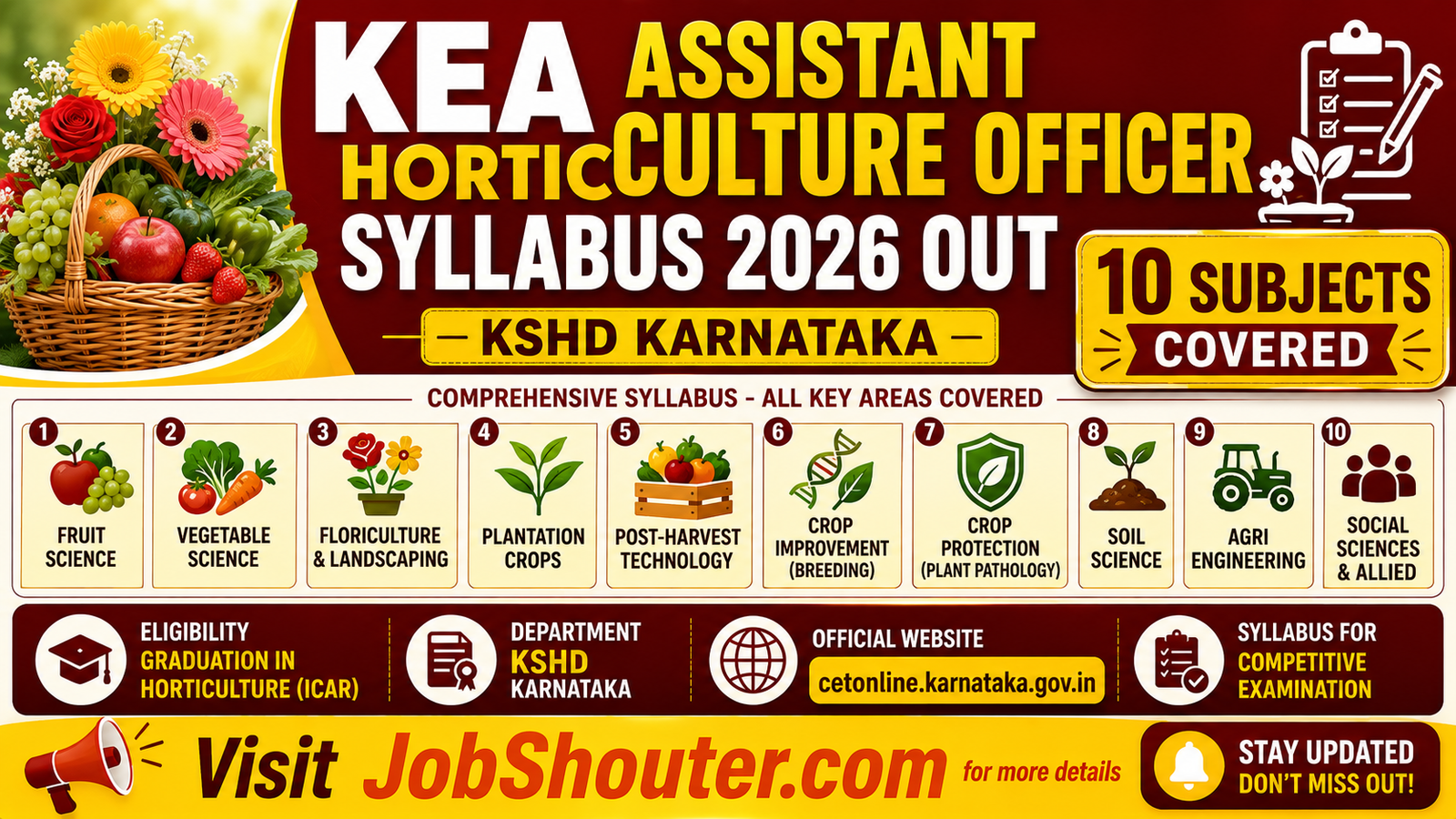
The Director of Horticulture and Chairman, Competitive Examination Syllabus Committee, Karnataka has released the official syllabus for the Assistant Horticulture Officer (AHO) Examination 2026 on 5 August 2026, linked to the Karnataka State Horticulture Development Mission (KSHD) / Directorate of Horticulture Recruitment 2026 for 85 posts (AHO and Assistant Director). The KEA AHO Syllabus 2026 is approved by the Competitive Examination Syllabus Committee and covers 10 major subject areas – Fruit Science, Vegetable Science, Floriculture and Landscape Architecture, Plantation/Spices/Medicinal and Aromatic Crops, Post-Harvest Technology, Crop Improvement, Crop Protection, Soil Science, Agricultural Engineering, and Social and Allied Sciences. Eligibility requires a Graduation in Horticulture from an ICAR-accredited university. The official syllabus PDF is available at cetonline.karnataka.gov.in. The exam pattern, question count, marks distribution and negative marking are not specified in the syllabus document and will be available in the official recruitment notification.
Important Note: Three things every KEA AHO aspirant must understand before beginning preparation. First, the exam pattern, total marks, question count, duration and negative marking are not mentioned in the syllabus document – these details will be specified in the official recruitment notification from KEA/KSHD at kshd.karnataka.gov.in or cetonline.karnataka.gov.in. Do not guess or assume the pattern; check the official notification before the exam. Second, the syllabus is exceptionally broad and deep – it covers all 10 major subjects of a B.Sc. (Horticulture) degree including Fruit Science, Vegetable Science, Floriculture, Plantation and Spice Crops, Post-Harvest Technology, Crop Improvement, Crop Protection, Soil Science, Agricultural Engineering and Social and Allied Sciences. Begin preparation well in advance using your graduation coursework as the base. Third, cross-cutting themes repeat across almost every subject – protected cultivation, precision horticulture (GPS/GIS/IoT/drones), post-harvest management, breeding and biotechnology appear under Fruit Science, Vegetable Science, Floriculture and Plantation crops. Preparing these themes once in depth will save time across all sections.
KEA AHO Syllabus 2026 – Overview
| Particulars | Details |
|---|---|
| Post Name | Assistant Horticulture Officer (AHO) |
| Issuing Authority | Director of Horticulture and Chairman, Competitive Examination Syllabus Committee, Karnataka |
| Linked Recruitment | KEA KSHD Recruitment 2026 – 85 Posts (AHO and Assistant Director) |
| Syllabus Released | 5 August 2026 |
| Minimum Qualification | Graduation in Horticulture from a University established by law in India, accredited by ICAR |
| Total Subjects | 10 |
| Exam Pattern | Not specified in the syllabus document – check official recruitment notification |
| Official Syllabus PDF | cetonline.karnataka.gov.in |
| Official Website | kshd.karnataka.gov.in / cetonline.karnataka.gov.in |
Important Dates
| Event | Date |
|---|---|
| KEA KSHD Recruitment 2026 Notification (85 Posts) | 2026 |
| AHO Syllabus Released | 5 August 2026 |
| Exam Date | To be notified – check cetonline.karnataka.gov.in |
Eligibility to Apply
| Criteria | Details |
|---|---|
| Educational Qualification | Graduation in Horticulture (B.Sc. Horticulture or equivalent) from a University established by law in India, accredited by the Indian Council of Agricultural Research (ICAR) |
| Age Limit | As per the official KSHD recruitment notification |
| Other Conditions | As per the official KEA/KSHD recruitment notification |
KEA AHO Exam Pattern 2026
The exam pattern for the KEA Assistant Horticulture Officer Examination 2026 is not specified in the official syllabus document. Details including total questions, total marks, exam duration, negative marking, and question type (objective/descriptive) will be published in the official recruitment notification at cetonline.karnataka.gov.in or kshd.karnataka.gov.in. Candidates must check and confirm the exam pattern from the official source before the examination.
KEA AHO Syllabus 2026 – Subject-wise Topics
Subject 1: Fruit Science
Fundamentals of Horticulture: Scope and importance of horticulture; classification and distribution of fruit crops; nutritional importance, area, production, productivity, export and import; horticultural regions of India and Karnataka; principles of orchard establishment, planning, layout and management; nursery techniques and quality planting material production; soil and climatic requirements; planting systems, planting densities, high-density and ultra-high-density planting; canopy architecture and orchard floor management; irrigation, fertigation, nutrient management, integrated nutrient management, weed management, mulching and soil health management; principles of training and pruning; bearing habits, flowering, fruit set and factors influencing fruitfulness; crop regulation, rejuvenation of senile orchards, top working, frame working, use of plant growth regulators; precision horticulture, protected cultivation, mechanization, climate-resilient fruit production and sustainable orchard management.
Plant Propagation and Nursery Management: Principles of sexual and asexual propagation; seed biology, dormancy, germination and seed treatments; apomixis, polyembryony; propagation through cuttings, layering, grafting, budding, division, runners, suckers, offsets, stolons, corms and other vegetative structures; physiological and biochemical basis of rooting and graft union formation; stock-scion relationships and graft incompatibility; propagation structures – mist chambers, greenhouses, polyhouses, glasshouses, hot beds, cold frames and phytotrons; nursery establishment, management, certification and accreditation; mother block maintenance, budwood certification; micrografting, micropropagation and tissue culture; role of plant growth regulators in propagation; quality planting material production.
Production Technology of Tropical and Subtropical Fruits: Origin, distribution, taxonomy, varieties and rootstocks of mango, banana, citrus, grape, guava, papaya, sapota, pineapple, pomegranate, jackfruit, avocado, litchi, mangosteen, passion fruit, rambutan, durian, carambola, breadfruit, rose apple and others; climatic and soil requirements; propagation, planting, canopy management, crop regulation, fertigation and nutrient management; use of plant growth regulators; physiological disorders; harvesting, maturity indices, post-harvest handling, grading, packaging, storage, value addition and export. Special topics: alternate bearing in mango and citrus, citrus decline, bud forecasting in grapes, sex expression in papaya, latex extraction and papain production.
Production Technology of Temperate and Dryland Fruits: Apple, pear, peach, plum, apricot, cherry, strawberry, kiwi, persimmon, almond, walnut, pecan and others; chilling requirements, training, pruning, pollination, pollinizers and self-incompatibility. Dryland horticulture: agro-climatic characterization of arid and semi-arid zones, watershed management, rainwater harvesting, soil and water conservation, micro-irrigation, antitranspirants, mulching, shelterbelts; ber, aonla, bael, custard apple, jamun, wood apple, pomegranate, carissa, date palm, tamarind, fig, phalsa, West Indian cherry and other arid fruit crops.
Protected Cultivation and Precision Horticulture: Precision technologies, IoT devices, environmental and plant sensors, weather stations, automation in irrigation and fertigation, robotics, autonomous farm machinery, decision support systems, GPS, GIS, Remote Sensing, drone technologies, field mapping and spatial data analysis.
Fruit Crop Improvement and Biotechnology: Scope and objectives of fruit breeding; origin and centres of diversity; germplasm exploration, characterization, conservation and utilization; floral biology, pollination, incompatibility and reproductive biology; introduction, selection, hybridization, mutation breeding, polyploidy, clonal selection, rootstock breeding; molecular breeding, marker-assisted selection, genomic selection, genome editing, transgenic approaches, tissue culture, embryo rescue and somatic hybridization; DUS testing, varietal protection and intellectual property rights.
Subject 2: Vegetable Science
Fundamentals of Vegetable Science: Scope and importance of vegetable crops; classification, origin, centres of diversity, nutritional importance, area and production; agro-climatic requirements; cropping systems, crop rotation, intensive vegetable production; nursery management and protected nursery production; irrigation, fertigation, integrated nutrient management, weed management, mulching, canopy management, use of plant growth regulators; physiological disorders; precision vegetable cultivation, protected cultivation, organic and natural farming, climate-resilient production.
Production Technology of Tropical and Subtropical Vegetables: Tomato, brinjal, chilli, sweet pepper, okra, cluster bean, cowpea, dolichos bean, French bean, cucumber, muskmelon, watermelon, bottle gourd, ridge gourd, sponge gourd, bitter gourd, snake gourd, ash gourd, pumpkin, squash, drumstick, sweet corn, curry leaf, amaranthus, basella, spinach beet, methi, dill and others; varieties and hybrids, climatic and soil requirements, nursery management, production technologies, post-harvest handling, value addition and export.
Production Technology of Temperate, Bulb, Root, Tuber and Perennial Vegetables: Cabbage, cauliflower, broccoli, Brussels sprouts, knol-khol, Chinese cabbage, lettuce, spinach, onion, garlic, leek, radish, carrot, beetroot, turnip, peas, broad bean, celery, asparagus, globe artichoke, rhubarb, potato, sweet potato, cassava, elephant foot yam, colocasia, dioscorea, arrowroot, Jerusalem artichoke and others; production technologies, physiological disorders, harvesting, post-harvest management.
Vegetable Crop Improvement and Seed Production: Scope and objectives of vegetable breeding; origin and evolution; germplasm conservation and utilization; reproductive biology, pollination mechanisms and breeding systems; heterosis breeding, hybrid seed production, mutation and polyploidy breeding; molecular breeding, marker-assisted selection, genomic selection, genome editing and transgenic approaches; breeder, foundation and certified seed production; seed certification standards, isolation distance, roguing, field and seed standards, seed processing, storage, testing and quality assurance for major vegetables.
Protected Cultivation, Post-Harvest Management and Sustainable Vegetable Production: Polyhouses, net houses, shade-net structures, low tunnels, hydroponics; precision irrigation and fertigation; post-harvest physiology, maturity indices, harvesting, grading, packaging, cold chain management, processing, value addition, quality standards, food safety, traceability and export; organic and natural vegetable production; Good Agricultural Practices (GAP); climate-smart vegetable production; resource-use efficiency.
Subject 3: Floriculture and Landscape Architecture
Fundamentals of Floriculture: Scope and importance of ornamental horticulture; history of floriculture in India and the world; classification, origin and distribution of ornamental plants; garden styles – English, Japanese, Mughal, Italian, French and contemporary; ornamental plant groups including annuals, biennials, perennials, bulbs, shrubs, trees, climbers, palms, ferns, orchids, cacti, succulents, indoor and foliage plants; lawn establishment and management; bonsai, topiary, floral art, flower arrangement and Ikebana; urban greening, environmental landscaping and sustainable floriculture.
Production Technology of Commercial Flower Crops: Rose, chrysanthemum, carnation, gerbera, gladiolus, tuberose, orchids, anthurium, lilies, jasmine, crossandra, marigold, China aster, dahlia, gaillardia, heliconia, bird of paradise and others; varieties and hybrids, propagation, nursery management, protected cultivation, irrigation, fertigation, nutrient management, use of plant growth regulators; harvesting, post-harvest handling, grading, packaging, storage, value addition and export; extraction of essential oils from aromatic flower crops.
Protected Floriculture and Precision Production Technologies: Greenhouse, polyhouse, shade-net house and other protected cultivation systems; environmental control, microclimate management, hydroponics, precision nutrient management; integrated management of pests, diseases and physiological disorders; production scheduling for domestic and export markets; post-harvest quality management, cold chain and marketing; economic feasibility and enterprise management.
Landscape Architecture and Environmental Planning: Scope, principles and elements of landscape architecture; preparation of landscape plans and garden designs; computer-aided landscape design using AutoCAD, GIS and other digital tools; bio-aesthetic planning; urban landscaping and green infrastructure; landscape development for residential areas, institutional campuses, public parks, hospitals, industries, highways, airports, railway stations and other public spaces; special gardens – rock, water, bog, marsh, sunken, terrace, roof, vertical, xeriscape, butterfly, fragrance, herbal, Japanese, Mughal and theme gardens; environmental landscaping for pollution mitigation, carbon sequestration, biodiversity conservation and climate resilience.
Ornamental Plant Improvement and Seed Technology: Scope of ornamental plant breeding; germplasm collection, characterization, conservation and utilization; reproductive biology and breeding systems; mutation breeding, polyploidy, heterosis breeding, exploitation of male sterility; breeding for novel flower colour, form, fragrance, vase life and stress resistance; molecular breeding, tissue culture, micropropagation, genome editing and transgenic approaches; breeder, foundation and certified seed production; seed certification standards, processing, storage, testing and quality assurance.
Subject 4: Plantation, Spices, Medicinal and Aromatic Crops
Plantation Crops: Coconut, arecanut, cashew, coffee, tea, cocoa, rubber, palmyrah and betel vine – propagation, nursery management, varietal improvement, planting systems, canopy management, nutrition, irrigation, weed management, cropping systems, harvesting, post-harvest management, processing, quality standards, value addition and marketing.
Spice Crops: Black pepper, small and large cardamom, turmeric, chilli, ginger, garlic, coriander, fenugreek, cumin, fennel, ajwain, vanilla, nutmeg, clove, cinnamon, allspice, tamarind and garcinia – production technologies, harvesting, curing, processing, grading, quality standards, value addition, storage, export requirements and economics; organic cultivation, GAP, GMP, GI and traceability.
Medicinal Crops: Senna, periwinkle, medicinal coleus, ashwagandha, glory lily, sarpagandha, Aloe vera, amla, kalmegh, isabgol, opium poppy, safed musli, stevia, Mucuna, long pepper, Shatavari, guggul, cinchona, Dioscorea, chakramuni, madhunashini, sweet flag, foxglove, belladonna, Tinospora, annatto, noni and other medicinal crops of Karnataka – cultivation, post-harvest handling, drying, processing, quality standards, active principles, value addition, marketing and regulatory aspects (AYUSH).
Aromatic Crops: Palmarosa, lemongrass, citronella, vetiver, Mentha species, patchouli, geranium, Artemisia (davana), lavender, Ocimum species, sandalwood, rosemary, jasmine, rose, tuberose and chamomile – cultivation, harvesting, post-harvest management, essential oil extraction, quality evaluation, storage, value addition, industrial applications and economics; essential oil chemistry, distillation techniques and utilization in pharmaceutical, cosmetic, perfumery and food industries.
Breeding, Nursery Management, Post-Harvest and Value Addition: Germplasm conservation; conventional and molecular breeding; propagation methods including grafting, budding, layering, cutting, tissue culture and micropropagation; harvest maturity, curing, drying, grading, packaging, storage, processing, extraction of oils and phytochemicals, quality assurance, value addition, branding, GI, export standards and traceability.
Subject 5: Post-Harvest Technology
Fundamentals: Importance and economic significance of post-harvest management; post-harvest losses and loss reduction strategies; quality attributes of fresh horticultural produce; pre-harvest factors influencing post-harvest quality; maturity indices, harvesting standards and harvesting methods; physiological and biochemical changes during ripening and senescence; ethylene biosynthesis and action; climacteric and non-climacteric fruits; ripening regulation techniques.
Post-Harvest Handling, Packaging and Storage: Cleaning, washing, curing, trimming, grading, sorting and standardization; pre-cooling methods; packaging materials, package design, cushioning, modified atmosphere packaging (MAP), controlled atmosphere packaging (CAP), active and intelligent packaging, edible coatings and biodegradable packaging; cold chain management; transportation; storage – ambient, evaporative, refrigerated, CA, MA, hypobaric and zero-energy cool chambers; physiological disorders and storage diseases; quarantine treatments and export protocols.
Processing of Fruits, Vegetables, Plantation and Spice Crops: Unit operations in food processing; thermal processing, pasteurization, sterilization, blanching and aseptic processing; preservation by sugar, salt, acids, fermentation, freezing, dehydration and irradiation; drying and dehydration technologies; minimal processing and fresh-cut produce; value addition of fruits, vegetables, spices, plantation crops and medicinal plants; processing of jams, jellies, marmalades, squashes, juices, RTS beverages, pickles, chutneys, sauces, ketchup, dehydrated products, frozen products and spice products; curing and processing of spices, tea, coffee, cocoa and plantation products.
Food Chemistry, Quality Assurance and Food Safety: Composition and nutritional quality of horticultural produce; food spoilage and prevention; quality evaluation of fresh and processed products; sensory evaluation; food standards, grading and certification; HACCP, GMP, GHP and ISO systems; FSSAI regulations, AGMARK, BIS standards, Codex Alimentarius and export quality standards; residue limits, traceability and food safety management systems.
Post-Harvest Engineering and Value Chain Management: Post-harvest equipment and machinery; refrigeration and cold storage engineering; pack houses and ripening chambers; supply chain and cold chain logistics; marketing, export and international trade of fresh and processed produce; entrepreneurship, project formulation and techno-economic feasibility; biofortification and nutraceuticals.
Subject 6: Crop Improvement
Plant Breeding and Crop Improvement: History and principles of plant breeding; modes of reproduction; pollination mechanisms, self-incompatibility and male sterility; centres of origin and diversity; germplasm conservation and utilization; breeding methods for self-, cross- and clonally propagated crops; selection, hybridization, pedigree, bulk and backcross breeding; heterosis, inbreeding depression, combining ability, hybrid development; quantitative genetics; mutation breeding, polyploidy and special breeding techniques; breeding for biotic and abiotic stress resistance; plant variety protection, IPR, plant breeders’ rights and farmers’ rights.
Plant Physiology, Biochemistry and Genetics: Structure and function of plant cells; biomolecules and enzymes; plant pigments and secondary metabolites; metabolism and bioenergetics; water relations, mineral nutrition and biological nitrogen fixation; photosynthesis, respiration, photorespiration and C3/C4/CAM pathways; plant growth regulators and their applications; flowering, photoperiodism, vernalization; physiology of seed development, dormancy and germination; fruit growth, development and ripening; cell division, gametogenesis and fertilization; principles of inheritance; mutation, chromosome behaviour, gene interaction, linkage and recombination; molecular basis of heredity, DNA replication, transcription, translation and regulation of gene expression.
Seed Science and Technology: Seed development, maturation and physiology; seed structure, composition and quality; history and development of the seed industry in India; seed systems, policies and national seed programmes; seed multiplication – classes and generation system; principles and methods of seed production in self-pollinated, cross-pollinated and hybrid horticultural crops; isolation requirements, roguing and genetic purity; harvesting, drying, processing, grading, treatment and packaging; seed storage, deterioration and storage management; seed quality testing, germination, vigour and viability; seed certification, field inspection, Seed Act, Seed Rules and Seed Control Order; seed enhancement technologies including priming, coating, pelleting and polymer treatment.
Subject 7: Crop Protection
Diseases of Fruit, Plantation, Medicinal and Aromatic Crops: Etiology, symptoms, disease cycle, epidemiology, diagnosis and integrated management of diseases of mango, banana, citrus, grape, guava, sapota, papaya, pineapple, jackfruit, pomegranate, ber, aonla, fig, custard apple, apple, pear, peach, plum, strawberry and other fruit crops; diseases of coconut, arecanut, cocoa, coffee, tea, cashew, rubber, oil palm and betel vine; diseases of medicinal and aromatic crops; post-harvest diseases and their management.
Diseases of Vegetable, Spice and Ornamental Crops: Diseases of tomato, brinjal, chilli, okra, cabbage, cauliflower, radish, carrot, onion, garlic, potato, sweet potato, peas, beans, cucurbits, fenugreek and other vegetable crops; diseases of black pepper, ginger, turmeric, coriander, cumin, cardamom, nutmeg, clove, cinnamon, vanilla and other spice crops; diseases of rose, jasmine, chrysanthemum, marigold, crossandra, tuberose, gerbera, anthurium, carnation, gladiolus and other ornamental crops; post-harvest diseases and their management.
Insect Pest Management and Insecticides: Economic classification of insects; definition and types of pests; crop losses caused by pests; pest population dynamics; ETL and EIL; pest surveillance, monitoring and forecasting; principles and components of IPM; cultural, mechanical, physical, biological, behavioural, legislative and chemical methods; biological control using predators, parasitoids and entomopathogens; mass production of biological control agents; classification, formulation, mode of action, application, resistance management and safe handling of insecticides; pesticide residues, MRLs, PHI and environmental safety.
Entomology of Vegetable, Spice and Protected Crops: Identification, biology, seasonal incidence, nature of damage and integrated management of pests of solanaceous, cucurbitaceous, cruciferous, leguminous, root and tuber, leafy vegetables and major spice crops; pests of protected cultivation and nursery crops; storage pests; residue management, MRLs and export quality standards.
Entomology of Fruit, Plantation, Medicinal and Aromatic Crops: Identification, biology, seasonal incidence and integrated management of pests of tropical, subtropical and temperate fruit crops; pests of coconut, arecanut, cocoa, coffee, tea, cashew, rubber and oil palm; pests of medicinal and aromatic crops; storage pests; residue management and safe pest management for domestic and export markets.
Subject 8: Soil Science
Soil Physics, Chemistry and Fertility: Physical properties of soils including texture, structure, bulk density, porosity, aggregation and soil-water relationships; soil colloids, cation and anion exchange, soil pH, EC, salinity, sodicity and calcareousness; soil organic matter, humus formation and C:N ratio; essential plant nutrients, their functions, deficiency symptoms, transformations and availability; dynamics of N, P, K, S, Ca, Mg and micronutrients; integrated nutrient management (INM); soil health and quality concepts.
Problem Soils and Soil Resource Management: Characteristics, classification and management of acid, saline, sodic, saline-sodic, calcareous, waterlogged and degraded soils; irrigation water quality – pH, EC, SAR and RSC; management of poor-quality irrigation water; soil amendments including lime, gypsum and organic amendments; sustainable soil management for horticultural crops.
Soil, Plant and Water Analysis: Principles and methods of soil, plant and irrigation water sampling; laboratory analytical techniques for estimation of soil pH, EC, organic carbon, available N, P, K, Ca, Mg, S and micronutrients (Fe, Zn, Cu, Mn and B); plant tissue analysis; working principles of pH meter, conductivity meter, spectrophotometer, flame photometer, AAS, ICP and other analytical instruments; interpretation of analytical results for nutrient recommendations.
Fertilizers, Organic Manures and Agricultural Chemistry: Classification, properties and quality standards of fertilizers including straight, complex, mixed, secondary and micronutrient fertilizers; urea, DAP, SSP, MOP, SOP and water-soluble fertilizers; methods and timing of fertilizer application; fertilizer-use efficiency; FCO; organic manures – FYM, compost, vermicompost, green manures and enriched organics; biofertilizers – Rhizobium, Azotobacter, Azospirillum, PSM and mycorrhizae; integrated and site-specific nutrient management.
Microbial Transformations, Nutrient Cycling and Bio-inputs: Role of microorganisms in C, N, P and S cycles; decomposition of organic matter; biological nitrogen fixation – symbiotic, associative and free-living systems; phosphorus mineralization and solubilization; mycorrhizae – biology, ecology and role in nutrient mobilization; biofertilizers, biopesticides, PGPR, microbial consortia, microbial inoculants; composting, vermicomposting and bioremediation; microbial management of agricultural wastes.
Subject 9: Agricultural Engineering
Farm Power and Agricultural Machinery: Forms and sources of energy in agriculture; IC engines – principles of SI and CI engines; engine components, performance and maintenance; tractors – classification, power transmission, operation, maintenance and applications in horticulture; farm machinery management and economics.
Tillage, Planting and Intercultural Equipment: Objectives and principles of tillage; primary and secondary tillage operations; construction, working principles and maintenance of mouldboard ploughs, disc ploughs, rotary tillers, cultivators, harrows, ridgers and bund formers; sowing, planting and transplanting equipment including seed drills, precision planters, potato planters and vegetable transplanters; intercultural implements including hoes, weeders, sweep cultivators and power weeders; mechanization of horticultural crop production.
Soil and Water Engineering: Soil-water-plant relationships; irrigation methods – surface, sprinkler, drip and micro-irrigation; irrigation scheduling, water-use efficiency and fertigation; pumps, pipelines and irrigation accessories; rainwater harvesting, watershed management and groundwater recharge; soil and water conservation; land development and drainage; precision irrigation technologies for horticultural crops.
Subject 10: Social and Allied Sciences
Agricultural Extension Education: Extension education systems in India; extension approaches and methodologies; technology assessment, refinement and transfer; ICAR extension programmes; extension programme planning, implementation, monitoring and evaluation; communication process, models, barriers and feedback; extension teaching methods and audio-visual aids; ICT, digital agriculture, e-extension and mobile-based advisory services; diffusion and adoption of innovations; leadership development and capacity building; entrepreneurship development, agripreneurship, startup ecosystem and government policies for entrepreneurship promotion.
Computer Science and Information Technology: Fundamentals of computers; hardware and software; operating systems; computer networks; internet, web technologies and cloud computing; MS Office applications; database management; cybersecurity basics; digital communication tools; applications of IT in horticulture, agriculture, research, extension, precision farming, GIS, Remote Sensing and decision support systems; emerging technologies – artificial intelligence, machine learning, IoT, drones and big data in agriculture.
Agricultural Economics and Agribusiness Management: Principles of micro and macroeconomics; demand, supply and price determination; production economics; cost concepts and break-even analysis; farm management, planning and budgeting; agricultural finance, credit and financial institutions; project formulation and appraisal; investment analysis using BCR, NPV, IRR and payback period; agricultural marketing systems, market structure, functions, channels and price spread; value chain and supply chain management; grading, standardization and quality assurance; agribusiness management; contract farming; Farmer Producer Organizations (FPOs); agricultural insurance and risk management; WTO, international trade, export-import policies and agricultural marketing reforms.
Preparation Tips for KEA Assistant Horticulture Officer Exam 2026
1. This is a full B.Sc. Horticulture curriculum exam – treat your graduation coursework as your primary resource.
The syllabus maps directly onto the standard ICAR-accredited B.Sc. (Horticulture) curriculum. Your ICAR-recommended textbooks for each subject (Fruit Science, Vegetable Science, Floriculture, etc.) are the most aligned preparation material. Do not skip any subject.
2. Crop-group repetition is a preparation advantage, not a burden.
Production technology, breeding, protected cultivation and post-harvest management themes are repeated across all crop groups – Fruit Science, Vegetable Science, Floriculture and Plantation crops. Build a single master framework for each theme, then apply it to each crop group separately. This approach cuts preparation time significantly.
3. Precision horticulture and digital agriculture are tested across all subjects.
GPS, GIS, Remote Sensing, IoT, drones, AI and machine learning appear under Fruit Science, Vegetable Science, Floriculture, Plantation Crops and Agricultural Engineering. Prepare these topics once from a dedicated source rather than fragmenting preparation across subjects.
4. Soil Science, Agricultural Engineering and Allied Sciences are often underestimated.
Candidates with horticulture backgrounds often neglect Soil Science chemistry and analysis, irrigation engineering topics, and extension/economics. These subjects each carry their own weight and should not be treated as minor additions.
5. Check the official exam pattern before finalising preparation strategy.
The syllabus document does not specify total marks, question count, duration or negative marking. Once the official recruitment notification from KEA/KSHD is published at cetonline.karnataka.gov.in, revise the weighting of subjects accordingly.
6. Karnataka-specific horticulture is embedded across multiple subjects.
Horticultural regions of Karnataka, important state crops, and the Directorate of Horticulture’s schemes and programmes are woven into the Fruit Science and Plantation/Spice sections. Stay updated with Karnataka’s horticulture production data, schemes and policies.
Important Links
| Description | Link |
|---|---|
| KEA AHO Official Syllabus PDF 2026 | Click Here |
| KEA KSHD Recruitment 2026 – 85 Posts (AHO and Assistant Director) | Click Here |
| CEtonline Karnataka Official Portal | Click Here |
KEA AHO Syllabus 2026 – FAQs
Q1. What is the KEA Assistant Horticulture Officer Syllabus 2026?
✅ The KEA AHO Syllabus 2026, released on 5 August 2026 by the Director of Horticulture and Chairman, Competitive Examination Syllabus Committee, Karnataka, covers 10 subjects – Fruit Science; Vegetable Science; Floriculture and Landscape Architecture; Plantation, Spices, Medicinal and Aromatic Crops; Post-Harvest Technology; Crop Improvement; Crop Protection; Soil Science; Agricultural Engineering; and Social and Allied Sciences. The official syllabus PDF is available at cetonline.karnataka.gov.in.
Q2. What is the exam pattern for KEA AHO Exam 2026?
✅ The exam pattern – including total questions, marks, duration, question type and negative marking – is not specified in the official syllabus document. These details will be published in the official KEA/KSHD recruitment notification at cetonline.karnataka.gov.in. Do not assume or guess the pattern; check the notification.
Q3. What is the eligibility qualification for KEA AHO 2026?
✅ Candidates must hold a Graduation in Horticulture (B.Sc. Horticulture or equivalent) from a University established by law in India, accredited by the Indian Council of Agricultural Research (ICAR). Other eligibility conditions (age, domicile, etc.) are as per the official KSHD recruitment notification.
Q4. How many subjects are in the KEA AHO Syllabus 2026?
✅ 10 subjects – covering the full spectrum of the B.Sc. Horticulture curriculum as detailed above.
Q5. Which subject has the most topics in the KEA AHO Syllabus?
✅ Fruit Science and Vegetable Science have the highest number of topics – each covering fundamentals, production technology for multiple crop groups (tropical, subtropical, temperate and dryland), crop improvement and biotechnology, protected cultivation, and precision horticulture. Plantation, Spices, Medicinal and Aromatic Crops is also very broad covering four distinct crop groups with separate breeding, nursery, post-harvest and economics modules.
Q6. Does the KEA AHO Syllabus include Karnataka-specific topics?
✅ Yes. Horticultural regions of Karnataka, important state crops, medicinal crops of Karnataka (including chakramuni, madhunashini, davana and others), and state-specific horticulture production data are woven throughout the Fruit Science, Plantation/Spice and Medicinal crops sections of the syllabus.
Q7. Is precision horticulture included in the KEA AHO Syllabus?
✅ Yes – extensively. GPS, GIS, Remote Sensing, IoT devices, drone technologies, AI, machine learning, automation in irrigation and fertigation, robotics and decision support systems appear under Fruit Science, Vegetable Science, Floriculture and Agricultural Engineering sections.
Q8. Are social sciences and economics included in the KEA AHO Syllabus?
✅ Yes. Subject 10 – Social and Allied Sciences – covers Agricultural Extension Education (including ICT and e-extension), Computer Science and IT (including AI and IoT in agriculture), and Agricultural Economics and Agribusiness Management (including project appraisal, value chain management, FPOs and WTO).
Q9. What is the linked recruitment for this syllabus?
✅ The KEA AHO Syllabus 2026 is linked to the KEA KSHD Recruitment 2026 for 85 posts – including Assistant Horticulture Officer and Assistant Director positions – under the Karnataka State Horticulture Development Mission / Directorate of Horticulture, Karnataka. Check cetonline.karnataka.gov.in for the recruitment notification.
Q10. Where can I download the KEA AHO Official Syllabus PDF?
✅ The official syllabus PDF is available at the CEtonline Karnataka portal – direct download link: cetonline.karnataka.gov.in/keawebentry456/hortrpc2026/HORT_RPC_OFF_syllabus_05082026kannada.pdf
Disclaimer
The information above is compiled from the official KEA Assistant Horticulture Officer Syllabus 2026, released on 5 August 2026 by the Director of Horticulture and Chairman, Competitive Examination Syllabus Committee, Karnataka, as available on the official CEtonline Karnataka portal cetonline.karnataka.gov.in. The exam pattern, total marks, question count, exam duration and negative marking are not specified in the syllabus document and will be available in the official KEA/KSHD recruitment notification. Candidates are advised to download the official syllabus PDF directly from cetonline.karnataka.gov.in and monitor the portal for the official exam notification and exam date. All links above lead only to official Karnataka Government portals.