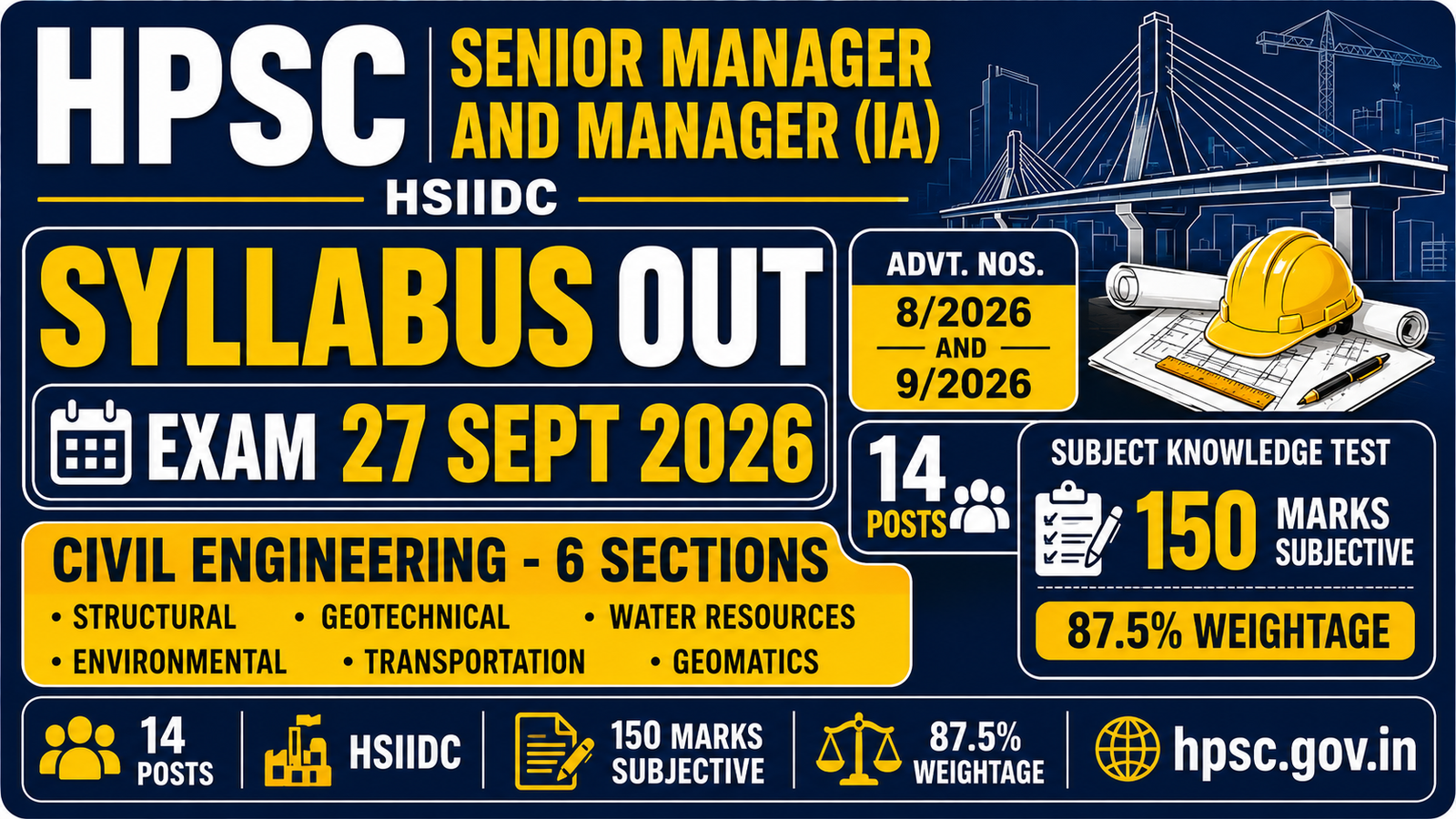
The Haryana Public Service Commission (HPSC), Panchkula released the official Scheme/Pattern of Exam and detailed Syllabus for the Subject Knowledge Test for the posts of Senior Manager (IA) (Advertisement No. 8/2026) and Manager (IA) (Advertisement No. 9/2026) in the Haryana State Industrial and Infrastructure Development Corporation (HSIIDC) on 04 August 2026. These are Group B posts under the broader HSIIDC recruitment drive (Advertisement Nos. 05 to 17 of 2026) – Senior Manager (IA) has 4 vacancies and Manager (IA) has 10 vacancies, totalling 14 posts. Both posts require a 1st Class B.E./B.Tech in Civil Engineering with relevant infrastructure experience, and the syllabus covers civil engineering in its full breadth – Structural, Geotechnical, Water Resources, Environmental, Transportation and Geomatics Engineering. The Subject Knowledge Test is scheduled on 27 September 2026, is subjective (descriptive) in nature, carries 150 marks for 3 hours, and has a minimum qualifying score of 35%. It carries 87.5% weightage in the final merit, with the Interview carrying the remaining 12.5%.
Important Note: Three things every appearing candidate must understand before preparing. First, this is a subjective (descriptive) written paper – not an objective/MCQ test. Candidates must be prepared to write full derivations, design steps, diagrams and numerical solutions within the 3-hour format. Practising MCQs alone will not be sufficient preparation. Second, the minimum qualifying mark is 35% (52.5 out of 150) in the Subject Knowledge Test – candidates who do not reach this threshold are not called for the interview regardless of how strong their profile is. Third, the Subject Knowledge Test carries 87.5% of the final merit score – the interview carries only 12.5%. The written exam is therefore the decisive stage of selection; do not deprioritise it in favour of interview preparation.
HPSC Senior Manager and Manager (IA) Syllabus 2026 – Overview
| Particulars | Details |
|---|---|
| Conducting Body | Haryana Public Service Commission (HPSC), Panchkula |
| Posts | Senior Manager (IA) – Advt. No. 8/2026; Manager (IA) – Advt. No. 9/2026 |
| Organisation | Haryana State Industrial and Infrastructure Development Corporation (HSIIDC) |
| Post Category | Group B |
| Total Vacancies (Both Posts) | 14 (Senior Manager (IA) – 4 + Manager (IA) – 10) |
| Syllabus/Pattern Notification Date | 04 August 2026 |
| Subject Knowledge Test Date | 27 September 2026 |
| Paper Type | Subjective (Descriptive) |
| Paper Language | English |
| Total Marks | 150 |
| Duration | 3 hours |
| Minimum Qualifying Marks | 35% (52.5 out of 150) |
| Subject Knowledge Test Weightage | 87.5% in final merit |
| Interview Weightage | 12.5% in final merit |
| Official Website | hpsc.gov.in |
Important Dates
| Event | Date |
|---|---|
| Recruitment Notification (Advt. Nos. 05-17 of 2026) | 12 January 2026 |
| Online Application Opens | 15 January 2026 |
| Online Application Closes | 16 February 2026 |
| Syllabus / Exam Pattern Notification Released | 04 August 2026 |
| Subject Knowledge Test | 27 September 2026 |
| Interview | To be notified after Subject Knowledge Test |
Vacancy Details
| Post | Advertisement No. | Vacancies | Nature of Post |
|---|---|---|---|
| Senior Manager (IA) | 8/2026 | 4 | Group B, HSIIDC |
| Manager (IA) | 9/2026 | 10 | Group B, HSIIDC |
| Total | 14 |
Category-wise vacancy breakup (General/SC/BC-A/BC-B/EWS/Ex-Servicemen/PwBD) is as per the original Advertisement Nos. 8/2026 and 9/2026 available at hpsc.gov.in.
Eligibility Criteria
| Post | Qualification | Experience | Language Requirement |
|---|---|---|---|
| Senior Manager (IA) | 1st Class B.E./B.Tech in Civil Engineering (MBA as additional qualification preferred) | Minimum 6 years post-qualification experience in development/creation and maintenance of Industrial Infrastructure, of which at least 3 years must be in an executive position | Hindi or Sanskrit passed up to Matric standard |
| Manager (IA) | 1st Class B.E./B.Tech in Civil Engineering (MBA as additional qualification preferred) | Minimum 2 years post-qualification experience in development/creation and maintenance of Industrial Infrastructure | Hindi or Sanskrit passed up to Matric standard |
Age Limit (as on 16 February 2026): Minimum 18 years, Maximum 42 years. Age relaxation for SC/BC/EWS/Ex-Servicemen/PwBD as per Haryana Government rules.
Selection Process
| Stage | Details |
|---|---|
| Stage 1 – Subject Knowledge Test | Subjective paper, 150 marks, 3 hours, English medium. Minimum 35% qualifying marks. Weightage: 87.5% in final merit. |
| Shortlisting for Interview | Candidates called in ratio of 2:1 against advertised posts (including bracketed candidates). |
| Stage 2 – Interview / Viva-Voce | Personal interview. Weightage: 12.5% in final merit. Attendance mandatory. |
| Final Merit List | Combined score of Subject Knowledge Test (87.5%) and Interview (12.5%). |
Exam Pattern – Subject Knowledge Test
| Component | Details |
|---|---|
| Paper Type | Subjective (descriptive / conventional) |
| Language | English |
| Total Marks | 150 |
| Duration | 3 hours |
| Minimum Qualifying Marks | 35% (52.5 marks) |
| Weightage in Final Merit | 87.5% |
| Negative Marking | Not applicable (subjective paper) |
The syllabus is identical for both Senior Manager (IA) and Manager (IA) posts – the same Subject Knowledge Test paper covers both positions. The posts differ in the experience requirement and the level of responsibility, not in the exam content.
HPSC Senior Manager and Manager (IA) Syllabus 2026 – Subject-wise
The Subject Knowledge Test covers six broad areas of Civil Engineering. All topics are at the degree (B.E./B.Tech Civil Engineering) standard.
1. Structural Engineering
(A) Engineering Mechanics
System of forces, free-body diagrams and equilibrium equations; internal forces in structures; friction and its applications; centre of mass; free vibrations of undamped SDOF (Single Degree of Freedom) system.
(B) Solid Mechanics
Bending moment and shear force in statically determinate beams; simple stress and strain relationships; simple bending theory, flexural and shear stresses, shear centre; uniform torsion; transformation of stress; buckling of columns; combined and direct bending stresses.
(C) Structural Analysis
Statically determinate and indeterminate structures by force/energy methods; method of superposition; analysis of trusses, arches, beams, cables and frames; displacement methods – slope deflection and moment distribution methods; influence lines; stiffness and flexibility methods of structural analysis.
(D) Construction Materials and Management
Structural steel – composition, material properties and behaviour; concrete – constituents and mix design, short-term and long-term properties; types of construction projects; project planning and network analysis – PERT and CPM; cost estimation.
(E) Concrete Structures
Working stress and limit state design concepts; design of beams, slabs and columns; bond and development length; prestressed concrete beams.
(F) Steel Structures
Working stress and limit state design concepts; design of tension and compression members, beams and beam-columns, column bases; connections – simple and eccentric; beam-column connections; plate girders and trusses; concept of plastic analysis of beams and frames.
2. Geotechnical Engineering
(A) Soil Mechanics
Three-phase system and phase relationships, index properties; Unified and Indian Standard soil classification systems; permeability – one-dimensional flow; seepage through soils – two-dimensional flow, flow nets, uplift pressure, piping; capillarity and seepage force; principle of effective stress and quicksand condition.
(B) Compaction and Consolidation
Compaction of soils; one-dimensional consolidation and time rate of consolidation; shear strength, Mohr’s circle, effective and total shear strength parameters; stress-strain characteristics of clays and sand; stress paths.
(C) Foundation Engineering
Sub-surface investigations – drilling bore holes, sampling, plate load test, Standard Penetration Test (SPT) and Cone Penetration Test (CPT); earth pressure theories – Rankine and Coulomb; stability of slopes – finite and infinite slopes, Bishop’s method; stress distribution in soils – Boussinesq’s theory, pressure bulbs; shallow foundations – Terzaghi’s and Meyerhoff’s bearing capacity theories, effect of water table; combined footing and raft foundation; contact pressure, settlement analysis in sands and clays; deep foundations – dynamic and static formulae, axial load capacity of piles in sands and clays, pile load test, pile under lateral loading, pile group efficiency, negative skin friction.
3. Water Resources Engineering
(A) Fluid Mechanics
Properties of fluids, fluid statics; continuity, momentum and energy equations and their applications; potential flow; laminar and turbulent flow – flow in pipes, pipe networks; concept of boundary layer and its growth; concept of lift and drag.
(B) Hydraulics
Forces on immersed bodies; flow measurement in channels and pipes; dimensional analysis and hydraulic similitude; channel hydraulics – energy-depth relationships, specific energy, critical flow, hydraulic jump, uniform flow, gradually varied flow and water surface profiles.
(C) Hydrology
Hydrologic cycle, precipitation, evaporation, evapo-transpiration, watershed, infiltration, unit hydrographs, hydrograph analysis; reservoir capacity; flood estimation and routing; surface run-off models; ground water hydrology – steady state well hydraulics and aquifers, application of Darcy’s Law.
(D) Irrigation
Types of irrigation systems and methods; crop water requirements – duty, delta and evapo-transpiration; gravity dams and spillways; lined and unlined canals; design of weirs on permeable foundation; cross drainage structures.
4. Environmental Engineering
(A) Water and Waste Water Quality and Treatment
Basics of water quality standards – physical, chemical and biological parameters; water quality index; unit processes and operations; water requirement; water distribution system; drinking water treatment.
(B) Sewerage System
Sewerage system design; quantity of domestic wastewater; primary and secondary treatment; effluent discharge standards; sludge disposal; reuse of treated sewage for different applications.
(C) Air Pollution
Types of pollutants, their sources and impacts; air pollution control methods; air quality standards; air quality index and limits.
(D) Municipal Solid Wastes
Characteristics, generation, collection and transportation of solid wastes; engineered systems for solid waste management – reuse/recycle, energy recovery, treatment and disposal.
5. Transportation Engineering
(A) Transportation Infrastructure
Geometric design of highways – cross-sectional elements, sight distances, horizontal and vertical alignments.
(B) Railway Engineering
Geometric design of railway track – speed and cant.
(C) Airport Engineering
Concept of airport runway length, calculations and corrections; taxiway and exit taxiway design.
(D) Highway Pavements
Highway materials – desirable properties and tests; desirable properties of bituminous paving mixes; design factors for flexible and rigid pavements; design of flexible and rigid pavements using IRC codes.
(E) Traffic Engineering
Traffic studies on flow and speed, peak hour factor, accident study, statistical analysis of traffic data; microscopic and macroscopic parameters of traffic flow, fundamental relationships; traffic signs; signal design by Webster’s method; types of intersections; highway capacity.
6. Geomatics Engineering
(A) Surveying
Principles of surveying, errors and their adjustment; maps – scale and coordinate system; distance and angle measurement – leveling and trigonometric leveling; traversing and triangulation survey; total station; horizontal and vertical curves.
(B) Photogrammetry and Remote Sensing
Scale and flying height; basics of remote sensing and GIS (Geographic Information Systems).
Preparation Tips for HPSC Senior Manager and Manager (IA) Exam 2026
1. This is a subjective paper – writing practice is non-negotiable.
Since the paper is descriptive and 3 hours long, you must practice writing structured long-form answers with derivations, diagrams, design steps and numerical solutions. Practising MCQs from gate material alone will leave you under-prepared for the answer format required here.
2. Structural Engineering is the largest and most detailed section – start here.
Solid Mechanics, Structural Analysis, and Concrete and Steel Structure design (including IS code and IRC code provisions) form the most content-heavy block. Map these topics against your B.Tech study material and prioritise completing them first.
3. Revise standard design theories and code provisions by name.
The syllabus explicitly names Terzaghi, Meyerhoff, Rankine, Coulomb, Bishop, Boussinesq, Webster, and IRC codes. In descriptive papers, examiners expect named theories with correct formulas. Make a separate formula and theorem revision sheet.
4. Build speed within the 3-hour constraint.
150 marks in 3 hours means roughly 1.2 minutes per mark. Practice full 3-hour mock papers to understand how much you can realistically write in the time available, and prioritise high-mark questions.
5. The 35% qualifying threshold is the first gate – do not risk it.
Even strong candidates can fall below 52.5 out of 150 if they attempt only familiar topics and leave weaker sections completely blank. Ensure you have at least surface-level revision across all 6 engineering areas so you can attempt every section of the paper.
6. Environmental and Geomatics sections are often underestimated.
Water treatment, sewage design, air pollution parameters and remote sensing basics are relatively compact sections that can yield good marks with focused 1-2 week revision. Do not skip them in favour of only structural content.
Important Links
| Description | Link |
|---|---|
| HPSC Senior Manager and Manager (IA) Syllabus PDF (Advt. Nos. 8 and 9 of 2026) | Click Here |
| HPSC Official Website | Click Here |
HPSC Senior Manager and Manager (IA) Syllabus 2026 – FAQs
Q1. What is the HPSC Senior Manager and Manager (IA) Syllabus 2026?
✅ The syllabus for both posts covers six broad areas of Civil Engineering – Structural Engineering (Engineering Mechanics, Solid Mechanics, Structural Analysis, Construction Materials, Concrete Structures, Steel Structures); Geotechnical Engineering (Soil Mechanics, Compaction and Consolidation, Foundation Engineering); Water Resources Engineering (Fluid Mechanics, Hydraulics, Hydrology, Irrigation); Environmental Engineering (Water/Waste Water, Sewerage, Air Pollution, Solid Waste); Transportation Engineering (Highway, Railway, Airport, Pavements, Traffic); and Geomatics Engineering (Surveying, Photogrammetry and Remote Sensing), as notified by HPSC on 04 August 2026 for both Advt. Nos. 8/2026 and 9/2026.
Q2. What is the exam pattern for HPSC Senior Manager and Manager (IA) 2026?
✅ The exam has two stages – Subject Knowledge Test (subjective/descriptive paper, 150 marks, 3 hours, English medium, minimum 35% qualifying marks, 87.5% weightage in final merit) followed by Interview/Viva-Voce (12.5% weightage in final merit). There is no negative marking since the paper is subjective, not MCQ.
Q3. When is the HPSC Senior Manager and Manager (IA) Subject Knowledge Test 2026?
✅ The Subject Knowledge Test is scheduled on 27 September 2026, as notified in the official HPSC syllabus/exam pattern notice dated 04 August 2026.
Q4. What is the qualifying mark for the Subject Knowledge Test?
✅ Candidates must secure a minimum of 35% marks (52.5 out of 150) in the Subject Knowledge Test to be eligible for the interview. Candidates who fall below this threshold are not called for the interview.
Q5. How many vacancies are there and what is the post-wise split?
✅ A total of 14 vacancies – 4 posts for Senior Manager (IA) (Advt. No. 8/2026) and 10 posts for Manager (IA) (Advt. No. 9/2026) in HSIIDC (Group B), under the broader HPSC HSIIDC recruitment drive (Advertisement Nos. 05 to 17 of 2026).
Q6. What is the educational qualification required for these posts?
✅ Both posts require 1st Class B.E./B.Tech in Civil Engineering from a recognised university (MBA is preferred as an additional qualification). For Senior Manager (IA) – minimum 6 years post-qualification experience in development, creation and maintenance of Industrial Infrastructure, with at least 3 years in an executive position. For Manager (IA) – minimum 2 years post-qualification experience in the same area. Hindi or Sanskrit passed up to Matric standard is mandatory for both.
Q7. Is the syllabus the same for both Senior Manager (IA) and Manager (IA)?
✅ Yes. HPSC has released a single combined syllabus notification (dated 04 August 2026) covering both Advt. No. 8/2026 (Senior Manager IA) and Advt. No. 9/2026 (Manager IA). The Subject Knowledge Test syllabus and exam pattern are identical for both posts. The posts differ in experience requirement and seniority, not in exam content.
Q8. Is there negative marking in the Subject Knowledge Test?
✅ No. The Subject Knowledge Test is a subjective (descriptive) paper, not an objective/MCQ test. Negative marking applies only to objective/MCQ papers; there is no negative marking for subjective papers.
Q9. How many candidates are called for the interview?
✅ Candidates are shortlisted for the interview in a ratio of 2:1 against the number of advertised posts (including bracketed candidates, if any), subject to having secured the minimum qualifying marks of 35% in the Subject Knowledge Test.
Q10. Where can I download the official HPSC Senior Manager and Manager (IA) Syllabus PDF?
✅ From the official HPSC website at hpsc.gov.in – the syllabus PDF titled “Ann_SchemePattern_Syllabus_SMIA_MIA_04_08_2026” was uploaded on 04 August 2026 and is directly downloadable from the announcements/notifications section of the portal.
Disclaimer
The information above is compiled from the official Scheme/Pattern of Exam and Syllabus notification dated 04 August 2026 for Senior Manager (IA) (Advertisement No. 8/2026) and Manager (IA) (Advertisement No. 9/2026) in HSIIDC, issued by the Haryana Public Service Commission (HPSC), Panchkula, and available at hpsc.gov.in. Vacancy, eligibility and other recruitment details are as per the original Advertisement Nos. 8/2026 and 9/2026. The Subject Knowledge Test date of 27 September 2026 is as stated in the official HPSC syllabus notification. Candidates are advised to download the official syllabus PDF directly from hpsc.gov.in and verify all details before preparing. All links above lead only to the official HPSC website.