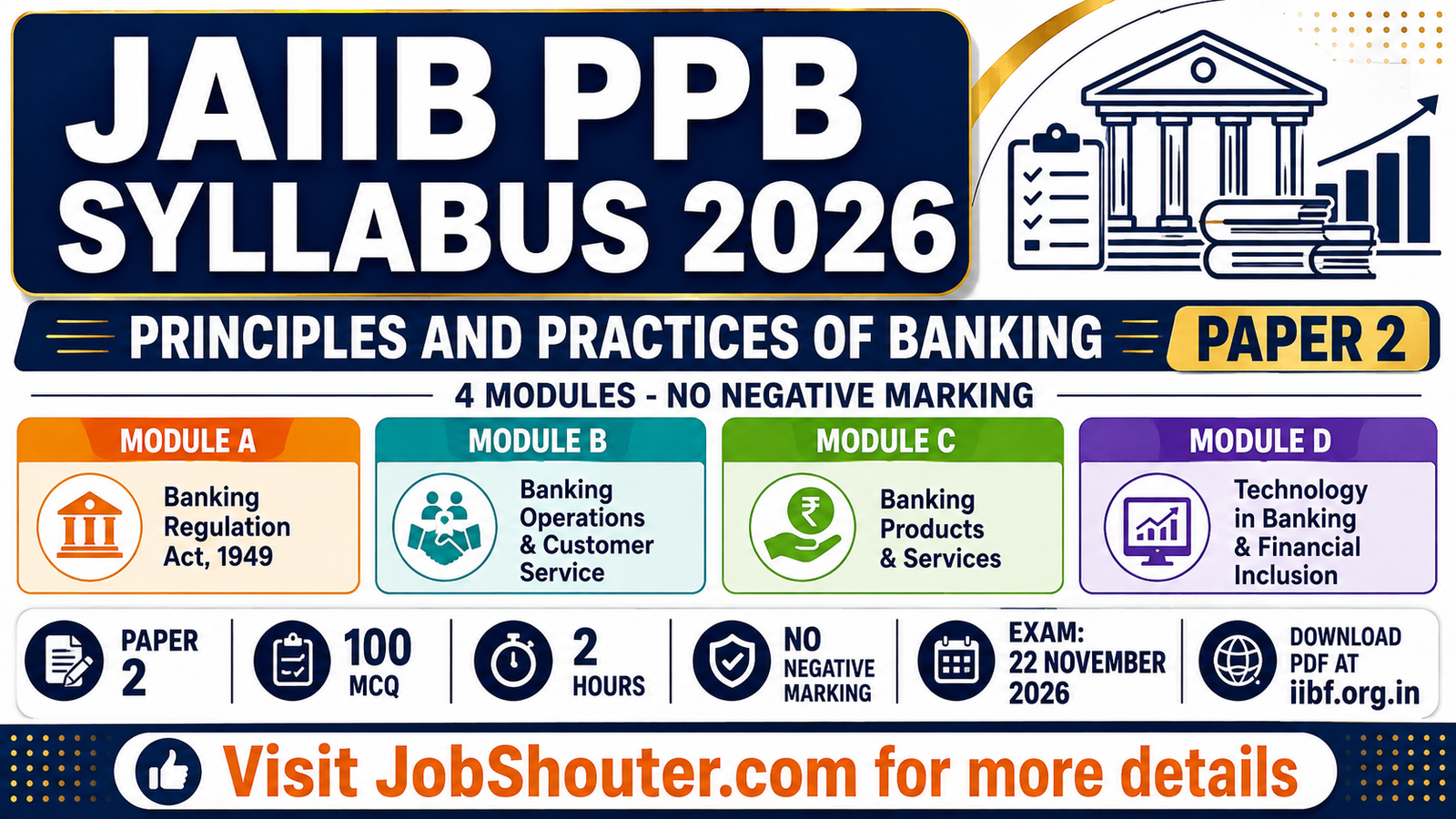
The Indian Institute of Banking and Finance (IIBF) has published the official Rules and Syllabus for the JAIIB (Junior Associate of IIB&F) examination, available for download at iibf.org.in under the JAIIB page. Principles and Practices of Banking (PPB) is Paper 2 of the JAIIB examination and is one of the most content-heavy of the four papers – it tests a candidate’s knowledge across banking operations, lending, banking technology, and ethics through 100 MCQ questions, 100 marks, and a 2-hour duration with no negative marking. The PPB syllabus is divided into 4 modules – Module A (General Banking Operations), Module B (Functions of Banks), Module C (Banking Technology), and Module D (Ethics in Banks and Financial Institutions) – each further broken into detailed topic areas. For the November 2026 cycle, the PPB exam date is 22 November 2026. Registration for the November cycle is open until 21 August 2026 at iibf.org.in, with a normal-fee window running from 1 to 7 August 2026.
Important Note: Four points that directly affect how you prepare and score in JAIIB PPB 2026. First, there are two distinct passing criteria – a candidate passes by scoring either 50 or more out of 100 overall, or by scoring 45 or more overall with at least 50% marks in each module; missing either threshold means a fail, regardless of the total. Second, the IIBF transactional portal is currently under a major software upgrade affecting registration services – candidates must monitor iibf.org.in for the restoration notice and register within the normal-fee window (1 to 7 August 2026) to avoid paying late fees of Rs. 100 (8 to 14 August) or Rs. 200 (15 to 21 August). Third, the third paper of JAIIB is “Accounting and Financial Management for Bankers (AFM)” – not “Accounting and Finance for Bankers” as some aggregator sources incorrectly state; the official IIBF JAIIB page and study material confirm the correct name and abbreviation. Fourth, the official Rules and Syllabus PDF is available for download directly from the JAIIB page at iibf.org.in – candidates must download and rely on the official PDF as the authoritative syllabus source, not third-party summaries.
JAIIB PPB 2026 – Overview
| Particulars | Details |
|---|---|
| Conducting Body | Indian Institute of Banking and Finance (IIBF), Mumbai |
| Exam Name | Principles and Practices of Banking (PPB) |
| Paper Number | Paper 2 of the JAIIB (Junior Associate of IIB&F) Exam |
| Exam Mode | Online – Multiple Choice Questions (MCQ) |
| Total Questions | 100 |
| Total Marks | 100 |
| Duration | 2 hours (120 minutes) |
| Number of Modules | 4 (Module A, B, C, D) |
| Medium | English or Hindi |
| Negative Marking | None |
| Passing Marks | 50 out of 100 overall; or 45 out of 100 with minimum 50% in each module |
| PPB Exam Date (November 2026) | 22 November 2026 |
| Registration Last Date (Normal Fee) | 7 August 2026 |
| Registration Last Date (with late fee) | 21 August 2026 |
| Official Rules and Syllabus | Available for download at iibf.org.in |
Important Dates
| Event | Date |
|---|---|
| November 2026 Registration – Normal Fee Window | 1 August 2026 to 7 August 2026 |
| November 2026 Registration – + Rs. 100 Late Fee | 8 August 2026 to 14 August 2026 |
| November 2026 Registration – + Rs. 200 Late Fee | 15 August 2026 to 21 August 2026 |
| PPB (Paper 2) Exam Date – November 2026 | 22 November 2026 |
| Admit Card Release | 7 to 10 days before exam date – check iibf.org.in |
| Result | Declared on iibf.org.in after each paper |
Selection Process (JAIIB Qualification Route)
| Stage | Details |
|---|---|
| Stage 1 | Appear in each paper of JAIIB (4 papers total) in online MCQ mode |
| Stage 2 | Clear each paper individually (50 marks, or 45 with 50% in each module) |
| Final Outcome | Candidate who clears all 4 papers within 5 attempts and 3 years earns the JAIIB certificate |
All four papers – IE and IFS, PPB, AFM, and RBWM – must be cleared. Papers cleared in earlier cycles are carried forward. There is no interview or document verification stage.
JAIIB PPB Exam Pattern 2026
| Parameter | Details |
|---|---|
| Exam Mode | Online – Objective type (MCQ) |
| Total Questions | 100 |
| Total Marks | 100 (1 mark per question) |
| Duration | 2 hours (120 minutes) |
| Negative Marking | None – attempt every question |
| Medium | English or Hindi (selected at time of registration) |
| Modules | 4 (A, B, C, D) |
| Passing Marks | 50 out of 100; or 45 out of 100 with minimum 50% in each module |
Passing Criteria – Two Routes
| Route | Condition |
|---|---|
| Route 1 (Standard) | Score 50 or more marks out of 100 overall |
| Route 2 (Module Balance) | Score 45 or more marks overall AND score at least 50% marks in each of the 4 modules |
Both routes are accepted. A candidate who scores 45 to 49 overall can still pass if they have maintained 50% or more within every individual module. A candidate scoring 50 or above passes regardless of module-wise distribution.
Module-wise Syllabus – Module A: General Banking Operations
Module A is the broadest module and forms the operational backbone of the PPB paper. It covers the entire lifecycle of a banking relationship – from account opening to grievance redressal – along with the legal and regulatory framework governing these activities.
| Topic Area | Key Sub-topics |
|---|---|
| Banker-Customer Relationship | Requirements to be called a bank; banker-customer relationship types (trustee, bailee-bailor, agent-principal, lessor-lessee, indemnifier-indemnified); deposit products and investor services |
| AML and KYC Guidelines | Money laundering and terrorism financing risks; AML framework in India; KYC policy; organisational set-up for AML; PMLA obligations; risk management; FATF-identified jurisdictions; correspondent banking; FATCA/CRS reporting; secrecy obligations |
| Operational Aspects of KYC | KYC norms; wire transfers; operational regulations; Central KYC Records Registry (CKYCR); monitoring of transactions |
| Opening of Accounts | Personal accounts; accounts of other customers; norms for opening current accounts; photographs; Legal Entity Identifier (LEI) |
| Operational Aspects of Deposit Accounts | Salient features; interest on deposits; prohibitions and exemptions; inoperative accounts and unclaimed deposits; joint account operations; nomination; attachment orders; submission to statutory authorities |
| Clearing, Collection and Cash Handling | Cheque Truncation System (CTS); RBI collection guidelines; cash handling and custody; security at branches and ATMs |
| Banker’s Special Relationship | Mandate; Power of Attorney (POA); banker’s lien; right of set-off; right of appropriation |
| Foreign Exchange Remittance | FEMA evolution; bringing in and taking out foreign exchange; inward and outward remittances; Indo-Nepal remittance scheme |
| NRI Business | Accounts permitted for NRIs and PIOs; accounts for foreign nationals in India; Special Non-Resident Rupee (SNRR) account; remittance of assets; property and investment by NRIs/PIOs |
| Foreign Currency Accounts | Types of foreign currency accounts; accounts in India and abroad; foreign national remittances; FCRA 2010 |
| Cash Management Services | Developments in CMS; types of cash management services; challenges and issues |
| Negotiable Instruments | Negotiable Instruments Act; payment of cheques; payment in due course; endorsement and crossing; forged instruments; dishonour; CTS |
| Responsibility of Paying Bank | Liability under NI Act; forged signatures; payment in due course/good faith; payment under mistake; cheque truncation |
| Responsibility of Collecting Bank | Statutory protection; duties of the collecting bank |
| Ancillary Services | Demand Drafts and Banker’s Cheques; Mail Transfer and Telegraphic Transfer; NEFT; RTGS; Electronic Benefit Transfer; mobile and digital banking; safe deposit lockers; merchant banking; government business |
| Financial Inclusion and Literacy | Extension of banking services; digital tools; financial literacy; RSETIs |
| Customer Service | Branch management policies; ATM operations; security and risk mitigation; counter services; special customer facilities |
| Grievance Redressal and Legal Framework | Model Grievance Redressal Policy; RBI Integrated Ombudsman Scheme 2021; Consumer Protection Act 2019; Right to Information Act 2005 |
Module-wise Syllabus – Module B: Functions of Banks
Module B covers the credit and lending side of banking – from appraisal to recovery – along with specialised lending areas such as agriculture, MSME, and priority sector.
| Topic Area | Key Sub-topics |
|---|---|
| Principles of Lending and Credit Facilities | Principles of lending; types of borrowers; fund-based working capital; term and demand loans; non-fund based facilities |
| Appraisal and Assessment | Credit appraisal techniques; methods of loan assessment; working capital and term loan assessment |
| Operational Aspects of Loan Accounts | Interest rates on loans; credit management; loan processing and sanction; accounting aspects; recovery agents guidelines; Fair Practices Code |
| Types of Collaterals and Securities | Secured vs unsecured loans; land and buildings; goods and title documents; advances against LIC, shares, debentures, book debts, term deposits; gold loans; supply bills; vehicle finance |
| Modes of Charging Securities | Essentials of contract; agency; bailment; types of charges; registration of charges |
| Documentation | Types of loan documents; documentation procedure |
| Non-Performing Assets (NPA) and Stressed Assets | Definition of NPAs; income recognition; gross and net NPA; asset classification; provisioning norms; writing off NPAs; resolution and restructuring |
| Laws Relating to Recovery | Recovery of Debts and Bankruptcy Act 1993; SARFAESI Act; Insolvency and Bankruptcy Code (IBC); Legal Services Authorities Act; Law of Limitation |
| Contracts of Indemnity | Definition; difference from guarantee; rights of indemnity holder; implied indemnity; application in banking |
| Guarantee and Bank Guarantee | Parties to contract; liability of surety; continuing guarantee; revocation and discharge; rights of surety; types of bank guarantees; precautions in issuance and payment |
| Letters of Credit (LC) | Meaning and parties; types of LCs; documents under LC; UCPDC 600; bank obligations under LC |
| Deferred Payment Guarantee | Purpose; method of payment |
| Bills Finance | Classes of bills; governing laws; types of bill finance; banker’s legal position in bill finance |
| Retail Loans and Credit Cards | Credit cards; home loans; personal loans; consumer loans |
| Priority Sector Advances | Applicability; targets and sub-targets; categories; non-achievement consequences |
| Agricultural Finance | Short-term and long-term loans; crop loans; Kisan Credit Card (KCC); Minimum Support Price; PMFBY |
| Finance to MFIs and NBFCs | Bank finance to NBFCs; on-lending; NBFC-MFI model; co-lending; Scale-Based Regulation (SBR) framework |
| MSME Finance | MSME Development Act; credit support; delayed payment provisions; TReDS; Credit Guarantee Fund Scheme; cluster financing |
| Government Sponsored Schemes | DAY-NRLM; DAY-NULM; PMJDY; MUDRA loans; KVIC |
| Self-Help Groups (SHG) | Definition and formation; SHGs under DAY-NRLM/DAY-NULM; SHG-Bank Linkage Programme |
Module-wise Syllabus – Module C: Banking Technology
Module C covers the technology infrastructure of modern banking, from core banking systems to cyber security and emerging fintech trends.
| Topic Area | Key Sub-topics |
|---|---|
| Bank Computerisation Essentials | Bank computerisation; networking technologies; UPS; Core Banking System (CBS); data warehousing and mining |
| Operational Aspects of CBS | Functions of CBS; flow and accounting of transactions; BOD/EOD operations; password control; logical access control; security controls |
| Alternate Delivery Channels and Digital Banking | ATMs; electromagnetic cards; electronic banking; customer protection in unauthorised transactions; TAT harmonisation; compensation for failed transactions |
| Data Communication Network and EFT Systems | Data communication networks; major networks in India; evolution of EFT systems; SWIFT; automated clearing; two-level funds transfer |
| Digital Payment Systems and NPCI | Electronic clearing systems; National Payments Corporation of India (NPCI); digital payment initiatives by the Government of India |
| Impact of Technology in Banking | Trends in technology development; role of technology upgradation; global trends; IT impact on banks |
| Security Considerations and Mitigation | Risk areas in banks; types of cyber threats; computer audit; IS Audit; online fraud modus operandi; cyber security awareness; Disaster Recovery Management; IT Act; RBI Integrated Ombudsman Scheme 2021 |
| Cyber Crime and Fraud Risk Management | Fraud vs crime distinction; phases of an effective incident response plan |
| Technology Trends in Banking | e-RUPI; FinTech; RegTech; SupTech; social media banking; hashtag banking; account aggregators; open banking |
Module-wise Syllabus – Module D: Ethics in Banks and Financial Institutions
Module D is the shortest module but carries marks and conceptual weight – it covers personal and professional ethics in the banking context.
| Topic Area | Key Sub-topics |
|---|---|
| Ethics, Business Ethics and Banking | Values and ethics; business ethics – definition, principles and practice; ethical foundation of banking; global financial crisis; case studies (Enron, Satyam) |
| Ethics at the Individual Level | Values, norms, beliefs; core values; morality and personal values; the Golden Rule; ethical dilemmas and decision-making framework |
| Ethical Dimensions – Employees | Abuse of official position; insider trading; obligations to third parties; job discrimination; sexual harassment; conflict of interest; HRM ethics; employees as ethics ambassadors |
| Work Ethics and the Workplace | Work ethics definition; benefits of ethical behaviour; unethical behaviours – causes and remedies; ethics of a banker; whistleblowing in banks and whistleblowing law in India |
| Banking Ethics – Changing Dynamics | Ethics and technology; data security and privacy; intellectual property rights; patents and proprietary rights; ethics of information security |
Preparation Tips for JAIIB PPB 2026
Module A and Module B together carry the highest content volume – start with these and give them proportionally more time. Module A’s legal topics (Negotiable Instruments Act, SARFAESI, IBC) and Module B’s lending and NPA sections are perennial high-weightage areas.
No negative marking means attempt every question. Even an educated guess on unfamiliar topics gives you a positive expected score. Never leave a question blank.
Watch the dual passing criteria. Many candidates aim for 50 overall and neglect individual module balance. If you score 45 to 49, you still need 50% within every module to pass. Identify your weakest module and ensure you cross that 50% threshold.
Use the official IIBF study material. The Rules and Syllabus PDF and the IIBF-published textbook “Principles and Practices of Banking” (published by Macmillan Education India, 2026 edition) are the authoritative preparation sources. Download the syllabus PDF from the JAIIB page at iibf.org.in and map every topic you study to it.
Regulations and schemes change frequently. Module A topics on KYC, AML, and RBI guidelines are revised by regulators periodically. Verify current provisions against RBI circulars – do not rely solely on older editions or aggregator summaries.
Module C (Banking Technology) is increasingly scenario-based. Questions test application – for example, what happens during a CBS EOD failure, or how fraud risk mitigation works in practice. Reading topic descriptions is not enough; understand the workflow.
Module D (Ethics) is conceptual, not factual. Questions test your understanding of ethical reasoning and application in banking scenarios. Reading the case studies (Enron, Satyam) with attention to the governance failures will help more than memorising definitions.
Take mock tests on the official IIBF mock test platform at iibfprac.sifyitest.com to familiarise yourself with the online exam interface before the 22 November 2026 exam date.
Register within the normal-fee window (1 to 7 August 2026) to avoid the Rs. 100 and Rs. 200 late fees applicable in the subsequent weeks. Monitor iibf.org.in to confirm the transactional portal is live before attempting registration.
Important Links
| Description | Link |
|---|---|
| JAIIB Official Page (Rules and Syllabus PDF, Exam Schedule, Fee) | Click Here |
| Download Official JAIIB Rules and Syllabus PDF | Click Here |
| Apply Online – JAIIB November 2026 Registration | Click Here |
| JAIIB Mock Test (iibfprac.sifyitest.com) | Click Here |
| IIBF Exam and Courses Page | Click Here |
| IIBF Official Website | Click Here |
JAIIB PPB Syllabus 2026 – FAQs
Q1. What is JAIIB PPB and which paper number is it?
✅ PPB stands for Principles and Practices of Banking. It is Paper 2 of the JAIIB (Junior Associate of IIB&F) examination conducted by the Indian Institute of Banking and Finance (IIBF). The four JAIIB papers are IE and IFS (Paper 1), PPB (Paper 2), AFM (Paper 3), and RBWM (Paper 4).
Q2. What is the exam pattern for JAIIB PPB 2026?
✅ The PPB paper has 100 MCQ questions, 100 marks total (1 mark each), duration of 2 hours (120 minutes), conducted online, with no negative marking. The medium is English or Hindi.
Q3. What are the 4 modules in the JAIIB PPB syllabus?
✅ The 4 modules are Module A – General Banking Operations, Module B – Functions of Banks, Module C – Banking Technology, and Module D – Ethics in Banks and Financial Institutions, as per the official IIBF Rules and Syllabus document.
Q4. What are the passing marks for JAIIB PPB?
✅ A candidate can pass in one of two ways: by scoring 50 or more marks out of 100 overall, or by scoring 45 or more marks overall combined with a minimum of 50% marks in each of the four modules.
Q5. What is the PPB exam date for JAIIB November 2026?
✅ The PPB paper for the November 2026 cycle is scheduled on 22 November 2026, as confirmed on the official IIBF JAIIB page. The exact shift timing will be on the candidate’s admit card.
Q6. Is there negative marking in JAIIB PPB?
✅ No. There is no negative marking in any JAIIB paper including PPB. Candidates should attempt all 100 questions.
Q7. Where can I download the official JAIIB PPB syllabus PDF?
✅ The official Rules and Syllabus PDF for JAIIB is available for download directly from the JAIIB page at iibf.org.in. The file is named “JAIIB-Final_Exam_24.07.25_Final_23.02.2026.pdf” and covers all four papers including PPB.
Q8. What is the last date to register for JAIIB November 2026?
✅ The final last date is 21 August 2026. However, registering early within the normal-fee window (1 to 7 August 2026) avoids late fees of Rs. 100 (8 to 14 August) and Rs. 200 (15 to 21 August). Note that the IIBF transactional portal is currently under a software upgrade – check iibf.org.in before attempting registration.
Q9. Which modules of JAIIB PPB carry the most weightage?
✅ Module A (General Banking Operations) and Module B (Functions of Banks) are the largest modules by content volume and historically contribute the most questions. Module C (Banking Technology) is growing in relevance with the expansion of digital banking topics. Module D (Ethics) is shorter but marks-carrying and cannot be ignored.
Q10. What official study material should I use for JAIIB PPB?
✅ The official study material is the IIBF-published textbook “Principles and Practices of Banking” (2026 edition, published by Macmillan Education India Pvt. Ltd.), available at the IIBF bookstore link on the JAIIB page at iibf.org.in. IIBF also provides an e-learning facility and a mock test platform at iibfprac.sifyitest.com.
Disclaimer
The information above is compiled from the official JAIIB Rules and Syllabus document (file: JAIIB-Final_Exam_24.07.25_Final_23.02.2026.pdf) and the JAIIB examination schedule and fee structure published on the official Indian Institute of Banking and Finance (IIBF) website at iibf.org.in, as verified on 2 August 2026. The four module names and topic areas are as per the official IIBF syllabus. The November 2026 exam dates (1, 22, 28 and 29 November 2026) and registration fee windows are as published on the official IIBF JAIIB page. The third paper’s correct official name is “Accounting and Financial Management for Bankers (AFM)”. Candidates are strongly advised to download the complete official Rules and Syllabus PDF from iibf.org.in and treat it as the authoritative reference for their preparation. All links above lead only to the official IIBF website.