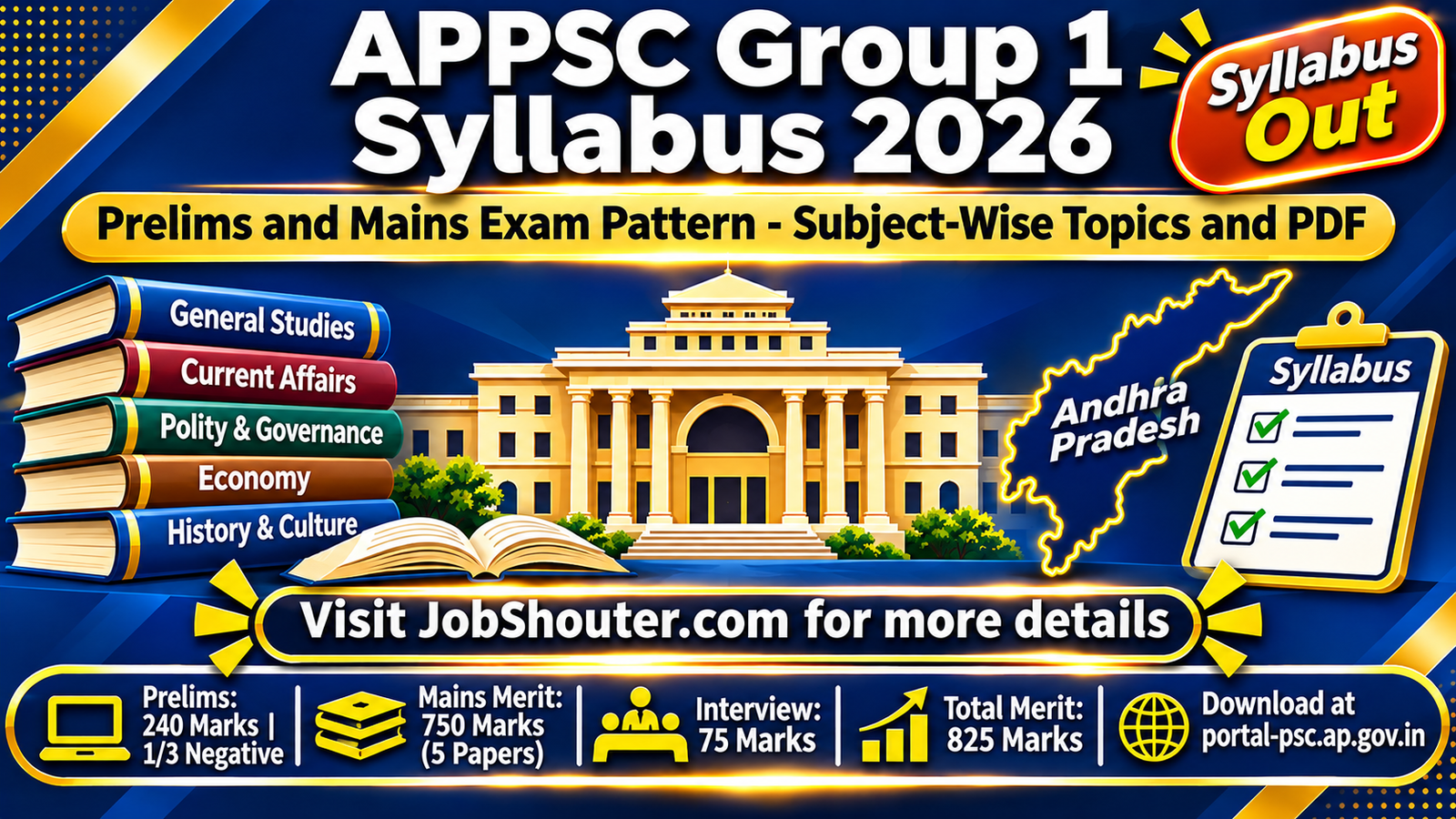
The Andhra Pradesh Public Service Commission (APPSC) conducts the Group-I Services Examination in three stages – a Preliminary Screening Test, a Main Written Examination and an Interview. The APPSC Group 1 Syllabus 2026 covers all three stages in detail. The Preliminary Examination consists of two objective papers carrying 240 marks in total, with one-third negative marking. The Main Examination has seven descriptive papers, of which five carry merit marks totalling 750, and two are qualifying language papers. The Interview carries 75 marks. The total final merit stands at 825 marks. Candidates preparing for APPSC Group 1 can download the official syllabus from portal-psc.ap.gov.in.
Important Note
1. The Preliminary Examination is a screening test only – its marks are NOT counted in the final merit. Only the five Main Examination merit papers (750 marks) and Interview (75 marks) determine your final ranking.
2. Telugu and English language papers are qualifying only – they are not added to merit. You must meet the qualifying threshold in both to appear in the merit ranking.
3. APPSC Group 1 gives special weight to Andhra Pradesh-specific topics across all stages – AP history, AP economy post-bifurcation, AP geography and AP current affairs. These must be studied thoroughly alongside national topics.
APPSC Group 1 Syllabus 2026 – Overview
| Particulars | Details |
|---|---|
| Conducting Authority | Andhra Pradesh Public Service Commission (APPSC) |
| Examination Name | APPSC Group-I Services Examination |
| Selection Stages | Preliminary Screening Test, Main Examination, Interview |
| Prelims Type | Objective-Type (MCQ) |
| Prelims Papers | 2 |
| Prelims Total Questions | 240 (120 per paper) |
| Prelims Total Marks | 240 (120 per paper) |
| Prelims Negative Marking | One-third of marks assigned per wrong answer |
| Prelims Duration | 120 minutes per paper (240 minutes total) |
| Mains Type | Descriptive Written Examination |
| Total Mains Papers | 7 |
| Qualifying Language Papers | 2 (Telugu and English – 150 marks each) |
| Merit-Based Mains Papers | 5 |
| Mains Merit Total | 750 marks |
| Interview Marks | 75 marks |
| Final Merit Total | 825 marks |
| Official Website | portal-psc.ap.gov.in |
APPSC Group 1 Selection Process 2026
| Stage | Purpose | Counted in Merit |
|---|---|---|
| Preliminary Screening Test | Shortlisting candidates for Mains | No – screening only |
| Main Written Examination – Language Papers (Telugu and English) | Qualifying | No – qualifying only |
| Main Written Examination – Papers I to V | Merit determination | Yes – 750 marks |
| Interview / Personality Test | Final assessment | Yes – 75 marks |
| Total Final Merit | – | 825 marks |
APPSC Group 1 Prelims Exam Pattern 2026
The Preliminary Examination has two objective papers of 120 marks each, conducted for 120 minutes each.
| Paper | Subject | Questions | Marks | Duration |
|---|---|---|---|---|
| Paper I | General Studies | 120 | 120 | 120 minutes |
| Paper II | General Aptitude | 120 | 120 | 120 minutes |
| Total | 240 | 240 | 240 minutes |
- Each correct answer carries 1 mark.
- One-third of the marks assigned to a question (i.e. one-third mark for a 1-mark question) is deducted for every wrong answer.
- Unanswered questions carry no penalty.
Prelims Paper I – General Studies: Section-Wise Marks
| Section | Subject | Marks |
|---|---|---|
| A | History and Culture | 30 |
| B | Constitution, Polity, Social Justice and International Relations | 30 |
| C | Indian and Andhra Pradesh Economy and Planning | 30 |
| D | Geography | 30 |
| Total | 120 |
Prelims Paper II – General Aptitude: Section-Wise Marks
| Section | Subject | Marks |
|---|---|---|
| A | General Mental Ability, Administrative and Psychological Abilities | 60 |
| B(i) | Science and Technology | 30 |
| B(ii) | Current Events of Regional, National and International Importance | 30 |
| Total | 120 |
APPSC Group 1 Mains Exam Pattern 2026
The Main Examination has seven papers. The Telugu and English papers are qualifying. The five numbered merit papers are counted in the final merit ranking.
| Paper | Subject | Marks | Duration | Nature |
|---|---|---|---|---|
| Qualifying Paper 1 | Telugu | 150 | 180 minutes | Qualifying |
| Qualifying Paper 2 | English | 150 | 180 minutes | Qualifying |
| Paper I | General Essay | 150 | 180 minutes | Merit |
| Paper II | History, Culture and Geography of India and Andhra Pradesh | 150 | 180 minutes | Merit |
| Paper III | Polity, Constitution, Governance, Law and Ethics | 150 | 180 minutes | Merit |
| Paper IV | Economy and Development of India and Andhra Pradesh | 150 | 180 minutes | Merit |
| Paper V | Science, Technology and Environmental Issues | 150 | 180 minutes | Merit |
| Merit Total | 750 |
Comparison: Prelims vs Mains
| Particulars | Prelims | Mains |
|---|---|---|
| Type | Objective MCQ | Descriptive |
| Papers | 2 | 7 |
| Purpose | Screening only | Merit and language qualification |
| Marks counted in merit | No | 750 (Papers I to V only) |
| Duration | 120 minutes per paper | 180 minutes per paper |
| Negative marking | One-third per wrong answer | Not applicable |
APPSC Group 1 Prelims Syllabus 2026 – Paper I: General Studies
Section A – History and Culture (30 Marks)
- Indus Valley Civilisation and Vedic Age
- Mahajanapadas, Jainism and Buddhism
- Magadha, Mauryan Empire and Kushans
- Satavahanas, Sangam Age and Gupta Empire
- Ancient Indian administration, art and architecture
- Chalukyas, Rashtrakutas, Cholas, Kakatiyas and other South Indian dynasties
- Delhi Sultanate, Vijayanagara Empire and Mughal Empire
- Bhakti and Sufi movements
- European trading companies in India
- Governor-Generals and Viceroys
- Revolt of 1857 and its significance
- Social and religious reform movements
- Indian National Movement and freedom struggle
- Role of Mahatma Gandhi, Sardar Patel and Subhas Chandra Bose
- Contributions of Dr. B. R. Ambedkar
- Post-independence consolidation and reorganisation of states
Section B – Constitution, Polity, Social Justice and International Relations (30 Marks)
- Evolution and important features of the Indian Constitution
- Preamble and Basic Structure doctrine
- Fundamental Rights and Duties
- Directive Principles of State Policy
- Constitutional amendments
- Union and State Governments
- Parliament and State Legislatures
- Federalism and Centre-State relations
- Constitutional authorities and bodies
- Local self-government and Panchayati Raj
- Public administration and governance
- Statutory and regulatory bodies
- Social justice and rights-related issues
- Women, children and disadvantaged communities
- India’s foreign policy and international relations
- International organisations
- Government policies and welfare programmes
Section C – Indian and Andhra Pradesh Economy and Planning (30 Marks)
- Indian economy after independence
- Economic planning and NITI Aayog
- National income and economic development
- Human Development Index and sustainable development
- Poverty, inequality and unemployment
- Agriculture, irrigation and agricultural reforms
- Rural and urban development
- Industry and industrial policy
- Economic reforms and globalisation
- International trade and balance of payments
- RBI and monetary policy
- Banking and financial sector reforms
- GST, taxation and fiscal policy
- Public debt, budgets and government expenditure
- Andhra Pradesh economy after bifurcation
- Andhra Pradesh Reorganisation Act, 2014
- State resources, revenue and infrastructure
- Water-sharing and irrigation issues in Andhra Pradesh
- Andhra Pradesh industrial development and employment
- State welfare programmes and development initiatives
Section D – Geography (30 Marks)
- Earth and the Solar System
- Structure and movements of the Earth
- Landforms and geomorphology
- Atmosphere and climate
- Oceans and marine resources
- Earthquakes, landslides and natural hazards
- Major physical divisions of India and the world
- Indian monsoon and climatic regions
- Rivers and drainage systems
- Natural vegetation and soil types
- Minerals and natural resources
- National parks and wildlife sanctuaries
- Population distribution and demographic changes
- Agriculture, industries and service sectors
- Transport, communication and trade
- Physical and economic geography of Andhra Pradesh
APPSC Group 1 Prelims Syllabus 2026 – Paper II: General Aptitude
Section A – General Mental Ability, Administrative and Psychological Abilities (60 Marks)
Reasoning and Mental Ability
- Logical reasoning and analytical ability
- Number series and coding-decoding
- Blood relations and relationship problems
- Venn diagrams
- Clocks, calendars and age problems
- Number system, HCF and LCM
- Ratio and proportion
- Averages, mean, median and mode
- Percentages and variation
- Profit and loss
- Simple and compound interest
- Time and work; pipes and cisterns
- Speed, time and distance
- Basic geometry and mensuration
- Algebra and simplification
- Data interpretation and analysis
- Data sufficiency and probability
Administrative and Psychological Abilities
- Emotional intelligence
- Empathy and stress management
- Social intelligence
- Interpersonal communication
- Decision-making and critical thinking
- Problem-solving and personality assessment
Section B(i) – Science and Technology (30 Marks)
- Science and technology in everyday life
- Indian science and technology policies
- Important scientific institutions of India
- ISRO and Indian space programmes
- Satellite programmes and their applications
- Defence technology and DRDO
- Energy resources and renewable energy (solar, wind, nuclear)
- Environmental science and biodiversity
- Climate change and global warming
- Environmental legislation
- Biotechnology and genetic engineering
- Nanotechnology and its applications
- Disaster management
- Information and Communication Technology
- E-governance and digital services
- Cybersecurity
Section B(ii) – Current Events (30 Marks)
- Andhra Pradesh current affairs
- National developments and government schemes
- International affairs
- Science and technology developments
- Economy and development updates
- Major regional, national and international events
APPSC Group 1 Mains Syllabus 2026 – Paper-Wise
Paper I – General Essay
Candidates write three essays, one from each of the prescribed sections, of approximately 800 words each. Key themes include current affairs, social and political issues, economic challenges and development, environmental concerns, history and culture, civic awareness, and reflective or analytical topics.
Paper II – History, Culture and Geography of India and Andhra Pradesh
- Prehistoric cultures and ancient Indian civilisation
- Ancient and medieval Indian history
- Modern Indian history and National Movement
- Andhra Pradesh history and cultural heritage
- Ancient and medieval Andhra dynasties
- Social and political developments in Andhra Pradesh
- Formation and bifurcation-related developments
- Physical geography of India
- Geography of Andhra Pradesh
- Population, settlement patterns and resources
- Agriculture, natural resources and infrastructure
- Environmental geography
Paper III – Polity, Constitution, Governance, Law and Ethics
- Indian Constitution and constitutional development
- Federalism and Centre-State relations
- Legislature, Executive and Judiciary
- Local governance
- Public administration and governance reforms
- Transparency and accountability
- Citizen-centric administration
- Public service values and ethics
- Integrity and probity in governance
- Human values, attitude and emotional intelligence
- Foundations of Indian law
- Basic civil, criminal, labour, cyber and taxation laws
Paper IV – Economy and Development of India and Andhra Pradesh
- Indian economic development and planning
- National income and economic growth
- Public finance and budgeting
- Fiscal and monetary policy
- Agriculture and rural development
- Industrial development and infrastructure
- Employment, poverty and inequality
- Inclusive and sustainable growth
- Andhra Pradesh economy
- Development challenges after state bifurcation
- Government welfare programmes and state initiatives
Paper V – Science, Technology and Environmental Issues
- Role of science and technology in national development
- IT, digital technologies and e-governance
- Indian space programmes
- Defence technology and energy security
- Renewable energy
- Environmental conservation and pollution control
- Climate change and mitigation
- Environmental legislation
- Biotechnology, nanotechnology and agricultural biotech
- Human diseases and public health
- Emerging scientific developments
APPSC Group 1 Qualifying Language Papers Syllabus 2026
Telugu Qualifying Paper (150 Marks, 180 Minutes)
- Essay writing
- Elaboration of poetic or literary thought
- Precis writing
- Reading comprehension
- Formal speech writing and publicity statements
- Letter and application writing
- Debate and dialogue writing
- Report writing
- Translation from English to Telugu
- Telugu grammar
English Qualifying Paper (150 Marks, 180 Minutes)
- Essay writing
- Formal letter and press release writing
- Report writing
- Writing based on charts, graphs and visual information
- Precis writing
- Reading comprehension
- English grammar (tenses, voice, narration, articles, prepositions)
- Idioms, phrasal verbs, synonyms, antonyms and one-word substitutions
- Translation from a regional language into English
Both qualifying papers must be cleared but their marks are not added to the final merit total.
APPSC Group 1 Interview 2026
| Particulars | Details |
|---|---|
| Stage | Interview / Personality Test |
| Maximum Marks | 75 |
| Eligible Candidates | Those qualifying the Main Examination as per APPSC shortlisting norms |
| Total Final Merit (Mains Papers I-V + Interview) | 825 marks |
How to Download APPSC Group 1 Syllabus 2026 PDF
- Visit the official APPSC portal at portal-psc.ap.gov.in.
- Go to the Syllabus or Group-I Services section.
- Select the Preliminary Syllabus or Main Examination Syllabus as required.
- Open and download the official PDF document.
- Verify the notification number and examination scheme against the PDF.
- Use the downloaded syllabus as a checklist during preparation.
Important Links
| Description | Link |
|---|---|
| APPSC Group 1 Prelims Official Syllabus | Click Here |
| APPSC Group 1 Mains Official Syllabus | Click Here |
| APPSC Official Portal | Click Here |
APPSC Group 1 Preparation Tips 2026
- Study the complete Prelims and Mains syllabus and map each topic before preparing a timetable.
- Andhra Pradesh-specific topics appear across Prelims and all five Mains merit papers. Make these a priority area.
- Give special attention to AP history, AP economy post-bifurcation, AP geography and AP current affairs.
- Revise the Indian Constitution, governance and social justice topics thoroughly for Paper III.
- Practise reasoning, data interpretation and numerical ability for Prelims Paper II Section A.
- Solve previous-year APPSC Group-I question papers to understand the pattern and difficulty level.
- Attempt objective mock tests with one-third negative marking to practise time and attempt management.
- Practise descriptive answer writing for all five Mains merit papers. Aim for structured, concise answers of the required word count.
- Maintain revision notes for facts, statistics, constitutional provisions and state-specific developments.
- Prepare the Telugu and English qualifying papers alongside merit papers – do not treat them as a last-minute afterthought.
- Read current affairs covering Andhra Pradesh, India and important international developments throughout the year.
- Analyse previous test performance and concentrate time on weaker subject areas.
FAQs
What is the APPSC Group 1 total marks for final merit?
The final merit is calculated on 825 marks – 750 from the five Mains merit papers (Papers I to V, 150 marks each) and 75 from the Interview.
Are Prelims marks counted in APPSC Group 1 final merit?
No. The Preliminary Examination is a screening test. Its marks are not counted in the final merit ranking.
How many papers are in APPSC Group 1 Mains?
There are seven papers – two qualifying language papers (Telugu and English, 150 marks each) and five merit-based descriptive papers (Papers I to V, 150 marks each).
What is the negative marking in APPSC Group 1 Prelims?
One-third of the marks assigned to a question is deducted for every wrong answer. For a one-mark question, the deduction is one-third mark.
Where can I download the APPSC Group 1 Syllabus 2026 PDF?
The official Prelims syllabus is at portal-psc.ap.gov.in/HomePages/GroupISyllubus and the Mains syllabus is at portal-psc.ap.gov.in/HomePages/Group-ISyllabus18. Both direct links are in the Important Links table above.
What subjects are in APPSC Group 1 Prelims Paper I?
Paper I covers General Studies – History and Culture (30 marks), Constitution and Polity (30 marks), Indian and AP Economy (30 marks) and Geography (30 marks).
What subjects are in APPSC Group 1 Prelims Paper II?
Paper II covers General Aptitude – Mental Ability, Administrative and Psychological Abilities (60 marks), Science and Technology (30 marks) and Current Events (30 marks).
Are Telugu and English qualifying papers part of the final merit?
No. The Telugu and English papers are qualifying. Candidates must meet the qualifying threshold but the marks are not counted in the final merit total.
Disclaimer
The information in this article is based on the official APPSC Group-I Services Examination syllabus and examination scheme published by the Andhra Pradesh Public Service Commission on portal-psc.ap.gov.in. Candidates must download and verify the current official syllabus PDFs from the links provided, as the Commission may update the syllabus at any time. JobShouter is not associated with the Andhra Pradesh Public Service Commission. This article is for informational purposes only.